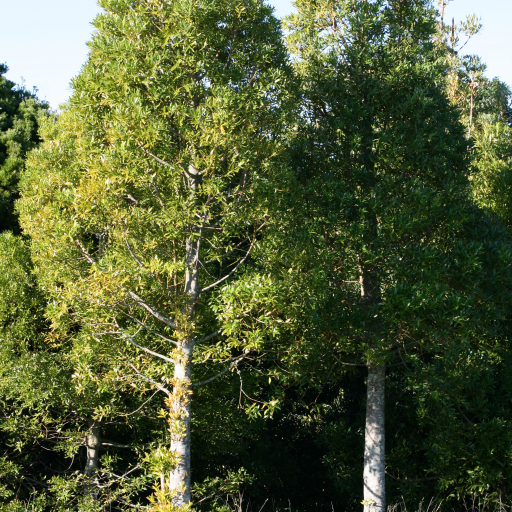
Plant Overview
Often referred to as the Pacific Kauri or Dakua, Agathis macrophylla is a majestic titan of the South Pacific. This ancient evergreen conifer is a true "living fossil," tracing its lineage back to the time of the dinosaurs. While it may start as a modest potted specimen, in the wild, it grows into a massive, pillar-like sentinel that can live for hundreds of years, dominating the rainforest canopy of Fiji, Vanuatu, and the Solomon Islands.
🔍 How to Identify
- 🍃 Broad Foliage: Unlike most conifers that have needles, the Pacific Kauri features thick, leathery, lance-shaped leaves that are glossy green and surprisingly broad.
- 🪵 The "Pillar" Trunk: Young trees have a narrow, conical shape, but mature specimens develop a perfectly straight, massive cylindrical trunk with smooth, mottled bark that flakes off in thin scales.
- ⚽ Spherical Cones: It produces distinct, rounded female cones that look like green, woody globes. When mature, these cones disintegrate while still on the tree to release winged seeds.
🏡 In Your Garden
- 🌱 The Long Game: If you are planting this in a garden, remember it is a "legacy tree." It requires deep, well-drained, acidic soil and a significant amount of space to reach its full potential.
- 💧 Humidity is Key: Coming from tropical islands, it thrives in high humidity and consistent moisture. It is highly sensitive to frost and will not survive in climates where the temperature drops significantly below freezing.
- 🪴 Container Growth: While it eventually wants to be a giant, it grows slowly enough in its youth to be kept as a stunning, architectural container plant for many years, provided it has bright, indirect light.
⚠️ Safety & Toxicity
- ✅ Safe Status: Agathis macrophylla is generally considered non-toxic to humans and common household pets.
- 🌲 Sticky Resin: Like many conifers, the tree produces a thick, milky white resin (often called "dammar"). While not poisonous, this resin is incredibly sticky and can cause mild skin irritation or be a mess to clean off fur and clothes.
✨ Fun Fact
The resin of the Pacific Kauri was historically so valuable that it was used by islanders as a source of light; they would wrap the dried, flammable resin in leaves to create long-burning torches. In modern times, this same resin is used in high-quality varnishes and adhesives!

Detailed Care Instructions
Agathis Macrophylla is a large tropical plant that requires regular watering to maintain proper growth and development. To water this plant, make sure to use a watering can or hose with a gentle stream of water to avoid damaging the delicate leaves and branches.
Check the soil moisture level regularly to determine when it's time to water. Insert your finger into the soil up to the second knuckle; if the soil feels dry at that depth, it's time to water. It's recommended to water the plant deeply, allowing water to seep down into the roots. Water until it starts to drain out of the bottom of the pot or container.
Avoid letting the soil dry out completely, as this can damage the plant's roots and lead to stunted growth. However, over-watering can also be harmful to the plant, leading to root rot and other problems. It's important to strike a balance between keeping the soil consistently moist and avoiding waterlogged conditions.
In addition to proper watering, it's important to fertilize Agathis Macrophylla regularly to promote healthy growth and development. Use a balanced fertilizer with equal parts nitrogen, phosphorus, and potassium, applied according to the manufacturer's instructions. Avoid over-fertilization, which can lead to excessive foliage growth at the expense of root development.
Agathis Macrophylla plant thrives in soil that is rich in nutrients and well-draining. The ideal soil for this plant is a mix of coarse sand, peat moss, and loamy soil. To ensure that the soil is well-draining, it is recommended to add perlite, vermiculite, or coarse sand to the mixture.
It is important to avoid using soil that is compacted, heavy, or has high clay content, as this can hinder the growth and health of the plant. Additionally, the soil pH should be slightly acidic to neutral, with a range ideally between 5.5 and 7.
When potting the Agathis Macrophylla plant, it is recommended to use a pot with drainage holes to prevent water from pooling at the bottom and causing root rot. The plant should be planted at the same depth as it was previously rooted in, and soil should be gently packed around it to secure it in place.
Overall, ensuring that the soil is nutrient-rich, well-draining, and slightly acidic to neutral is key to fostering healthy growth in the Agathis Macrophylla plant.








