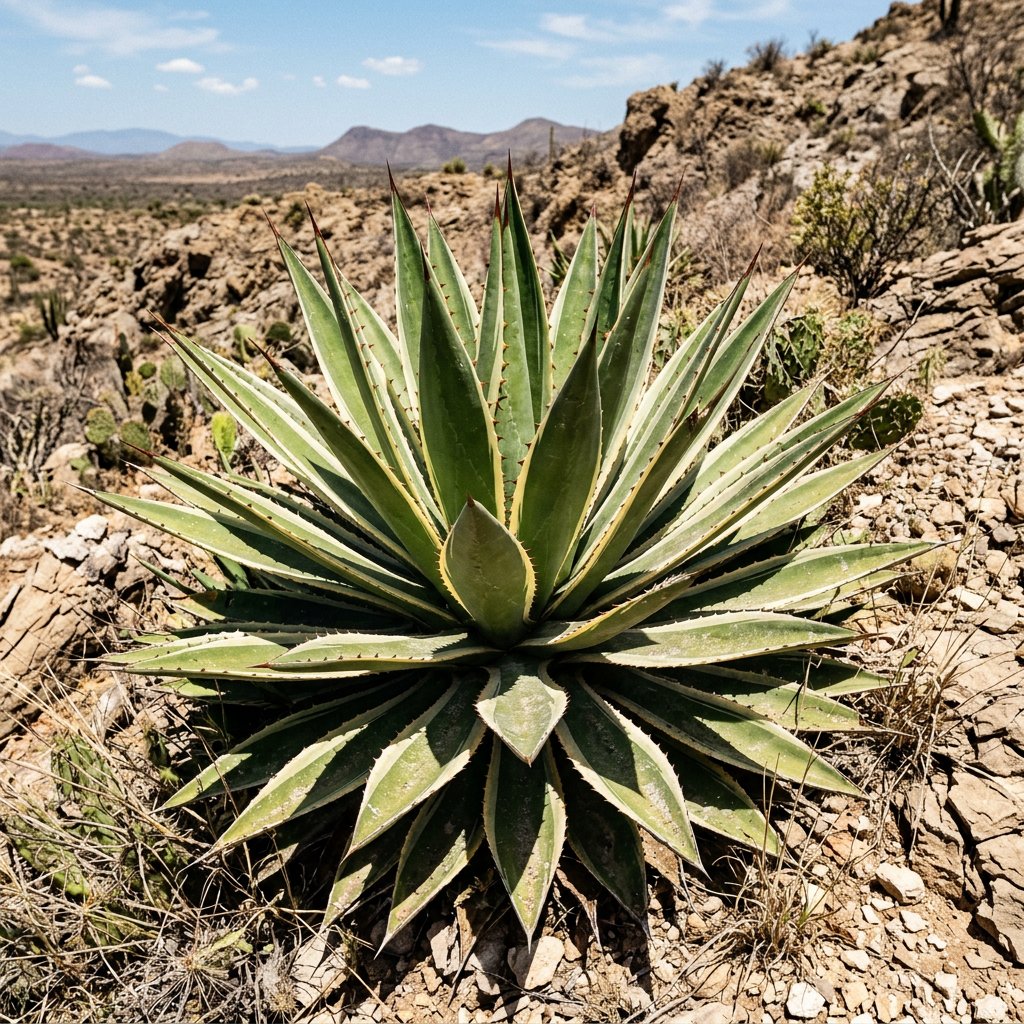
Plant Overview
Often called the "Espadín" in the world of craft spirits, Agave angustifolia is a striking succulent that commands attention with its perfect geometric symmetry. Native to Mexico and Central America, this "Narrow-leaf Century Plant" is the backbone of the Mezcal industry, prized for its high sugar content and resilience. Whether it’s anchoring a xeriscape garden or growing wild on a rocky slope, its sword-like silhouette is an iconic symbol of the arid Americas.
🔍 How to Identify
- ⚔️ The Leaves: Long, stiff, and exceptionally narrow (hence the name angustifolia). They radiate from a central core in a dense, globe-like rosette.
- 🎨 Color & Texture: The foliage is typically a pale sea-foam green or silvery-grey, often featuring a rough, sandpaper-like texture on the surface.
- 🌵 The Armor: The leaf margins are lined with small, sharp teeth, and each leaf ends in a formidable, dark brown terminal spine that can easily puncture skin.
🏡 In Your Garden
- ☀️ Sun Worshiper: This plant thrives on neglect but demands light. It creates a deep taproot to find water, meaning once it is established, it is nearly impossible to kill through drought—but it is also very difficult to move without damaging the root system.
- 🪴 The "Pup" Factory: Be prepared for company! This agave is a prolific producer of "pups" or offsets. If left unchecked, a single plant will eventually turn into a dense thicket of clones, making it an excellent (and painful) natural security fence.
⚠️ Safety & Toxicity
- 🚫 Skin Irritant: The sap contains calcium oxalate crystals. If you prune the leaves and the juice touches your skin, it can cause a stinging, itchy rash similar to fiberglass exposure.
- 🐾 Pet & Child Safety: Beyond the chemical irritation, the terminal spines are "eye-level" hazards for dogs and children. Always plant it away from high-traffic walkways or clip the sharp tips with pliers for safety.
✨ Fun Fact
The Agave angustifolia is "monocarpic," meaning it spends its entire life (10–20 years) storing energy for one single, massive blooming event. It sends up a flower spike that can reach 15 feet tall, after which the mother plant completely withers and dies, leaving her "pups" to take her place.

Detailed Care Instructions
To grow Agave Angustifolia, also known as the Caribbean Agave, you can follow these steps:
- Choose the right location: Select a sunny spot with well-draining soil for planting. Agave Angustifolia prefers full sun but can tolerate partial shade.
- Prepare the soil: Ensure the soil is well-draining and slightly sandy. If the soil is heavy or clayey, add organic matter such as compost to improve drainage.
- Planting: Dig a hole slightly larger than the size of the plant's root ball. Place the plant in the hole, backfill with soil, and gently firm it down. Leave some space around the base of the plant to avoid excess moisture accumulation.
- Watering: Agaves are drought-tolerant plants, so water sparingly. After planting, water the agave thoroughly and let the soil dry out before watering again. Once established, water only during extended dry periods or when the plant shows signs of dehydration.
- Mulching: Apply a layer of organic mulch around the base of the plant to conserve moisture, suppress weed growth, and regulate soil temperature. Maintain a gap between the mulch and the stem to prevent rot.
- Fertilizing: Agave Angustifolia doesn't require regular fertilization. However, you can apply a slow-release, low-nitrogen fertilizer once per year during the growing season to encourage healthy growth.
- Pruning: Agave Angustifolia doesn't require regular pruning. Remove any dead or damaged leaves by cutting them at the base with clean, sharp pruners.
- Protection from frost: Agave Angustifolia is a tropical plant and can be damaged by freezes or prolonged frost. If you live in a colder climate, consider growing it in a container that can be brought indoors during the winter or provide frost protection using frost blankets or coverings.
- Pests and diseases: Agave Angustifolia is generally resistant to pests and diseases. However, watch out for mealybugs, scale insects, or fungal issues such as rot. Treat any problems as soon as they're detected using appropriate insecticides or fungicides.
- Propagation: Agaves can be propagated by collecting offsets, or "pups," that grow around the base of the main plant. Wait until the pup has developed its own roots, then carefully remove it and replant in a new location.
Remember that Agave Angustifolia is a desert plant and is well-suited to hot, arid climates. Ensure you can provide the necessary conditions, including adequate sunlight and good drainage, to successfully grow this plant.

Place in a bright room that is sun drenched almost all day. Or directly in a south-facing window.

Agave Angustifolia is a type of plant that requires minimal watering. As a desert plant, it is accustomed to living in dry climates and does not need as much water as other plants. When watering Agave Angustifolia, it is important to do it sparingly – overwatering can cause the plant's roots to rot.
To water Agave Angustifolia, lightly sprinkle water around the base of the plant using a watering can or a hose. Be careful not to get water on the leaves of the plant, as this can cause the leaves to rot and die. Watering once a week in the summer and once every two weeks in the winter is usually sufficient for this plant.
It is also important to ensure that the soil around the plant is well-draining, as standing water can cause damage to the roots. If the soil feels damp to the touch, it is best to wait a few more days before watering again.
Lastly, it is important to note that Agave Angustifolia prefers to be watered in the morning or early afternoon, as this allows the plant to dry off before nightfall. This can help prevent issues with fungal growth and other problems that can arise from water sitting on the plant or in the soil for too long.
To fertilize this plant, you should choose a slow-release fertilizer that is low in nitrogen and high in phosphorus and potassium. Apply the fertilizer once in the spring and once in the fall, following package instructions for dosage and application. Water the plant thoroughly after applying the fertilizer to ensure it is absorbed by the roots. Avoid over-fertilizing, as this can cause damage to the plant.
The ideal soil for this particular plant species should be well-draining and have high levels of organic matter. It should preferably be sandy or gritty in texture, with a pH level between 6.0 and 7.0. In addition, the soil should be capable of retaining moisture without becoming waterlogged, which can lead to root rot and other issues. A mixture of coarse sand, perlite, and peat moss is typically recommended for planting and growing Agave Angustifolia. It is also important to ensure that the soil is well-aerated, allowing for proper root growth and nutrient absorption. Overall, the key to successfully growing this plant lies in providing it with a supportive soil environment that can meet its basic needs and support its growth and development over time.
To propagate this succulent plant, the first step is to cut off a healthy leaf from the mature plant. The cutting should be taken from the bottom of the stem, and about six inches long. It's important to let the cuttings dry out for a few days to prevent rotting.
Once the cuttings have dried out, they can be planted in well-draining soil. The soil should be moist, but not overly wet. It's best to plant the cuttings at an appropriate depth so that they are secure, but not buried too deep.
The newly planted cuttings should be placed in an area with bright, indirect sunlight to encourage root growth. It's important to keep the soil moist but not waterlogged during this time. After a few weeks, the cuttings should start to produce new roots and shoots.
Once the new plants are established, they can be transplanted to larger pots or outdoors in a sunny, well-draining location. Proper care, including occasional watering and fertilization, will help the new plants to grow strong and healthy.
Common pests of the mescal agave include Scale insect, mealybugs. Make a habit of checking your mescal agave frequently for pests so that any infestations can be caught and managed early.








