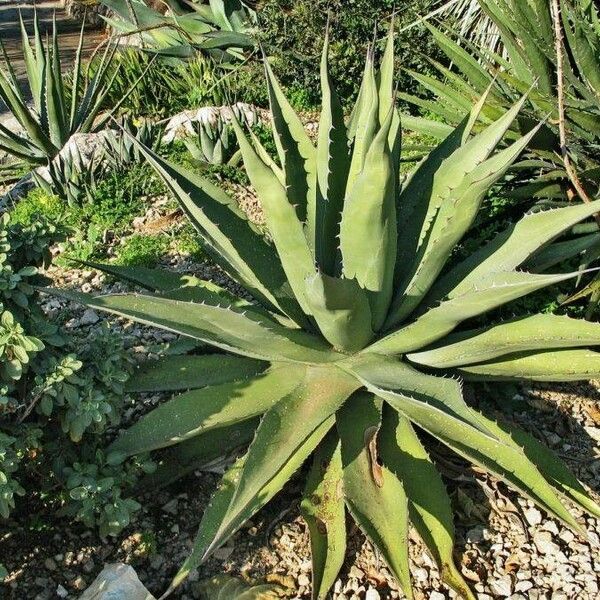
Plant Overview
Endemic to the rugged deserts of central Baja California, Agave avellanidens is a true sculptural masterpiece of the succulent world. Often nicknamed the "Baja Agave," this plant is prized by collectors for its imposing stature and fiercely beautiful leaf margins that look like they were carved from stone. It is a slow-growing survivor, perfectly adapted to the harsh, sun-drenched volcanic landscapes of its homeland.
🔍 How to Identify
- 🌵 The Rosette: Forms a massive, single rosette of thick, rigid leaves that can eventually reach up to 4 to 6 feet in diameter.
- 🦈 Marginal Teeth: The leaf edges are lined with large, dark, and often hooked teeth that resemble shark fins or wave-like serrations.
- 🎨 Coloration: The leaves are typically a striking glaucous gray-green or light blue hue, often featuring a distinct terminal spine at the tip that can be quite long and dark.
🏡 In Your Garden
- ☀️ Sun Worshiper: Because it originates from the intense light of Mexico, it requires full sun to maintain its tight, symmetrical shape; in shade, the leaves may become "leggy" and lose their vibrant color.
- 🪨 Drainage is Key: This species is highly susceptible to root rot if left in standing water. It thrives in "lean" soil—think rocky, sandy mixes that mimic its native volcanic terrain rather than rich potting soil.
- 📏 Space Requirements: While it grows slowly, it eventually becomes a heavy, formidable presence. Avoid planting it near walkways where its sharp spines could snag passersby.
⚠️ Safety & Toxicity
- 🌵 Physical Hazard: The terminal spines and marginal teeth are extremely sharp and can cause deep puncture wounds. Wear heavy gloves and eye protection when pruning.
- 🧪 Sap Irritation: Like many agaves, the sap contains calcium oxalate crystals. If the leaves are cut, the leaking sap can cause a burning sensation or a "contact dermatitis" rash on sensitive skin. Keep away from curious pets and children.
✨ Fun Fact
This agave is "monocarpic," meaning it spends 15 to 30 years storing energy for one single, spectacular reproductive event. It sends up a massive flower spike that can reach 20 feet high, blooms once, and then the mother plant dies, often leaving behind "pups" or seeds to carry on its legacy.

Detailed Care Instructions
Agave Avellanidens is a hardy and low-maintenance plant that is easy to grow in the right conditions. Here are some tips on how to successfully grow Agave Avellanidens:
- Choose a well-draining soil mix: Agave plants prefer a sandy, well-draining soil mix. You can mix perlite or sand into a commercial cactus mix to improve drainage.
- Provide plenty of sunlight: Agave plants thrive in full sun to partial shade. Make sure to place your Agave Avellanidens in a spot where it can receive at least 6-8 hours of sunlight per day.
- Water sparingly: Agave plants are drought-tolerant and do not require frequent watering. Water your Agave Avellanidens sparingly, allowing the soil to dry out between waterings. Overwatering can cause root rot and other issues.
- Protect from frost: Agave Avellanidens is not frost-tolerant and will need protection from freezing temperatures. If you live in a colder climate, consider bringing your Agave plant indoors during the winter months or providing it with extra protection.
- Fertilize sparingly: Agave plants are not heavy feeders and do not require frequent fertilizing. You can fertilize your Agave Avellanidens with a diluted liquid fertilizer once or twice during the growing season.
- Propagate with offsets: Agave plants produce offsets, or pups, that can be separated from the main plant and replanted to propagate more plants. Wait until the offset has grown large enough to have its own root system before removing it from the main plant.
By following these tips, you can successfully grow Agave Avellanidens and enjoy its unique and striking appearance in your garden or home.
To water this plant, you should allow the soil to dry out completely between each watering. This plant prefers a thorough watering until the water drains out of the bottom of the pot. Watering frequency will vary depending on the climate and environment, but typically once every 1-2 weeks during the growing season should be sufficient. In winter, water sparingly as the plant goes dormant. Be sure to water at the base of the plant to avoid causing rot or mold on the leaves. It is important to use well-draining soil and pots with drainage holes to prevent waterlogged roots. Keep an eye on the leaves for signs of dehydration or overwatering, and adjust your watering schedule accordingly.
To fertilize the Agave Avellanidens plant, apply a balanced liquid fertilizer diluted to half strength once a month during the growing season, typically spring and summer. Avoid over-fertilizing, as this can cause damage to the plant. Additionally, make sure to water the plant thoroughly after fertilizing to prevent burning the roots.
Agave Avellanidens plants thrive in well-draining soil with a slightly acidic to neutral pH level. A sandy or rocky soil mixture is preferred, as it mimics the plant's natural habitat in arid regions. Adding organic matter such as compost or peat moss can help improve the soil's fertility and water retention without becoming waterlogged, which can lead to root rot. A mixture of sand, perlite, and cactus potting mix works well for planting and transplanting Agave Avellanidens. It's important to ensure that the soil is not overly compacted or heavy, as this can impede the plant's growth and overall health.
Agave Avellanidens plants can be propagated through division of offsets or pups. To do so, carefully remove the pups from the parent plant using a sharp, sterile knife or shears. Allow the pups to dry and callus for a few days before planting them in a well-draining soil mixture.
Alternatively, Agave Avellanidens plants can also be propagated from leaf or stem cuttings. Take a healthy leaf or stem cutting from the plant and allow it to dry for a few days. Plant the cutting in a well-draining soil mixture and keep it lightly moist until roots develop.
Propagation can also be done by collecting and planting seeds from mature Agave Avellanidens plants. Sow the seeds in a well-draining soil mixture and keep them consistently moist until they germinate.
Overall, propagating Agave Avellanidens plants can be a rewarding process that allows you to expand your collection of these unique and striking succulents.








