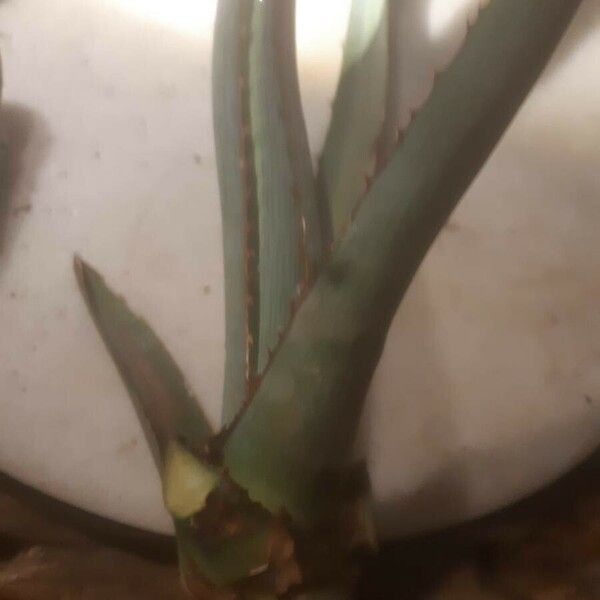
Plant Overview
Often referred to as the "Deformed Agave" due to its variable and twisting leaf shapes, Agave difformis is a rugged beauty from the high deserts of Central Mexico. Its name comes from the Latin word for "irregular," highlighting the unique, wavy silhouette that sets it apart from more symmetrical succulents. This plant is a favorite for xeriscaping, offering an architectural, prehistoric look that thrives where other plants might wither.
🔍 How to Identify
- 🗡️ Leaf Structure: The leaves are long, narrow, and sword-shaped, typically reaching about 12 to 20 inches. They often feature a distinct light-colored stripe running down the center.
- 🦷 Marginal Teeth: The edges of the leaves are lined with prominent, dark brown or grey "teeth" that are hooked, giving the plant a fierce, jagged appearance.
- 🌀 Growth Habit: Unlike many solitary agaves, this species is a "clumper." It aggressively produces offsets (pups) at its base, eventually forming a dense, spiky colony or thicket.
🏡 In Your Garden
- 🏜️ Drainage is Key: Because it originated in the rocky limestone hills of Hidalgo and San Luis Potosí, it hates "wet feet." It requires extremely gritty, fast-draining soil to prevent root rot during the winter months.
- ☀️ Sun Seeker: To maintain its compact shape and deep coloration, it needs full sun. In lower light, the leaves may become "leggy" or lose their characteristic wavy twist.
- 🌵 Low Maintenance: Once established, it is incredibly drought-tolerant. It is a "set it and forget it" plant, perfect for rock gardens or large containers where it can spill over the edges.
⚠️ Safety & Toxicity
- 🚫 Physical Hazard: The terminal spines (the tips of the leaves) are very sharp and can easily puncture skin. It is best planted away from walkways or areas where children and pets play.
- 🧪 Irritating Sap: Like many Agaves, the sap contains calcium oxalate crystals. If a leaf is broken, the juice can cause "Agave dermatitis"—an itchy, blistering skin rash.
- 🐾 Pet Safety: While not typically tempting to chew due to its toughness, the sap is toxic if ingested by dogs or cats, leading to mouth irritation and stomach upset.
✨ Fun Fact
Agave difformis is monocarpic, meaning it lives for 10 to 30 years, blooms once with a massive flower spike that can reach 12 feet high, and then the mother plant dies. However, because it produces so many "pups" throughout its life, the colony lives on indefinitely!

Detailed Care Instructions

Place in a bright room that is sun drenched almost all day. Or directly in a south-facing window.

When the top few inches of soil dry out, water your plants. If the top few inches of soil are still moist, do not water your plant. Wait a few days, then poke your finger into the soil to see if anything has changed. Overwatering poses a disease risk, such as the development of fungal diseases in the roots. These plants have adaptations in there leaves that allow them to survive in low water supply.








