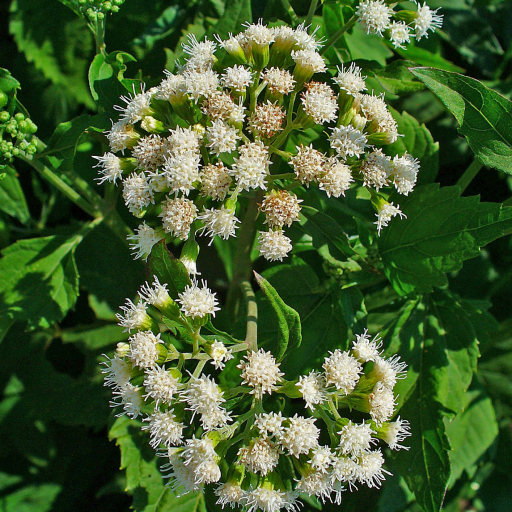
Plant Overview
Commonly known as the Lesser Snakeroot, this delicate woodland perennial often goes unnoticed until late summer when its frothy white blooms light up the forest floor. Despite its name, the "aromatic" scent is often subtle and spicy rather than overtly floral. It holds a mysterious place in North American history, closely tied to the "milk sickness" that once plagued early pioneers.
🔍 How to Identify
- 🍃 Leaf Texture: The leaves are opposite, roughly triangular or heart-shaped, with noticeably jagged (serrated) edges and a slightly fuzzy, dull green surface.
- ☁️ Flower Clusters: Look for dense, flat-topped clusters of bright white, thread-like flowers that lack traditional "petals," giving them a fuzzy, cloud-like appearance.
- 📏 Stature: It is generally shorter and more branching than its famous cousin, the White Snakeroot, usually reaching a modest height of 1 to 2 feet.
🏡 In Your Garden
- 🦋 Pollinator Buffet: This plant acts as a vital late-season fuel station for native bees, wasps, and small butterflies preparing for the cooler months.
- 🌳 Woodland Specialist: It thrives in dappled sunlight and well-drained, sandy, or rocky soils. It is an excellent choice for "wild corners" or native shade gardens where other plants might struggle with thin soil.
⚠️ Safety & Toxicity
- 🚫 Toxic Status: Contains tremetol, a potent toxin that is dangerous to both humans and livestock if ingested.
- 🐾 Risk Level: While it is rarely eaten by humans, it is a significant risk to grazing animals. The toxin can even be passed through the milk of animals that consume it, leading to a condition once known as "milk sickness." Keep it well away from pastures and curious pets.
✨ Fun Fact
Abraham Lincoln’s mother, Nancy Hanks Lincoln, is famously believed to have died from "milk sickness" caused by the Tremetol toxin found in the Ageratina family, highlighting how a simple wildflower once shaped the course of American history!

Detailed Care Instructions
To grow Ageratina aromatica, also known as aromatic snakeroot or white mistflower, follow these steps:
- Choose a suitable location: Ageratina aromatica prefers full sun to partial shade. It can tolerate a range of soil types but prefers well-draining soil.
- Prepare the soil: If your soil is heavy or clayey, improve drainage by adding organic matter such as compost. Mix it into the top few inches of soil.
- Planting: Dig a hole slightly larger than the root ball of the plant. Place the plant in the hole, making sure it is at the same depth as it was in the container. Backfill the hole with soil, firming it gently around the roots.
- Watering: Water the plant thoroughly after planting and regularly during the first few weeks to help establish its roots. After that, water it deeply once or twice a week, depending on rainfall and soil moisture levels. Avoid overwatering as it can lead to root rot.
- Mulching: Apply a layer of organic mulch, such as wood chips or straw, around the base of the plant to help retain moisture, suppress weeds, and regulate soil temperature.
- Fertilizing: Ageratina aromatica does not require heavy fertilization. It can thrive in nutrient-poor soils. However, if your soil is very poor, you can apply a balanced slow-release fertilizer in early spring according to package instructions.
- Pruning: Ageratina aromatica benefits from regular pruning to maintain its shape and promote bushier growth. Prune any dead or damaged branches and remove any suckers that arise from the base to redirect energy to the main plant.
- Pests and diseases: Ageratina aromatica is relatively pest and disease-resistant. However, keep an eye out for common garden pests like aphids or caterpillars. If necessary, apply organic insecticides or use natural pest control methods.
- Propagation: You can propagate Ageratina aromatica through seeds or stem cuttings. Collect seeds from mature flowers and sow them in a nursery tray filled with seed-starting mix in early spring. For stem cuttings, take 4-6 inch sections of stems with foliage and insert them in well-draining soil. Keep the soil moist until the cuttings root.
- Winter care: Ageratina aromatica is hardy in USDA zones 7 to 9. In colder regions, protect the plant by applying a layer of mulch around the base and covering it with a breathable fabric or specialized plant cover during severe winter weather.
Remember to always check your local gardening guidelines and conditions to ensure the best success in growing Ageratina aromatica.

Place in a window with dappled sun or a spot in the middle of a room. Or directly in a window facing west or east.

To water this plant, it is important to first check the moisture level of the soil. Stick a finger into the soil up to the second knuckle and feel for moisture. If the soil feels dry, it is time to water the plant.
When watering, aim to water the soil around the plant rather than watering the leaves or stem directly. This helps prevent the development of fungal diseases.
Use a watering can or hose to slowly water the soil until it is moist but not waterlogged. Be sure to water enough to penetrate the soil to a depth of several inches.
Watering frequency will depend on factors such as the time of year, temperature, and humidity levels. During hot, dry weather, it may be necessary to water more frequently to keep the soil moist. It is important to avoid overwatering, as this can lead to root rot and other issues.
To fertilize this plant, apply a balanced, slow-release fertilizer in the early spring before new growth begins. Use half the recommended dosage and work it into the soil around the base of the plant. Avoid getting the fertilizer on the foliage or directly on the stem. Water the plant thoroughly after fertilizing. Repeat this process every 4-6 weeks during the growing season.
This plant prefers well-drained soil that is rich in organic matter. It can tolerate a range of soil types, including loamy, sandy, and clay soils. The soil pH should be neutral to slightly acidic, between 6.0 and 7.0. It is important to avoid soils that are too dry or too wet, as this can result in poor growth and development. Consider adding compost or other organic materials to the soil to improve its quality. It is also recommended to mulch around the base of the plant to help retain moisture and suppress weeds.
- Select a healthy and mature plant to obtain cuttings from. It is important to choose a plant that is disease-free and has no signs of stress.
- Use a sharp and sanitized pair of garden shears to cut a stem that is about 4-6 inches long. Make sure to cut the stem right below a leaf node.
- Strip the leaves off the bottom third of the stem. This will help to reduce the moisture loss of the cutting and promote root formation.
- Dip the cut end of the stem into rooting hormone powder or liquid. This step is optional but can speed up the rooting process.
- Fill a small pot with well-draining soil mix and make a hole in the center of the soil with a pencil or any pointed object.
- Insert the cutting into the hole and firm the soil gently around the stem.
- Water the soil gently and place the pot in a warm and bright location that receives indirect sunlight.
- Cover the pot with a clear plastic bag to maintain the humidity around the cutting. Make sure to remove the bag for a few minutes each day to prevent excessive moisture accumulation, which can lead to rotting.
- Check the soil regularly and water whenever the top layer of soil feels dry. Be careful not to overwater the cutting as it can lead to root rot.
- After a few weeks, check for roots by gently tugging on the stem. If there is resistance, it means that roots have formed. At this point, it is safe to remove the plastic bag and start to acclimate the cutting to its new environment.
- Once the roots have fully developed, transplant the cutting into a larger pot or directly into the garden bed.








