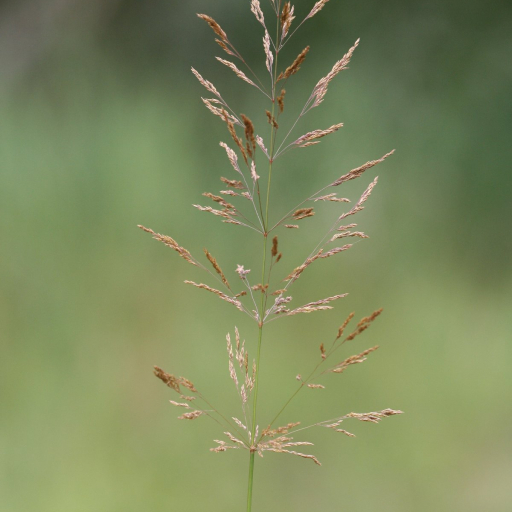
Plant Overview
Often called "Redtop" for the shimmering, reddish-purple haze its flowers cast over a field, Agrostis gigantea is a robust perennial grass with a dual personality. While it is a hero for erosion control on riverbanks and a reliable forage for livestock, it can be a persistent "uninvited guest" in home lawns due to its aggressive spreading nature. Originating in Europe and Asia, it has traveled the world, flourishing wherever the soil stays slightly damp.
🔍 How to Identify
- 🌾 The "Redtop" Bloom: Its most striking feature is the airy, pyramid-shaped flower clusters (panicles) that take on a distinct purplish-red tint during the summer months.
- 🍃 Rough Leaves: The leaf blades are flat, wide (compared to other bentgrasses), and have a noticeably rough texture on both sides, which helps distinguish it from softer turf grasses.
- 📏 Pointed Ligule: If you peel a leaf back from the stem, you’ll see a long, thin, silvery membrane (the ligule) that is pointed or blunt—a key botanical fingerprint for this species.
🏡 In Your Garden
- 💧 Thrives in "Wet Feet": Unlike many grasses that rot in soggy conditions, Black Bentgrass loves heavy clay and poorly drained areas. If you have a low spot in your yard where nothing grows, this grass will likely thrive there.
- 🏃 A Persistent Spreader: It spreads via underground runners called rhizomes. Because of this, it is very difficult to "pull out" successfully; any small piece of root left behind will quickly sprout a new plant. It is best used for wilder "meadow" style gardens rather than manicured borders.
⚠️ Safety & Toxicity
- ✅ Generally Safe: Agrostis gigantea is non-toxic to dogs, cats, and horses. In fact, it is frequently used as high-quality hay for livestock.
- 🤧 Allergy Alert: Like most grasses, it produces a significant amount of wind-borne pollen during its mid-summer flowering stage, which can be a trigger for hay fever sufferers.
✨ Fun Fact
Despite being a close relative of the "Creeping Bentgrass" used on world-class golf course putting greens, Agrostis gigantea is considered too coarse and "tough" for golf. It is the rugged, blue-collar cousin of the grass family!

Detailed Care Instructions
To grow Agrostis Gigantea, also known as Redtop or Colonial Bentgrass, follow these steps:
- Select a suitable location: Agrostis Gigantea thrives in full sun to partial shade. It prefers well-draining soils with a pH range of 5.5 to 7.5.
- Prepare the soil: Till the soil to a depth of 6 inches and remove any weeds, rocks, or debris. Mix in organic matter like compost or peat moss to improve soil fertility and drainage.
- Planting: Agrostis Gigantea can be grown from seeds. Scatter the seeds evenly over the prepared soil and lightly rake them in. Avoid burying the seeds too deep, as they need exposure to light for germination. Water gently to settle the seeds into the soil.
- Watering: Keep the soil consistently moist, but not waterlogged, during the germination phase. Once the plants are established, water deeply but infrequently, allowing the top layer of soil to dry out between waterings.
- Fertilization: Apply a balanced slow-release fertilizer or a specialized grass fertilizer according to the recommended dosage on the product label. This will provide the necessary nutrients for growth and development.
- Weed control: Regularly inspect the area for weeds and remove them promptly to prevent competition with the Agrostis Gigantea plants.
- Mowing: Once the plants reach a height of 3 to 4 inches, you can start mowing them to a height of 2 to 3 inches. Regular mowing will encourage denser growth and prevent the grass from becoming too tall and untidy.
- Disease and pest control: Agrostis Gigantea is generally resistant to common diseases and pests, but monitor the plants for signs of damage or infestation. Use appropriate fungicides or insecticides if necessary.
- Maintenance: Regularly aerate the soil by perforating it with small holes to prevent compaction and improve water and nutrient absorption. Overseed any thin or bare patches to maintain a uniform appearance.
- Winter care: Agrostis Gigantea is a cool-season grass that may go into dormancy during hot summers. It often resumes growth in the fall. Avoid heavy traffic on dormant grass to prevent damage.
By following these steps and providing proper care, you can successfully grow Agrostis Gigantea plants.

Place in a bright room that is sun drenched almost all day. Or directly in a south-facing window.

Agrostis Gigantea plants require regular watering to thrive, but care must be taken not to overwater them. It is best to water deeply and infrequently, allowing the soil to dry out slightly between waterings. When watering, it is important to avoid getting water on the leaves or stems as this can lead to disease or pest problems. One way to do this is to water directly at the base of the plant, using a watering can or hose with a targeted nozzle. Another option is to use a drip irrigation system, which delivers water directly to the root zone without wetting the foliage. It is also important to ensure good drainage to prevent waterlogging and root rot. This can be achieved by planting in well-draining soil or adding organic matter such as compost or mulch to improve soil structure. Overall, consistent watering and good drainage are essential for the health and vitality of Agrostis Gigantea plants.
To fertilize this plant, apply a balanced fertilizer with equal amounts of nitrogen, phosphorus, and potassium in the spring and summer months. Avoid over-fertilizing, as this can lead to excessive growth and weakened plants. Water the plant deeply after fertilizing to ensure that the nutrients are absorbed properly. Test the soil every two to three years to determine if any additional nutrients are needed.
Agrostis Gigantea thrives in soil that is well-drained and fertile, with a neutral to slightly acidic pH. It prefers to grow in soil that is rich in organic matter, such as compost or leaf mold. The soil should be loose and aerated, allowing for proper root development and water penetration. It is also important for the soil to retain moisture while still allowing for adequate drainage. Heavy, compacted soils should be avoided, as they can restrict root growth and lead to poor plant health. Overall, a nutrient-rich, well-drained soil with a neutral pH is best for cultivating Agrostis Gigantea.
Agrostis Gigantea is a grass species that can be propagated through both sexual and asexual means. Propagation through sexual means involves collecting seeds from the plant and sowing them in an appropriate growing medium. The seeds should be sown in the spring or fall, and they require moist soil and indirect sunlight to germinate. Once the seeds have germinated, they can be transplanted into individual pots or directly into the ground.
Propagation through asexual means involves dividing the plant. This should be done in the early spring or fall, when the plant is actively growing. The plant should be carefully dug up, and the roots and shoots should be separated into smaller sections. Each section should have at least one healthy shoot and a small portion of the root system. These sections can then be replanted in the appropriate growing medium.
Agrostis Gigantea can also be propagated through tissue culture. This involves taking small pieces of plant tissue and placing them in a nutrient-rich medium to stimulate new growth. Once new growth has been stimulated, the tissue can be transferred to a new growing medium or directly into soil. Tissue culture is a more advanced method of propagation and is typically used by horticulturists and researchers.








