Plant Overview
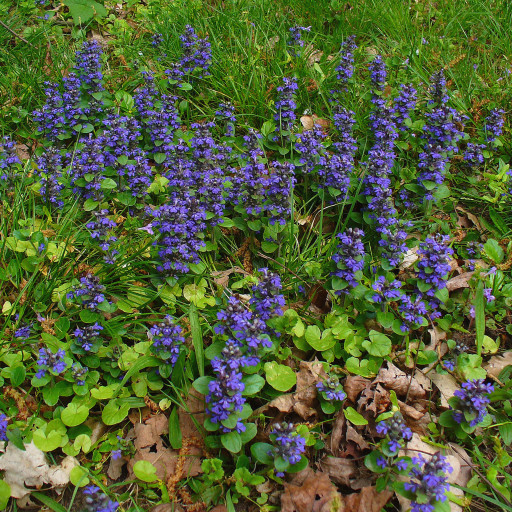
Often called Bugleweed or Carpet Bugle, Ajuga reptans is the ultimate "living rug" for those tricky, shaded corners of your garden. Native to Europe, this persistent perennial has earned a reputation for its ability to weave a dense mat of glossy foliage that chokes out weeds with ease. In folklore, it was once prized by herbalists as a "wound-wort," believed to help heal the bruises and cuts of forest travelers.
🔍 How to Identify
- 🍃 Leaf Rosettes: The plant grows in low, tight rosettes of oval or spoon-shaped leaves. They are remarkably glossy, often appearing polished, and can range from deep forest green to metallic bronze or dark purple.
- 🪻 Flower Spikes: In late spring and early summer, it sends up erect, 4- to 8-inch spikes. These are crowded with tiny, two-lipped tubular flowers, typically in a striking "electric" blue or violet.
- 🏃 The "Reptans" Habit: True to its name (which means "creeping"), it spreads via long, horizontal runners called stolons. These root wherever they touch the ground, quickly forming a continuous colony.
🏡 In Your Garden
- 🌱 Shade Savior: While most lawn grasses struggle under the canopy of large trees, Ajuga thrives there. It is the go-to solution for erosion control on shady slopes where little else will grow.
- 💧 The Airflow Essential: While it loves moisture and rich soil, it is susceptible to "crown rot" if the air is too stagnant or the soil stays soggy. It’s best to plant it in areas with some air movement rather than cramped, humid corners.
- ✂️ Vigorous Boundary-Crosser: Because it spreads via runners, it doesn't know where the lawn ends and the flower bed begins. You may need to install edging or occasionally "reclaim" your pathways from its persistent creep.
⚠️ Safety & Toxicity
- 🟢 General Status: Ajuga reptans is considered non-toxic to humans and is generally listed as non-toxic to dogs, cats, and horses by the ASPCA.
- 👄 Mild Caution: While safe, it is not a culinary herb. Ingesting large amounts of any non-food plant can cause mild stomach upset in curious toddlers or pets. It also contains some phytoecdysteroids, which the plant uses to defend itself against certain leaf-eating insects.
✨ Fun Fact
In the Middle Ages, Ajuga was known as "Middle-comfrey." It was so highly regarded for its supposed healing powers that an old French proverb claimed, "He who has Bugle and Sanicle needs no surgeon."

Detailed Care Instructions
You'll find plenty of companion woodland plants for bugleweed that grow well in partial or full shade. For example, pair with coral bells, daffodils, violas, forget-me-nots, astilbe, and hardy geraniums. For extra greenery, plant hostas and ferns.
Does bugleweed have a scent?
Although the blue flowers are prominent, they don't have any fragrance.
Is bugleweed deer-resistant?
Bugleweed is deer-resistant. It tastes very bitter and bad to most animals, except the muskrat, which likes to nibble on the roots.
| Color | Blue, Violet |
| Soil Ph | 3.7 To 6.5; Ajuga Likes A Somewhat Acidic Soil |
| Humidity | Normal |
| Lighting | Part Sun |
| Soil Type | Prefers Medium-Moisture, Well-Drained Soils With Good Organic Content; Tolerates Moderately Dry Soil |
| Bloom Time | May To June |
| Difficulty | Medium |
| Plant Type | Evergreen Perennial |
| Hibernation | Cold Period |
| Mature Size | 6 To 8 Inches |
| Native Area | Europe, Northern Africa, Southwestern Asia |
| Temperature | 12°C - 30°C |
| Sun Exposure | Full Sun To Part Shade |
| Hardiness Zones | 3 To 10 (Usda) |
To grow Ajuga reptans (commonly known as bugleweed), follow these steps:
- Choose a suitable location: Ajuga reptans prefers partial to full shade, but can tolerate some sun. Ensure the soil is well-drained and rich in organic matter.
- Prepare the soil: Before planting, loosen up the soil and remove any weeds or debris. Add compost or aged manure to enrich the soil if necessary.
- Propagation: Ajuga reptans can be propagated by division or from cuttings. If you have an existing plant, you can divide it by carefully cutting through the root system and separating the clumps. Dig a hole, place the divided clump into the hole, and cover the roots with soil. Water well.
- Watering: Keep the soil consistently moist, especially during the first few weeks after planting. Once established, Ajuga reptans is fairly drought-tolerant.
- Mulching: Apply a layer of organic mulch around the plants to help retain moisture, control weeds, and moderate soil temperature.
- Fertilizing: Ajuga reptans doesn't require heavy fertilization. However, you can apply a balanced, slow-release fertilizer in the spring to encourage growth.
- Pruning: Ajuga reptans does not require much pruning. However, you can trim any dead or damaged foliage to maintain its appearance.
- Controlling spread: Ajuga reptans can be invasive if not controlled. To prevent unwanted spreading, you can install barriers or regularly trim back any runners that extend beyond desired boundaries.
- Pest and disease control: Ajuga reptans is generally resistant to pests and diseases. However, watch for slugs, snails, and crown rot. Provide good air circulation and avoid over-watering to prevent crown rot.
By following these steps, you should successfully grow Ajuga reptans in your garden or landscape.

Place in a window with dappled sun or a spot in the middle of a room. Or directly in a window facing west or east.

To properly water this plant, first check the soil moisture level by sticking your finger into the soil to a depth of about 1 inch. If the soil feels dry, it is time to water.
When watering, slowly pour water around the base of the plant, making sure the water seeps into the soil. Avoid getting the leaves wet. Water deeply enough to moisten the soil to a depth of at least 6 inches.
During the hot, dry summer months, this plant may require more frequent watering. However, be careful not to overwater as this can lead to root rot.
In general, it is best to water this plant in the morning so that any excess moisture can evaporate during the day, reducing the risk of fungal diseases.
To fertilize this plant, you should apply a balanced fertilizer with a ratio of 10-10-10 or 20-20-20 in early spring. Be careful not to over-fertilize as it can burn the roots, so follow the manufacturer's instructions. Apply the fertilizer around the base of the plant and water it in thoroughly. Avoid fertilizing during the hot summer months and instead apply a light layer of compost or organic material around the base of the plant to add nutrients to the soil.
Ajuga Reptans prefers well-drained soil that is slightly acidic with a pH level between 5.5 and 6.5. The soil should also be rich in organic matter and have a good moisture retention capacity. Sandy loam, loam, and clay loam soils are ideal for this plant. Although it can tolerate some dryness, it prefers moist soil that is not waterlogged. The soil should also have good fertility, as this plant benefits from regular feedings with a balanced fertilizer during the growing season. It is important to avoid using heavy clay soils and soils with poor drainage, as these can lead to root rot and other plant diseases.
To propagate this species of plant, one can use several methods. One way is through rhizome division, where one can separate portions of the plant's underground stem and replant them. Another method is through stem cuttings, where one can cut a piece of the stem from the main plant and place it in soil or water until it develops roots. Additionally, seed propagation is also possible, where one can collect the seeds from mature plants and sow them in soil. It is important to ensure proper watering and sunlight conditions for successful propagation, and to avoid spreading any potential diseases or pests during the process.








