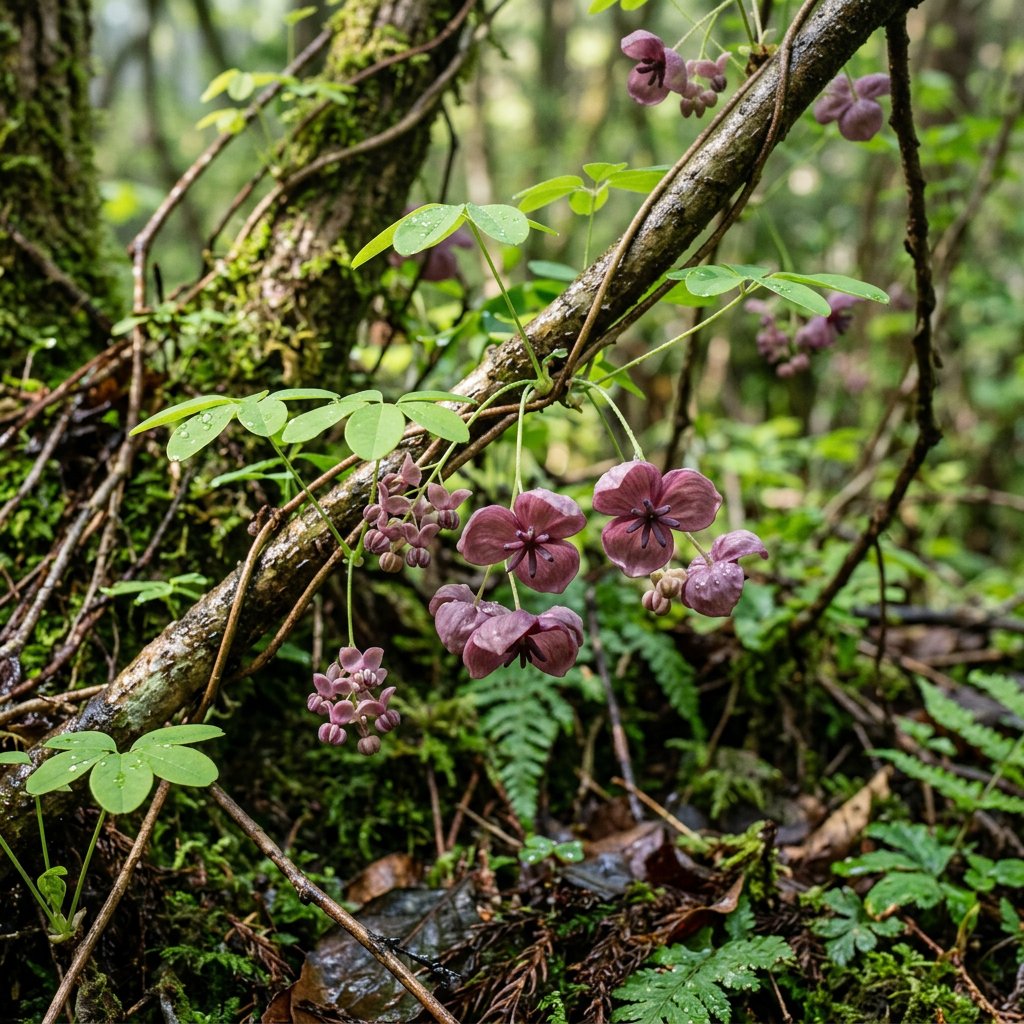
Plant Overview
Often called the "Chocolate Vine," Akebia quinata is a woody, deciduous climber that brings an exotic, almost mystical aesthetic to vertical garden spaces. Originating from the forests of East Asia, it is beloved for its unusual, spicy-sweet fragrance that mimics the scent of vanilla and cocoa. It is a plant of contrasts—appearing delicate and lace-like, yet possessing a vigorous, "jungle-like" growth habit.
🔍 How to Identify
- 🍃 The "Five-Leaf" Pattern: The most distinct feature is its foliage; five bluish-green, oval leaflets radiate from a central point like a hand, giving the plant a lush, airy texture.
- 🌸 Exotic Blooms: In spring, it produces dangling clusters of cup-shaped, chocolate-maroon flowers. Interestingly, the plant produces separate male and female flowers on the same vine.
- 🍆 Sausage-Shaped Fruit: If cross-pollinated, the vine grows strange, waxy, sausage-shaped pods that turn a dusty violet or grayish-purple when they ripen in late summer.
🏡 In Your Garden
- 🪜 The Twining Habit: Unlike ivy which "sticks" to walls, Akebia climbs by wrapping its stems around structures. It requires a sturdy trellis, fence, or pergola to support its weight as it matures.
- 🏃 Growth Management: This vine is a "sprinter." In the right conditions, it can grow up to 20 feet in a single season. While excellent for quick privacy screens, it requires annual pruning to prevent it from escaping the garden and smothering nearby shrubs.
- 🌘 Light Versatility: It is one of the few flowering vines that can thrive in deep shade, though you will get the most "chocolate" scented flowers if it receives at least partial sunlight.
⚠️ Safety & Toxicity
- ✅ General Safety: Akebia quinata is considered non-toxic to humans, dogs, and cats. It is a very "family-friendly" choice for high-traffic garden areas.
- 🍴 Edibility Note: The gelatinous white pulp inside the mature fruit is edible and has a mild, sweet flavor similar to a pear or dragonfruit. However, the purple skin is bitter and usually discarded.
✨ Fun Fact
🧺 Woven History: In Japan, the strong, flexible woody stems of the Akebia vine are not just garden ornaments; they have been harvested for centuries to create high-end traditional baskets and furniture known as Akebia-zaiku.

Detailed Care Instructions
| Color | Purple |
| Soil Ph | Neutral, But Tolerates Both Acidic And Alkaline Soil |
| Humidity | Normal |
| Invasive | Weed |
| Lighting | Part Sun |
| Soil Type | Sandy Loam |
| Bloom Time | Spring |
| Difficulty | Medium |
| Plant Type | Perennial Flowering Vine |
| Hibernation | Cold Period |
| Mature Size | 15 To 40 Feet Long |
| Native Area | China, Japan, Korea; Has Naturalized In Many Areas Of North America |
| Temperature | 15°C - 29°C |
| Sun Exposure | Full Sun, But Will Tolerate Shade |
| Hardiness Zones | 4 To 8, Usda; Remains Evergreen In Zones 6 And Warmer |
To grow Akebia Quinata, also known as Chocolate Vine or Fiveleaf Akebia, follow these steps:
- Choose the right location: Akebia Quinata prefers partial shade to full sun. Select a spot in your garden that receives some sun during the day but is protected from harsh afternoon rays.
- Soil preparation: Akebia Quinata thrives in well-draining soil that is rich in organic matter. Amend the soil with compost or well-rotted manure to improve its fertility and drainage.
- Planting: Dig a hole that is slightly larger than the nursery container. Gently remove the plant from its container, ensuring that the roots are undisturbed. Place it in the hole, making sure the soil line matches the original level on the stem. Fill the hole with soil, and then tamp it down gently to remove any air pockets.
- Watering: Water the plant thoroughly after planting, and then keep the soil consistently moist during the growing season. Water deeply but infrequently, allowing the soil to dry out slightly between waterings.
- Mulching: Apply a layer of organic mulch around the base of the plant to retain moisture, suppress weeds, and regulate soil temperature.
- Pruning: Akebia Quinata can become quite vigorous and may require pruning to control its growth. Prune the plant in late winter or early spring before new growth begins. Remove any dead, damaged, or crossing branches. You can also prune to shape the plant or prevent it from spreading too much.
- Fertilizing: Feed the plant with a balanced organic fertilizer in spring or early summer to promote healthy growth. Follow the instructions on the fertilizer package for proper application rates.
- Reproduction: Akebia Quinata can be propagated by both seeds and cuttings. Collect seeds from mature fruits during fall and sow them directly in the garden or in containers. Cuttings can be taken in summer by snipping a 4 to 6-inch long stem and placing it in a well-draining soil mix.
- Training and support: Akebia Quinata is a vigorous climber and may need support to grow upwards. Provide a trellis, arbor, or other structures for the vine to climb and attach itself. Train the plant's stems periodically to prevent tangling and ensure proper growth.
- Pest and disease control: Akebia Quinata is generally resistant to pests and diseases. However, watch out for aphids, scale insects, or powdery mildew. If necessary, use organic pest control methods or consult with a local garden center for suitable treatments.
Remember to be patient, as Akebia Quinata may take some time to establish and produce blooms. With proper care and attention, you can enjoy the beautiful chocolate-scented flowers and edible fruits of this delightful vine.

Place in a window with dappled sun or a spot in the middle of a room. Or directly in a window facing west or east.

Akebia Quinata plant requires moderate watering. The soil should be kept moist but not waterlogged. The frequency of watering should be adjusted according to the climate and the environment in which the plant is placed. In general, it is recommended to water the plant once or twice a week. Ensure that the soil has good drainage and does not stay soggy. Keep an eye on the leaves of the plant, if they are turning brown or drooping, it is a sign of overwatering. On the contrary, if the leaves are curling up and turning yellow, it indicates under-watering. It is important to note that during the winter months, the plant requires less water. Therefore, it is important to evaluate the moisture level of the soil regularly before watering.
To fertilize this plant, apply a balanced, slow-release fertilizer in early spring. Use a fertilizer with equal amounts of nitrogen, phosphorus, and potassium. Spread the fertilizer evenly around the base of the plant, avoiding direct contact with the roots. Water the plant thoroughly after applying the fertilizer. Repeat the fertilization process annually in early spring. Avoid over-fertilizing, as this can lead to excessive growth and decreased flowering.
The ideal soil for the Akebia Quinata plant is well-draining soil that is rich in organic matter. The soil should be slightly acidic to neutral, with a pH between 6.0 and 7.0. It should also be moist but not waterlogged, as this can lead to root rot. The plant prefers soil that is loamy or sandy, and it can tolerate some clay content. It is important to avoid using heavy, compacted soil, as this can prevent the plant from growing and may lead to issues with drainage. Additionally, it is beneficial to mix in some coarse sand or perlite to improve drainage and aeration. Overall, the Akebia Quinata prefers soil that is nutrient-rich, well-draining, and has a pH that is slightly acidic to neutral.
Akebia quinata can be easily propagated through stem cuttings. To start, select healthy stems that are around 4-6 inches long. Cut the stem just below a leaf node and gently remove the lower leaves from the stem. Dip the cut end into rooting hormone powder and then plant it in a small pot filled with well-draining soil. Water the soil and cover the cutting with a clear plastic bag to create a greenhouse-like environment. Keep the cutting in a warm, bright location but out of direct sunlight. After a few weeks, the cutting will begin to root and new growth will appear. Once the new growth is established, the cutting can be transplanted into a larger pot or into the ground.








