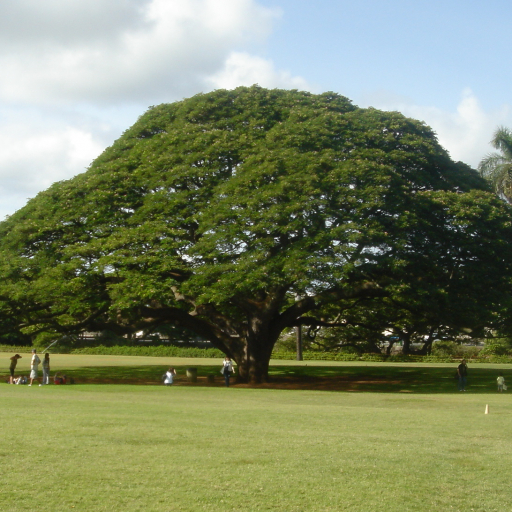
Plant Overview
Known as the "Rain Tree" or "Monkeypod," this majestic giant is famous for its massive, symmetrical umbrella-like canopy that provides vast islands of shade in tropical landscapes. Its most enchanting trait is "nyctinasty"—the habit of its leaflets folding together at night or when the sky turns gray with rain, allowing water to fall straight through to the grass below.
🔍 How to Identify
- 🌳 The Canopy: It features a broad, flattened crown that can spread up to 100 feet wide, often appearing wider than the tree is tall.
- 🌿 Feathery Foliage: The leaves are bipinnate (divided twice) and dark green; they are noticeably "sleepy," closing in pairs as dusk approaches.
- 🌸 Powder-Puff Flowers: In spring and summer, the tree is covered in clusters of bicolored pink and white flowers with long, silky stamens that look like delicate pom-poms.
🏡 In Your Garden
- 🏗️ Root Management: This is not a tree for small residential yards. Its root system is aggressive and shallow; it is known to lift sidewalks and crack foundations if planted within 30 feet of a structure.
- 🍃 Nutrient Booster: Like many legumes, it is a nitrogen-fixer. It actually improves the soil quality around it, which is why grass often grows more lushly directly under its canopy than in the open sun.
- 💧 Water Tolerance: While it loves tropical humidity, it is remarkably drought-tolerant once established, making it a favorite for large parks and golf courses.
⚠️ Safety & Toxicity
- ✅ General Safety: The Albizia Saman is generally considered non-toxic to humans, dogs, and cats.
- 🐎 Livestock Treat: In many regions, the thick, sweet-smelling seed pods are used as nutritious fodder for cattle and horses, who find the sticky pulp inside quite delicious.
- 🍂 Falling Limbs: Due to its massive horizontal reach, older trees can be prone to "sudden branch drop." Caution should be taken when walking under very old specimens during high winds.
✨ Fun Fact
The name "Rain Tree" has two origins: one is the folding of the leaves during rain, but the other comes from cicadas! In some regions, cicadas feed on the sap so heavily that their honeydew secretions fall from the canopy like a constant, light drizzle.

Detailed Care Instructions
To grow an Albizia Saman plant, also known as a Saman tree or a rain tree, you can follow these steps:
- Obtain seeds or seedlings: You can purchase Albizia Saman seeds or seedlings from a local nursery or online.
- Choose the planting location: Albizia Saman thrives in tropical and subtropical climates, typically in USDA hardiness zones 10-12. Select a sunny spot with well-draining soil for optimal growth.
- Prepare the soil: Albizia Saman prefers slightly acidic to neutral soil. Before planting, make sure the soil is loose and enriched with organic matter like compost.
- Plant the tree: If you have seeds, soak them in water for 24 hours before planting. Sow the seeds about an inch deep in the soil and cover lightly. If you have seedlings, dig a hole slightly larger than the root ball and gently place the seedling in, backfilling with soil.
- Water regularly: After planting, water the tree thoroughly and keep the soil moist until the plant establishes itself. Once it is established, water the tree once a week or as needed.
- Provide support: If you are growing the tree from a seedling, consider staking it for support until it can stand on its own.
- Mulch the base: Apply a layer of mulch around the base of the tree to help retain moisture, suppress weed growth, and regulate soil temperature.
- Prune as necessary: Albizia Saman has a spreading and open canopy. Prune the tree to maintain shape and remove any dead or diseased branches, but avoid over-pruning as it can impact its growth.
- Fertilize occasionally: Apply a balanced slow-release fertilizer during the growing season to promote healthy and vigorous growth.
- Watch for pests and diseases: Albizia Saman is generally resistant to pests and diseases. However, keep an eye out for common issues such as aphids, scale insects, or fungal infections. Treat any infestations promptly.
Remember, Albizia Saman is a large tree that can reach heights of 60-80 feet (18-24 meters) with a spread of up to 100 feet (30 meters). Make sure you have enough space for its mature growth before planting.

Place in a bright room that is sun drenched almost all day. Or directly in a south-facing window.

To water this particular plant, one should pay attention to the soil surrounding the roots. It is important to not over-water, as the roots can become waterlogged and susceptible to disease. The soil should be allowed to dry slightly between waterings, but should never become completely dry. One technique is to stick a finger into the soil to test for moisture levels. The plant should be watered deeply to encourage the roots to grow deep into the soil. Care should also be taken to avoid watering the leaves, as this can cause water spots and damage to the foliage. Finally, during periods of drought or hot weather, the plant may require more frequent waterings.
To fertilize the Albizia Saman plant, you should use a balanced fertilizer with equal amounts of nitrogen, phosphorus, and potassium. Apply the fertilizer once every month during the growing season (spring and summer). Be sure to dilute the fertilizer according to the manufacturer's instructions and apply it evenly around the plant's root zone, avoiding direct contact with the trunk. Water the plant thoroughly after applying the fertilizer to ensure that the nutrients are absorbed by the roots.
Albizia Saman thrives well in well-draining soil that is rich in organic matter. It needs soil that is slightly acidic to neutral with a pH level of 6.0 to 7.5. The soil should be loose and loamy, with good water retention properties. The ideal soil for Albizia Saman should be a mixture of sand, silt, and clay, with humus or compost added to enrich it. It should be planted in soil that has good drainage as the plant is susceptible to root rot. Fertilizer can be added to the soil during planting to provide the necessary nutrients needed for growth. Soil that is too heavy, compacted, or nutrient-poor will result in stunted growth or even death of the plant.
Propagation of this plant can be done through seeds or cuttings. The seeds can be obtained from mature pods that have turned brown on the tree. They should be collected and cleaned before planting. The seeds can be sown directly into soil or they can be soaked in water overnight before planting.
Cuttings can also be taken from the plant. Semi-hardwood cuttings should be taken from the tips of young stems in the early morning. They should be approximately 4-6 inches in length and dipped in rooting hormone before planting in a well-draining soil mix.
Both methods require consistent watering and the plants should be kept in a partially shaded area until they have established roots. Once they are established, they can be transplanted into their permanent location.








