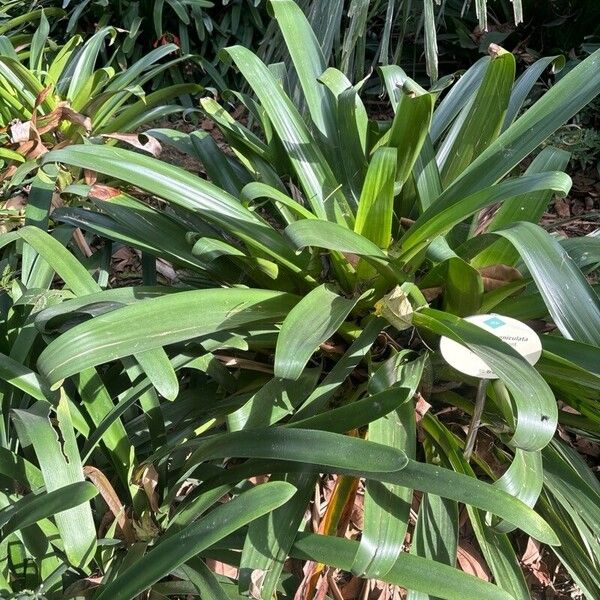
Plant Overview
Often referred to as the "Giant Brazilian Bromeliad," Alcantarea geniculata is a true architectural masterpiece of the plant world. Originating from the rocky slopes of Brazil, this massive bromeliad looks like something straight out of a prehistoric landscape. It is prized by gardeners for its dramatic, silver-tinted foliage and its ability to serve as a stunning focal point in tropical or Mediterranean-style gardens.
🔍 How to Identify
- 🌿 The Foliage: Large, broad, strap-like leaves form a massive, symmetrical rosette. The leaves often have a striking silvery-green or blue-grey hue with a smooth, waxy texture.
- 🦴 The "Knee" Spike: Its species name, geniculata, comes from the Latin word for "jointed" or "bent like a knee." This refers to the enormous flower stalk that grows in a distinct, zig-zagging pattern.
- 🌸 The Inflorescence: When it finally blooms (which can take years), it produces a towering flower spike that can reach over 6 feet tall, adorned with delicate cream or yellowish flowers.
🏡 In Your Garden
- ☀️ Light and Color: To keep its stunning silver sheen, this plant craves bright light. In lower light, the leaves may turn a duller green as the plant stretches to find the sun.
- 💧 The Central Tank: Like most bromeliads, it has a central "cup" formed by its leaves. In the wild, this acts as a mini-ecosystem for frogs and insects. At home, ensure this cup is kept filled with fresh water, but flush it out occasionally to prevent salt buildup or mosquito larvae.
- ⛰️ Soil & Drainage: Because it naturally grows on rocky cliffs, it hates "wet feet." Use a very well-draining orchid mix or a gritty succulent soil to prevent the base from rotting.
⚠️ Safety & Toxicity
- 🟢 Status: Non-toxic and generally safe for homes with curious inhabitants.
- 🌵 Physical Safety: While not poisonous, the leaves are very stiff and have pointed tips. If placed near a walkway, the sharp ends can easily poke passersby, so it is best kept in a spot where it has plenty of "personal space."
✨ Fun Fact
The Alcantarea geniculata is a "monocarpic" plant, meaning it reaches a grand finale—it blooms once in its lifetime, puts on a spectacular show for several months, and then slowly dies, leaving behind several "pups" (baby plants) at its base to carry on its legacy!

Detailed Care Instructions







