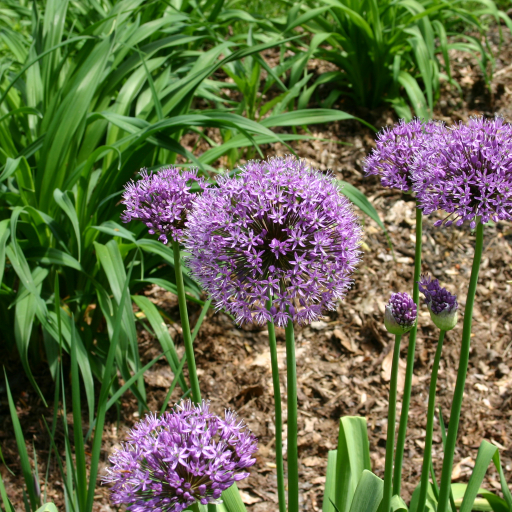
Plant Overview
Often called the Persian Onion, Allium aflatunense is the "Lollipop of the Garden." Native to the mountain slopes of Central Asia, these architectural wonders are famous for their perfectly spherical, violet flower heads that seem to float above the garden landscape. They are a favorite among designers for adding vertical drama and a touch of whimsical geometry to late-spring borders.
🔍 How to Identify
- 💜 The Bloom: A dense, 4-inch wide globe (umbel) composed of hundreds of tiny, star-shaped purple flowers.
- 📏 The Stem: A tall, sturdy, and leafless "scape" that can reach up to 3 feet in height, resisting even strong spring winds.
- 🍃 The Foliage: Strap-shaped, grey-green leaves that emerge in a basal rosette at the soil level.
- 🧅 The Scent: While the flowers smell faintly sweet, the leaves and bulbs emit a classic onion-like aroma when bruised or crushed.
🏡 In Your Garden
- ⏳ The Vanishing Act: A unique quirk of this plant is that its foliage begins to turn yellow and wither just as the flowers begin to bloom. This is the plant's way of sending energy back to the bulb; avoid the temptation to cut the "ugly" leaves until they are completely brown.
- 🛡️ Natural Repellent: Because of their pungent onion scent, they are highly resistant to deer and rabbits. They act as a "living shield" for more vulnerable plants when interspersed throughout a flower bed.
- 🦋 Pollinator Magnet: While mammals stay away, bees and butterflies are mesmerized by the nectar-rich florets, making them essential for a wildlife-friendly garden.
⚠️ Safety & Toxicity
- 🐾 Pet Warning: Like all members of the Allium genus (including garlic and chives), this plant is toxic to dogs and cats. If ingested, it can cause damage to red blood cells (hemolytic anemia).
- 👶 Human Safety: While not typically fatal to humans, the bulbs can cause severe stomach upset if eaten and may cause mild skin irritation in sensitive individuals. It is best treated as a "look but don't taste" ornamental.
✨ Fun Fact
The seed heads of Allium aflatunense are just as beautiful as the flowers! Even after the purple fades, the dried tan-colored globes persist on their stalks, looking like structural modern art or "giant dandelions" in the summer sun.

Detailed Care Instructions
Here are some steps on how to grow Allium Aflatunense plants:
- Choose the right location: Allium Aflatunense plants prefer full sun but can tolerate partial shade. Make sure the location has well-draining soil.
- Prepare the soil: Before planting, prepare the soil by removing any weeds or grass. Allium Aflatunense plants prefer soil that is rich in organic matter, so you can add compost or well-rotted manure to improve the soil's fertility.
- Plant the bulbs: Allium Aflatunense plants grow from bulbs. Plant the bulbs in the fall, approximately 4-6 inches deep and around 6-8 inches apart. Place them with the pointed end facing up.
- Watering: After planting, water the bulbs thoroughly to settle the soil. Allium Aflatunense plants have moderate watering requirements, so water them regularly but avoid overwatering, as this can cause the bulbs to rot.
- Fertilization: Allium Aflatunense plants benefit from a balanced fertilizer application in the spring. Use a slow-release fertilizer, following the instructions on the packaging.
- Maintenance: Allium Aflatunense plants have minimal maintenance needs. Remove any dried or yellowing foliage to maintain a neat appearance. Deadhead spent flowers to prevent seed formation if you want to focus on bulb growth.
- Overwintering: Allium Aflatunense plants are hardy and can withstand cold winters. However, it's a good idea to put a layer of mulch around the plants to protect them during extreme cold.
- Dividing and propagation: Allium Aflatunense plants can be divided every few years to prevent overcrowding. Dig up the bulbs in the fall after the foliage has died back, separate them, and replant them in their new locations.
By following these steps, you can successfully grow Allium Aflatunense plants and enjoy their beautiful purple flowers in your garden.

Place in a bright room that is sun drenched almost all day. Or directly in a south-facing window.

To properly water this plant, ensure that the soil is moist but not waterlogged. It is important to provide regular watering during the growing season, particularly during the summer months. Avoid over-watering or allowing the soil to dry out completely, as this can harm the plant's health. To conserve moisture and reduce the need for frequent watering, it may be helpful to mulch around the base of the plant. Additionally, it is recommended to water at the base of the plant rather than from overhead, as this can help prevent the development of fungal diseases.
- Choose a well-draining soil that is rich in organic matter and slightly alkaline.
- Before planting, mix the soil with compost or aged manure.
- Plant bulbs in the fall, about 6 inches deep and 6 inches apart.
- Fertilize with a balanced, slow-release fertilizer in early spring before new growth emerges.
- Apply a second application of fertilizer when flowers start to form.
- Water regularly, especially during dry spells, to promote healthy growth and flowering.
- Remove spent flowers to encourage the plant to redirect energy towards bulb production.
- For larger bulbs and more abundant flowers, lift and divide the bulbs every few years in the fall.
The ideal soil for Allium Aflatunense plant should be well-draining and rich in organic matter. It should have a pH range of 6.0 to 7.5. The soil should be able to hold moisture, but not be waterlogged as this may cause rotting of the roots. It should also be able to retain nutrients to provide ample nourishment for the plant. A sandy loam or loamy soil is often recommended. Prior to planting, it is advisable to amend the soil with compost or well-rotted manure.
To propagate this plant, you will need to wait until it has finished flowering, usually in early summer. Then, carefully dig up the bulbs and separate any smaller bulbs that have formed around the base of the larger ones. These smaller bulbs, known as offsets, can be replanted immediately in a location with well-draining soil and full sun. Make sure to plant them at the same depth as the original bulb and space them at least 6 inches apart. Water regularly and fertilize with a balanced fertilizer throughout the growing season. In a few years, these offsets will mature and produce their own flowers.








