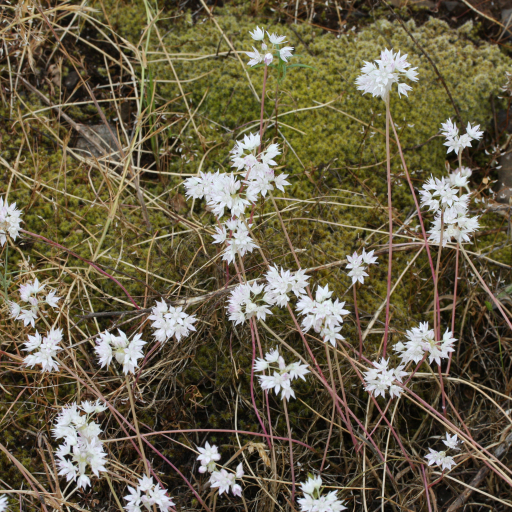
Plant Overview
Known affectionately as the Narrowleaf Onion or Slimleaf Onion, this delicate wild beauty is a staple of Western North American landscapes. Often found swaying in the breeze across grassy hillsides and rocky meadows, it looks like a collection of tiny white or pinkish pom-poms held up by invisible wires. While it shares a lineage with the onions in your kitchen, this species is celebrated more for its resilient nature and papery, ethereal blooms than for its flavor.
🔍 How to Identify
- 🌸 The Bloom: It produces a spherical cluster (an umbel) of 10 to 50 tiny, star-shaped flowers. These flowers range from a crisp, translucent white to a soft, blushing pink.
- 📄 Texture: One of its most distinct features is that the flower petals become thin and papery as they age, often remaining on the stem long after the plant has gone to seed.
- leaf The Foliage: True to its name, the leaves are very narrow and grass-like. Interestingly, these leaves often begin to wither and turn brown just as the flowers reach their peak, a strategy to save energy for the bloom.
🏡 In Your Garden
- ☀️ Drought Strategy: This plant is a "geophyte," meaning it survives the harsh, dry summers by retreating into its underground bulb. It requires very little water once the blooming season ends, making it a star for water-wise or "xeriscape" gardens.
- 🦋 Pollinator Magnet: While it might look dainty, it is a powerhouse for local wildlife. It is a favorite pit stop for native bees and butterflies, providing essential nectar during the late spring and early summer months.
⚠️ Safety & Toxicity
- 🐾 Status: Toxic to pets (dogs and cats).
- 🧅 Details: Like all members of the Allium genus (including garlic and chives), it contains N-propyl disulfide. If ingested by pets, it can cause damage to red blood cells and lead to anemia. While humans can technically eat the bulbs, they are much smaller and more pungent than garden onions, and wild foraging is generally discouraged unless you are an expert, as it can be easily confused with "Death Camas."
✨ Fun Fact
The Narrowleaf Onion is a master of "repellent gardening." Because of its natural onion scent, deer and rabbits almost always give it a wide berth, making it a fantastic natural barrier to protect more "delicious" plants in your flower beds!

Detailed Care Instructions
To grow Allium Amplectens (or 'Nectaroscordum siculum'), follow these steps:
- Location: Choose a location that receives full sun to partial shade. This plant prefers well-drained soil, so make sure the soil is not too heavy or compacted.
- Soil Preparation: Prepare the soil by removing any weeds or grass and loosening it with a garden fork or tiller. Add organic matter like compost or well-rotted manure to improve the soil's fertility and drainage.
- Planting Time: Allium Amplectens bulbs should be planted in the fall, around September to October, before the first frost hits. This gives the bulbs time to establish their roots before winter.
- Bulb Planting: Dig holes about 4-6 inches deep and space them 6-8 inches apart. Place the bulbs in the hole, pointed end facing up, and cover them with soil. Water the area thoroughly after planting to ensure proper hydration.
- Watering: Allium Amplectens plants require regular watering, especially during dry periods. Keep the soil moderately moist but avoid overwatering to prevent bulb rot.
- Maintenance: Remove any faded flower heads to promote new growth and prevent self-seeding. After the foliage has completely died back, you can cut it off at ground level.
- Division: Allium Amplectens bulbs can be left undisturbed for several years before they may need to be divided. If the clumps become crowded and need dividing, do so in late summer or early fall when the foliage starts to wither. Dig up the bulbs, separate them, and replant them at the appropriate depth.
- Pest and Disease: These plants are generally resistant to pests and diseases. However, keep an eye out for slugs and snails, which may feed on the foliage. Use organic pest control methods if necessary.
By following these steps, you should be able to grow healthy and beautiful Allium Amplectens plants in your garden.

Place in a bright room that is sun drenched almost all day. Or directly in a south-facing window.

Allium Amplectens plant is a perennial plant that can grow up to 2 feet tall. It requires regular watering, especially during the growing season. The best way to water this plant is by watering deeply once a week, allowing the soil to dry out slightly between waterings. Ensure that the soil is evenly moist, but not waterlogged. Irrigating the plant at the base, rather than overhead, is recommended to prevent the development of fungal diseases. During the prolonged dry spells, it is recommended to water this plant twice a week to keep it healthy, and its foliage vibrant. The frequency of watering may depend on local weather conditions, humidity levels, and soil type. It is also important to water this plant in the early morning or late evening, when the sun is not too intense, to prevent water evaporation.
To fertilize your plant, use a balanced fertilizer with equal parts nitrogen, phosphorus, and potassium. Apply the fertilizer to the soil once a month during the growing season, which is typically in the spring and summer months. Water the plant immediately after fertilizing to help the nutrients reach the roots. Be sure to follow the package instructions carefully and don't over-fertilize, as this can damage the plant.
The Allium Amplectens plant prefers well-draining soils with a neutral pH level. It does well in loamy soils that are rich in organic matter. Sandy soils are also suitable as long as they are well-draining. The plant requires a soil that is moist but not waterlogged. It is important to avoid heavy clay soils as they can cause water-logging and root rot. Adding compost or aged manure into the soil before planting can improve the soil quality and provide nutrients for the plant. The use of a slow-release fertilizer is recommended to ensure the plant gets the necessary nutrients throughout the growing season.
- Choose a healthy parent plant: Find a mature, healthy Allium Amplectens plant with well-developed roots and sturdy growth.
- Select appropriate cuttings: Take cuttings from the parent plant that are at least 5-6 inches long. Cut the stems just below the node where the leaf attaches to the stem.
- Remove leaves: Remove the lower leaves from the cutting, leaving only a few leaves at the top.
- Dip in rooting hormone: Dip the cut ends of the stems in rooting hormone. This will help the cuttings develop roots more quickly.
- Plant in soil: Remove any leaves that will be covered by soil and plant the cutting in a pot filled with moist, well-draining soil. Make sure to bury the cut end of the stem.
- Provide proper care: Keep the soil moist and provide bright, indirect light for the cutting. Once the plant develops new growth and begins to produce roots, it can be transplanted into its permanent home in the garden.
- Monitor for pests and disease: Regularly check for pests or signs of disease, and take action immediately if any problems arise.








