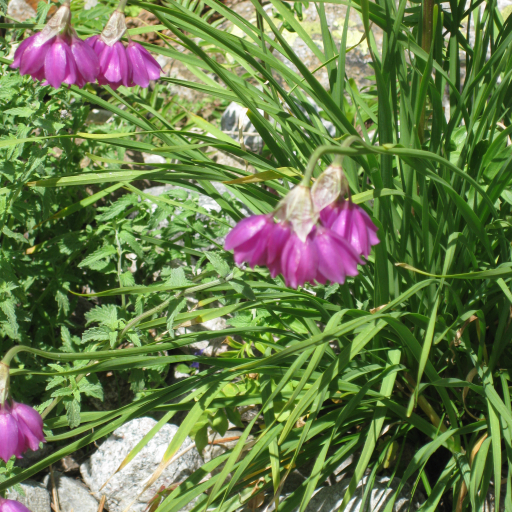
Plant Overview
Often called the Insubrian Onion, this rare alpine beauty is a hidden gem from the craggy limestone peaks of the Italian Alps. Unlike the upright, "lollipop" flower heads of many ornamental onions, this species charms with its heavy, nodding clusters of oversized rose-pink bells. It carries the name of the Insubres, the ancient Celtic tribe that once roamed its native Lombardy region.
🔍 How to Identify
- 🌸 The Bloom: Large, bell-shaped flowers in shades of deep rose or magenta that hang gracefully in small, pendulous clusters of 3 to 5.
- 📐 The Stem: Reaches about 10–12 inches in height, featuring a characteristic "nod" or crook at the top that causes the flowers to face the ground.
- 🌿 The Foliage: Narrow, flat, ribbon-like leaves with a slightly waxy, grayish-green hue that typically emerge from the base.
🏡 In Your Garden
- 🏔️ Alpine Roots: Because it originates from alpine scree slopes, it demands impeccable drainage. It thrives in rock gardens, troughs, or raised beds where water can flow freely away from the bulb.
- ☀️ Sun & Stone: This plant is a "calcicole," meaning it loves lime-rich or chalky soils. It prefers a sunny spot but appreciates a "cool root run"—achieved by planting it near a large stone that keeps the soil temperature stable.
⚠️ Safety & Toxicity
- 🐾 Pet Warning: Like all members of the Allium family (including garlic and onions), it contains thiosulfates which are toxic to cats and dogs if ingested.
- 🍽️ Edibility: While it carries a mild, pleasant onion scent and is technically non-toxic to humans, its rarity in the trade means it is almost exclusively grown as a collector's ornamental rather than food.
✨ Fun Fact
Despite its delicate and fragile appearance, Allium insubricum is incredibly tough; it has earned the Royal Horticultural Society’s Award of Garden Merit for its ability to thrive in garden settings despite its very specific high-altitude origins.

Detailed Care Instructions
To grow Allium Insubricum plants, also known as Insubric garlic, follow these steps:
- Select a suitable location: Allium Insubricum grows best in full sun, although it can tolerate some partial shade. Ensure that the soil is well-drained and fertile.
- Prepare the soil: Remove any weeds or debris from the planting area. Loosen the soil and incorporate organic matter such as compost or well-rotted manure to improve drainage and nutrient content.
- Planting: Allium Insubricum is usually planted in the fall or early winter. Dig a hole about 3-4 inches deep and place the bulbs in the hole with the pointed end facing up. Space the bulbs about 6-8 inches apart. Cover the bulbs with soil and firm it gently.
- Watering: After planting, water the bulbs thoroughly. Keep the soil moist but not waterlogged during the growing season. Reduce watering as the plants approach maturity to prevent rotting.
- Mulching: Apply a layer of organic mulch, such as straw or wood chips, around the plants. Mulching helps retain moisture, suppresses weed growth, and regulates soil temperature.
- Fertilizing: Allium Insubricum plants benefit from an application of balanced fertilizer in early spring. Follow the instructions on the fertilizer packaging for proper dosage.
- Maintenance: Remove any weeds that may compete with the plants for nutrients and water. Allium Insubricum does not usually require staking. However, tall varieties might need support in windy areas.
- Harvesting: Allium Insubricum bulbs can be harvested when the foliage starts turning yellow and drying up. Gently lift the bulbs with a garden fork, taking care not to damage them. Allow the harvested bulbs to dry in a warm, well-ventilated area for a few weeks before storing them.
- Storing: After curing, store the harvested bulbs in a cool, dark, and dry place. Ensure good air circulation to prevent mold formation.
By following these steps, you can successfully grow Allium Insubricum plants and enjoy their beautiful purple flowers and delicious garlic bulbs.

Place in a bright room that is sun drenched almost all day. Or directly in a south-facing window.

Allium Insubricum is a perennial plant that belongs to the Allium genus. To water this plant, it is important to ensure that the soil remains consistently moist but not waterlogged. Overwatering can cause the plant to develop root rot and other diseases. One should water the plant deeply and thoroughly, allowing the water to penetrate the soil. When watering, one should avoid getting water on the foliage as this can lead to the development of fungal diseases. It is also important to water the plant early in the morning or late in the evening when the temperatures are cooler to reduce evaporation. Additionally, one should avoid watering during periods of heavy rain as this can lead to waterlogging. A good way to monitor soil moisture levels is to stick a finger into the soil up to the second knuckle. If the soil feels dry, it is time to water. The frequency of watering will depend on factors such as the temperature, humidity, and soil type.
To fertilize the Allium Insubricum plant, mix a balanced, slow-release fertilizer into the soil in early spring before new growth appears. Apply a light top-dressing of compost or well-rotted manure around the base of the plant in early fall. Avoid using high-nitrogen fertilizers, as this can cause excessive foliage growth at the expense of flower production. Water deeply after fertilizing to ensure proper absorption of nutrients.
Allium Insubricum prefers a well-draining soil that is slightly acidic with a pH of 6.5 to 7.5. The soil should be rich in organic matter and have good fertility. A sandy loam or loamy soil texture is ideal for this plant. It is important to avoid heavy clay soils that are prone to waterlogging as this can lead to root rot. A soil that retains some moisture is preferred, but it should not be overly wet. A top dressing of compost or well-rotted manure can be added each year to maintain soil fertility. Mulching around the plant can also help retain moisture in the soil and suppress weeds. Overall, the soil should be well-prepared before planting and kept moist throughout the growing season.
Allium Insubricum can be propagated through division or from seeds. To propagate through division, carefully dig up the plant in the fall or early spring and separate the bulbs. Make sure each bulb has some roots attached to it. Replant the bulbs in well-draining soil with good organic matter. Water the newly planted bulbs thoroughly and keep the soil moist but not waterlogged until they are established.
To propagate from seeds, collect the seeds from the plant after it has flowered and the seed heads have dried. Sow the seeds in trays or pots filled with well-draining soil. Cover the seeds with a thin layer of soil and water gently. Keep the soil moist and place the trays or pots in a warm, bright location. The seeds should germinate within a few weeks. Once the seedlings have grown to a suitable size, they can be transplanted into larger pots or directly into the ground.








