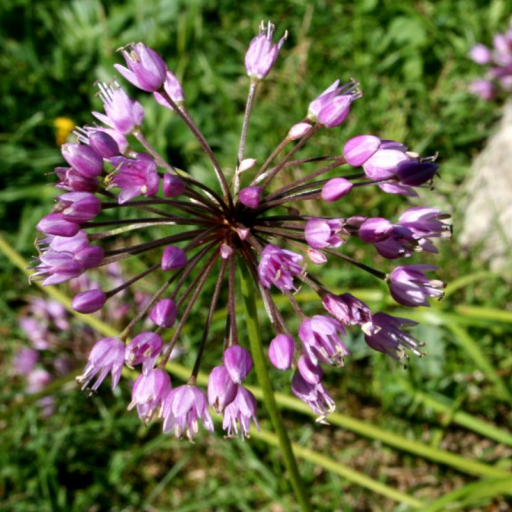
Plant Overview
The Mountain Onion, often known by its scientific name Allium lusitanicum, is a resilient beauty that thrives where other plants give up. Native to the rocky slopes and sunny hillsides of Europe, it brings a splash of lilac-pink to rugged landscapes. It is a favorite for rock gardens because of its "tough-as-nails" personality and elegant, globe-shaped blooms that dance on slender stems.
🔍 How to Identify
- 🌸 The Blooms: It features dense, spherical clusters (umbels) of starry, bell-shaped flowers that range from pale pink to deep lilac.
- 🍃 The Foliage: Unlike many garden onions with hollow leaves, its foliage is typically narrow, flat, and grass-like, with a soft gray-green hue.
- 👃 The Scent: If you gently bruise a leaf, it releases a sharp, unmistakable savory aroma of onion or garlic—a classic trait of the Allium family.
🏡 In Your Garden
- 🪨 The "No-Fuss" Tenant: This plant hates "wet feet." Because it originates from rocky terrain, it requires exceptional drainage. It is the perfect candidate for a gravel garden or a crevice where soil is thin.
- 🐝 Pollinator Magnet: In late summer when other flowers might be fading, the Mountain Onion becomes a bustling airport for bees, butterflies, and hoverflies, providing a vital late-season nectar source.
- 🛡️ Natural Repellent: While humans might find the scent pleasant in a kitchen context, the onion aroma acts as a natural deterrent for deer and rabbits, making it a "guard plant" for more vulnerable neighbors.
⚠️ Safety & Toxicity
- 🐾 Status: Generally safe for humans in small quantities, but toxic to pets.
- 🐕 Details: Like all members of the onion family, it contains N-propyl disulfide. While usually harmless to people, this compound can cause red blood cell damage in cats and dogs if ingested. Keep it tucked away in rockeries where curious pups won't nibble.
✨ Fun Fact
Despite its name lusitanicum (referring to Lusitania, or modern-day Portugal), this plant is a wide-ranging traveler found from the mountains of Spain all the way to Central Europe. It is considered a "relict" species in some areas, meaning it has survived in specific rocky pockets since the end of the last Ice Age!

Detailed Care Instructions
To grow Allium lusitanicum or Portuguese garlic, follow these steps:
- Choose a sunny location: Allium lusitanicum thrives in full sun. Select a spot in your garden or container that receives at least 6-8 hours of direct sunlight per day.
- Prepare the soil: The soil should be well-draining and fertile. Add organic matter such as compost or well-rotted manure to improve the soil's texture and nutrient content. Ensure the pH level of the soil is between 6.0 and 7.5.
- Planting: Plant the Allium lusitanicum bulbs in early spring or autumn. Dig a hole or trench that is 3-4 inches deep. Space the bulbs about 4-6 inches apart, placing them with their pointed ends up. Cover the bulbs with soil and lightly firm it down.
- Watering: Allium lusitanicum prefers moderate moisture levels. Water the plants regularly, providing about 1-2 inches of water per week during the growing season. Avoid overwatering, which can lead to rotting.
- Mulching: Apply a layer of organic mulch around the plants to help conserve moisture, suppress weed growth, and provide insulation during colder months.
- Fertilization: Allium lusitanicum doesn't require excessive fertilization. However, you can apply a balanced fertilizer once in early spring as new growth emerges. Follow the packaging instructions for the correct dosage.
- Maintenance: Remove any weeds that compete with the plants for nutrients and water. Deadhead the spent flowers to prevent seed production and encourage the plant to focus on bulb development.
- Harvesting: Allium lusitanicum bulbs are typically ready for harvest in mid to late summer. Gently dig around the bulbs, being careful not to damage them, and lift them from the soil. Allow them to dry in a warm, well-ventilated place for a few weeks to cure before storing them.
- Storage: Store the cured bulbs in a cool, dry place with good air circulation. A well-ventilated mesh bag or wooden crate works well. Ensure there is no excess moisture, as it can lead to rotting.
By following these steps, you should be able to successfully grow Allium lusitanicum and enjoy its aromatic foliage and edible bulbs.

Place in a bright room that is sun drenched almost all day. Or directly in a south-facing window.

In order to properly water the Allium Lusitanicum plant, it is important to consider a few key factors. First, it is important to ensure that the soil is moist but not waterlogged. This can be achieved by watering the plant deeply once or twice a week instead of giving it frequent shallow watering sessions. This helps to encourage the roots to grow downwards and become more resilient, which can help the plant to be more drought-tolerant over time.
Additionally, it is important to consider the unique needs and growing conditions of the Allium Lusitanicum plant. Some factors that may impact its water requirements include the amount of sunlight it receives, the temperature and humidity level of its environment, and the type of soil it is planted in. By monitoring these factors and adjusting your watering schedule accordingly, you can help to ensure that your plant remains healthy and thriving for years to come.
To properly fertilize Allium Lusitanicum, follow these instructions:
- Choose a balanced, slow-release fertilizer with equal amounts of nitrogen, phosphorus, and potassium (NPK). A ratio of 10-10-10 or 14-14-14 will work well.
- Apply the fertilizer in early spring, just as the plant begins to emerge from the ground. Avoid fertilizing during dormant periods or late in the growing season.
- Calculate the amount of fertilizer needed based on the size of your planting area. Follow the manufacturer's instructions to determine the appropriate application rate.
- Sprinkle the fertilizer evenly around the base of the plants, keeping it a few inches away from the stems. Avoid directly touching the foliage with the fertilizer.
- Gently work the fertilizer into the top inch or so of soil using a hand rake or cultivator. Be careful not to damage the shallow roots while doing so.
- Water the plants thoroughly after fertilizing to help the nutrients penetrate the soil and reach the roots.
- Avoid excessive fertilization, as it can lead to overgrowth or weak stems. Stick to the recommended amounts and frequency specified on the fertilizer packaging.
- Monitor the plant's growth and health throughout the season. If you notice signs of nutrient deficiency, such as yellowing leaves or stunted growth, consider providing a light application of fertilizer to replenish nutrients.
Remember, it is always a good practice to read the specific instructions provided by the manufacturer of your chosen fertilizer and adjust the application rate and timing accordingly.
Allium Lusitanicum prefers well-draining soil that is fertile and rich in nutrients. The soil should have a neutral to slightly alkaline pH level, ideally between 6.0 and 7.5. It is also important that the soil is loose and not compacted, as the plant's roots need to be able to spread easily.
To achieve the ideal soil conditions for Allium Lusitanicum, you can mix in compost or well-rotted manure to improve soil structure and add nutrients. Adding perlite or vermiculite can also improve drainage and prevent waterlogging.
It is important to note that Allium Lusitanicum is sensitive to high levels of phosphorus in the soil, so it is recommended to avoid fertilizers that are high in this nutrient. Instead, use a balanced fertilizer with equal amounts of nitrogen, phosphorus, and potassium.
Overall, creating a well-drained, fertile, and slightly alkaline soil will provide the best growing conditions for Allium Lusitanicum.
Propagation of Allium Lusitanicum plants can be achieved through a variety of methods including division, seed sowing, and bulbils. Here's a detailed guide on each method:
- Division:
- Start by selecting a mature and healthy Allium Lusitanicum plant.
- Dig around the plant, carefully lifting the clump of bulbs from the ground using a garden fork or shovel.
- Gently separate the individual bulbs from each other, ensuring that each bulb has some roots attached.
- Replant the divided bulbs into prepared soil or pots, ensuring they are positioned at the same depth as before.
- Water the newly planted divisions thoroughly and provide them with adequate sunlight.
- Start by selecting a mature and healthy Allium Lusitanicum plant.
- Seed sowing:
- Collect mature seeds from the Allium Lusitanicum plant once they have fully ripened and turned brown.
- Prepare a seed tray or small pots with a well-draining potting mix.
- Scatter the seeds evenly over the soil surface or sow them at a depth of about 1/4 inch.
- Lightly cover the seeds with a thin layer of soil and mist the surface with water.
- Place the tray or pots in a warm location with indirect sunlight or under grow lights, maintaining a temperature around 65-75°F (18-24°C).
- Keep the soil consistently moist throughout the germination period, which usually takes 2-4 weeks.
- Once the seedlings have developed 2-3 true leaves, transplant them into individual pots or directly into the garden.
- Collect mature seeds from the Allium Lusitanicum plant once they have fully ripened and turned brown.
- Bulbils:
- Bulbils are small bulbs that form at the top of the Allium Lusitanicum plant's flower stalk.
- Allow the flower stalk to mature until it turns brown and the bulbils are fully formed.
- Carefully remove the bulbils from the stalk, taking care not to damage them.
- Place the bulbils on a tray or in a container filled with a moist growing medium like perlite or sand.
- Keep the bulbils in a cool location for approximately three weeks to allow them to dry slightly.
- Once dried, plant the bulbils in pots or directly into the garden, ensuring they are placed at a depth equivalent to their size.
- Water the bulbils thoroughly after planting and provide them with adequate sunlight.
Regardless of the propagation method chosen, it is important to provide newly propagated Allium Lusitanicum plants with proper care, including regular watering, well-draining soil, and adequate sunlight. With patience and proper care, the plants will establish themselves and grow into mature specimens, producing vibrant flowers in due time.
- Bulbils are small bulbs that form at the top of the Allium Lusitanicum plant's flower stalk.








