Plant Overview
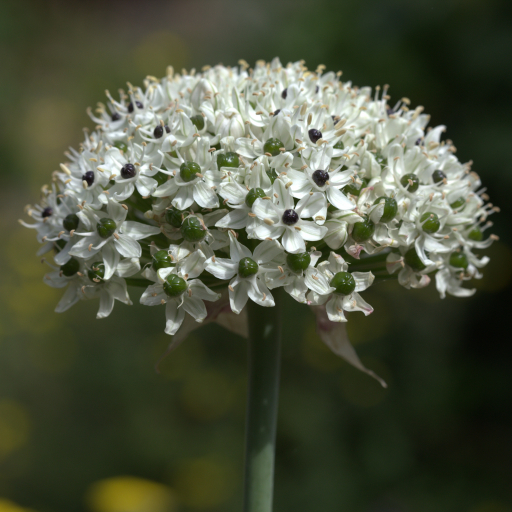
Often called "Black Garlic" or the "Broadleaf Onion," Allium nigrum is a bit of a botanical trickster. Despite its name, you won't find jet-black petals here; instead, it produces stunning, architectural clusters of silvery-white flowers. This Mediterranean native is a favorite for designers who want to add "structure" to a garden, standing tall and proud long after other spring bulbs have faded.
🔍 How to Identify
- 🌸 The Flower Head: Unlike the perfect "pom-poms" of other onions, these umbels are slightly flattened on top, featuring dozens of star-shaped, creamy-white florets.
- 🟢 The "Dark Eye": Each individual flower has a prominent, deep green to near-black ovary at its center, which is where the species gets its name (nigrum meaning black).
- 🍃 Broad Foliage: While many Alliums have grass-like leaves, this variety has thick, lance-shaped, grey-green leaves that can be up to 2 inches wide.
🏡 In Your Garden
- ☀️ Sun-Seeker: This plant is a sun-worshipper. It needs a bright, open spot to prevent the stems from flopping over. It is particularly "drought-smart," making it perfect for rock gardens or xeric landscapes.
- 🧱 Architectural Interest: Because the flower heads turn into beautiful dried seed pods, many gardeners leave the stalks standing all summer. They provide a structural, skeletal look that looks hauntingly beautiful in the autumn frost.
- 🦌 The Scent Shield: While humans mostly smell the flowers, the leaves and bulbs have a faint onion scent that deer, rabbits, and even most rodents find repulsive, making it a "bodyguard" for more delicious neighbor plants.
⚠️ Safety & Toxicity
- 🐾 Toxic to Pets: Caution. All members of the Allium family (including garlic, onions, and leeks) are toxic to dogs, cats, and horses.
- 🤢 Ingestion Risks: If eaten by pets, it can cause "Heinz body anemia," a condition that damages red blood cells. While rarely fatal in small amounts, it causes lethargy, vomiting, and elevated heart rates. Keep the bulbs away from dogs who like to dig!
✨ Fun Fact
✨ Homeric Myth: Some historians and botanists believe Allium nigrum (or a very close relative) was the legendary "Moly" plant described in Homer's Odyssey. In the epic, Hermes gives Odysseus this magical herb to protect him against the transformations and spells of the enchantress Circe.

Detailed Care Instructions
To grow Allium Nigrum plants, follow these steps:
- Planting: Choose a sunny location in your garden with well-drained soil. Allium Nigrum plants prefer slightly acidic to neutral soil. You can plant the bulbs in the fall, around 4-6 weeks before the ground freezes, or early spring.
- Soil Preparation: Prepare the soil by removing any weeds, rocks, or debris. Loosen the soil to improve drainage and create a favorable environment for the plant's roots.
- Bulb Planting: Dig a hole that is about 2-3 times the depth of the bulb. Place the bulb in the hole, pointed side up, and cover it with soil. Space the bulbs about 4-6 inches apart.
- Watering: Water the newly planted bulbs thoroughly to settle the soil and provide moisture. After that, water the plants moderately during their growth period, but avoid overwatering to prevent rotting.
- Fertilization: Allium Nigrum plants do not require heavy feeding. You can add a balanced fertilizer or compost to the soil during planting, but it is not necessary afterwards. Avoid using high-nitrogen fertilizers as they might fuel leaf growth rather than bulb development.
- Mulching: Apply a layer of organic mulch, such as straw or shredded leaves, around the plants. This helps retain soil moisture, suppress weed growth, and provide insulation to the bulbs during winter.
- Maintenance: Allium Nigrum plants are generally low maintenance. Keep an eye out for pests or diseases and address any issues promptly. Remove any dead or yellowing leaves regularly to maintain plant health and aesthetics.
- Harvesting: Allium Nigrum plants produce beautiful white flowers on tall stems. Once the flowers start to fade and dry out, you can cut them for dried floral arrangements if desired.
By following these steps, you should be able to successfully grow Allium Nigrum plants and enjoy their stunning blooms in your garden.

Place in a bright room that is sun drenched almost all day. Or directly in a south-facing window.

Watering the Allium Nigrum plant requires regular attention to the soil moisture level and weather conditions. To avoid overwatering, it is recommended to water deeply once a week or every ten days, allowing the soil to dry out slightly in between watering.
When watering, it is important to direct the water at the base of the plant instead of the foliage to prevent fungal growth and disease. Use a watering can or soaker hose to deliver water directly to the soil.
During the summer months or hot, dry periods, you may need to increase watering frequency to twice a week. In contrast, during the cooler months or rainy periods, you may need to reduce watering frequency to prevent waterlogging.
Using a layer of mulch around the roots can help regulate soil temperature and moisture levels while reducing the need for frequent watering. It is also important to monitor the plant for signs of wilting or yellowing leaves, which can indicate over or underwatering.
For optimal growth of this plant, it is recommended to fertilize it with a balanced fertilizer once a month during its active growing season, which is typically in the spring and summer months. Avoid over-fertilizing as it can lead to excessive foliage growth at the expense of flower production. Additionally, it is beneficial to incorporate organic matter into the soil prior to planting and to mulch around the base of the plant to retain moisture and suppress weed growth.
Allium Nigrum plant is a bulbous perennial plant that requires well-draining soil. The ideal soil composition for this plant should be moist but well-draining and rich in organic matter. The soil pH should be between 6.0 and 7.5 to ensure optimal growth and development. A sandy loam, loamy sand, or sandy clay loam soil with good drainage is also suitable for growing this plant. The addition of organic matter such as compost, well-rotted manure, or leaf mold will help improve the soil structure and provide the necessary nutrients for growth. It is important to avoid heavy clay soil that retains moisture and restricts root growth, as this can cause the bulbs to rot. In summary, the ideal soil for growing Allium Nigrum plant should be well-draining, moderately fertile, and rich in organic matter with a neutral pH.
The process of propagating this plant starts by gathering healthy, mature bulbs during the dormant season. Once the bulbs have been collected, they should be stored in a cool, dry place until the planting season begins.
When it's time to plant, choose a well-draining soil and select a spot that receives full sun or partial shade. Dig holes that are just deep enough to cover each bulb and space them about 4-6 inches apart.
After planting, water the bulbs thoroughly and continue to provide regular watering throughout the growing season. Fertilizer can also be added to support healthy growth.
As the plant matures, it will produce small offsets that can be separated from the parent bulb and replanted in their own locations. This can be done during the dormant season by gently pulling the offsets away from the bulb and planting them in a similar manner as the parent bulb. With proper care, the newly planted offsets will mature into mature plants over time.








