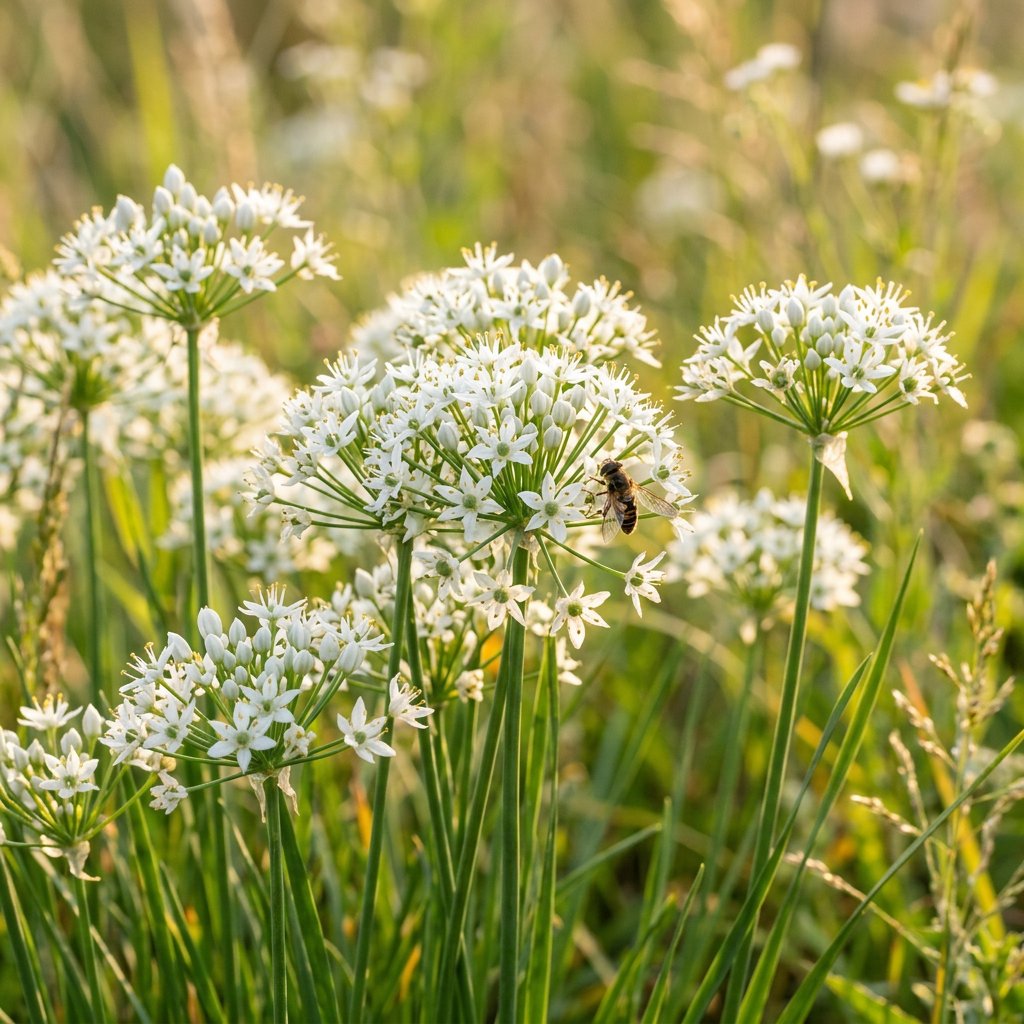
Plant Overview
Often called Garlic Chives or Chinese Chives, Allium tuberosum is a culinary staple that bridges the gap between the sharpness of garlic and the freshness of a green onion. While most chives have hollow, straw-like leaves, this variety offers flat, succulent blades and elegant white flowers. In Asia, it has been cherished for over 4,000 years, not just as a savory herb, but as a symbol of longevity and health.
🔍 How to Identify
- 🌿 The Foliage: Unlike common chives, the leaves are solid, flat, and strap-like, resembling thick blades of grass rather than hollow tubes.
- 🌸 The Blooms: It produces striking, globe-like clusters of star-shaped white flowers. Surprisingly, these blooms carry a sweet, violet-like fragrance rather than a garlicky one.
- 👃 The Scent: When the leaves are bruised or cut, they release a distinct, savory aroma that is much more reminiscent of fresh garlic than standard onions.
🏡 In Your Garden
- 🌱 Growth Habit: This is a clump-forming perennial that is incredibly hardy. It is often the first to emerge in spring and the last to fade in autumn, making it a reliable "cut and come again" crop for the kitchen.
- ✂️ The "Volunteer" Problem: While beautiful, it is a prolific self-seeder. If you don't "deadhead" (cut off) the spent flower heads before they drop seeds, you may find dozens of tiny garlic chives popping up all over your garden next season.
- 🐝 Pollinator Magnet: The nectar-rich white flowers are a favorite for honeybees, butterflies, and beneficial hoverflies, making it an excellent companion plant for vegetable patches.
⚠️ Safety & Toxicity
- 🐾 Pet Warning: Like all members of the Allium family (onions, garlic, leeks), this plant is toxic to dogs and cats. It can cause oxidative damage to red blood cells, leading to anemia if ingested.
- 🍽️ Human Consumption: It is perfectly safe and delicious for humans to eat! However, sensitive individuals may experience mild indigestion if they consume very large quantities of the raw leaves.
✨ Fun Fact
In many Asian cultures, Garlic Chives are grown in the dark (covered with pots or mats) to produce "Yellow Chives" (Jiu Huang). Without sunlight, the plant cannot produce chlorophyll, resulting in tender, pale yellow leaves with a much more delicate, buttery flavor!

Detailed Care Instructions
| Color | Creamy White |
| Soil Ph | Neutral |
| Humidity | Normal |
| Lighting | Full Sun |
| Soil Type | Rich, Well-Draining |
| Bloom Time | August To September |
| Difficulty | Medium |
| Plant Type | Fibrous Bulb, Perennial, Clump-Forming Herb |
| Mature Size | 6 To 12 In. Or 1 To 3 Ft. Tall; 2 Ft. Wide |
| Native Area | Southeastern Asia |
| Temperature | 20°C - 30°C |
| Sun Exposure | Full Sun To Part Shade |
| Hardiness Zones | 3-9 |
To grow Allium tuberosum (also known as garlic chives), follow these steps:
- Choose a suitable location: Find a sunny spot in your garden or balcony that receives at least 6 hours of sunlight per day.
- Prepare the soil: Garlic chives prefer well-drained soil, so make sure the soil is loose and fertile. Amend the soil with organic matter such as compost or well-rotted manure to improve its texture and fertility.
- Start from seeds or transplants: You can either start garlic chives from seeds or purchase transplants from a nursery. If starting from seeds, sow them about ¼ inch deep in the soil, and keep them consistently moist until they germinate. If using transplants, dig a hole slightly larger than the root ball and gently place the plant in, making sure the top of the root ball is level with the soil surface.
- Water regularly: Keep the soil evenly moist, but not waterlogged. Water deeply whenever the top inch of soil feels dry. Avoid overhead watering as it can encourage leaf diseases. Watering in the morning allows foliage to dry during the day, minimizing the chances of fungal infections.
- Fertilize appropriately: Apply a balanced, slow-release fertilizer at planting time and once or twice during the growing season. Follow the package instructions for the correct amount to use.
- Control weeds: Regularly remove weeds around the garlic chives to minimize competition for nutrients and water.
- Harvesting: You can start harvesting leaves of garlic chives when they reach about 6 to 8 inches in height. Cut the leaves close to the base, leaving at least half of the leaves on the plant to ensure continuous growth. You can also harvest the flowers before they fully open for use in culinary preparations.
- Divide and propagate: After a few years, garlic chives tend to form clumps. Dig up the clumps in early spring or fall, separate them into smaller sections, and replant them to give them more space and encourage healthier growth.
As with any plant, it's important to regularly monitor for pests or diseases and take appropriate measures if needed.

Place in a bright room that is sun drenched almost all day. Or directly in a south-facing window.

To water this plant, it is important to ensure that the soil around it remains moist. This can be accomplished by watering deeply and thoroughly, allowing the water to penetrate the soil deeply and reach the roots of the plant. It is important to avoid overwatering, as this can cause the plant to develop root rot or other diseases. Additionally, it is important to provide adequate drainage so that excess water can drain away from the plant's roots. This can be accomplished by using a well-draining soil mix and by ensuring that the plant is not sitting in standing water. It may be necessary to water this plant more frequently during periods of particularly hot or dry weather, but it is important to avoid soaking the soil.
To fertilize this plant, it is recommended to apply a balanced fertilizer, such as a 10-10-10 formula, during the growing season. The fertilizer should be applied at a rate of 1 tablespoon per square foot of soil, and should be watered in thoroughly after application. It is important to avoid applying too much fertilizer, as this can cause the plant to produce an excess of foliage at the expense of flowers.
The ideal soil for the plant is well-draining and has a neutral to slightly acidic pH. It should be loose and fertile, with good nutrient content and organic matter. Peat-based or compost-enriched soils are suitable, as well as sandy loams or clay loams. The plant prefers moist but not waterlogged conditions and may benefit from occasional mulching to retain moisture and suppress weeds. Avoid heavy or compacted soils, as they may impede root growth and drainage, and adjust the pH level if necessary using lime or sulfur amendments.
To propagate this plant, take a sharp knife or garden scissors and cut a healthy stem or shoot from an established plant. Trim the bottom of the stem to remove any leaves and create a clean cut. Then, either plant the cutting directly in soil or place it in a jar of water to root before planting. Keep the cutting moist and in a warm, bright area until it begins to produce roots and new growth. Once it has established roots and new growth, it can be planted in its permanent location in the garden.








