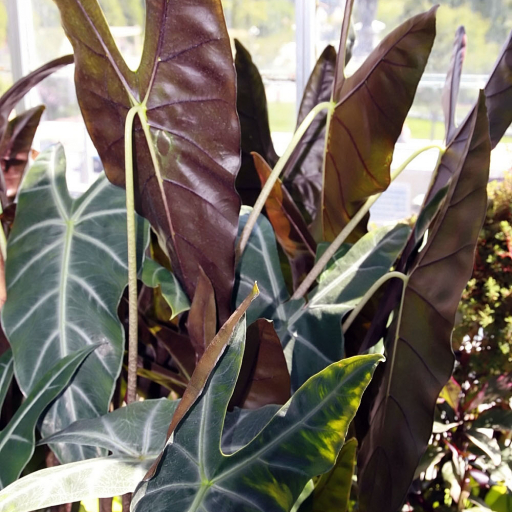
Plant Overview
Often called the Tiger Taro or Low’s Alocasia, this striking tropical native hails from the humid rainforests of Southeast Asia. Known for its dramatically elongated, arrow-shaped leaves, Alocasia longiloba is a masterpiece of natural geometry. It’s a favorite among collectors who want a "jungle" look without the sprawling size of larger Alocasia species.
🔍 How to Identify
- 🏹 The Leaf Shape: Unlike rounded Alocasias, this one has deeply "sagittate" (arrowhead-shaped) leaves that can grow quite long and narrow, ending in sharp points.
- 🖋️ Stark Veining: The leaf surface is typically a matte, deep olive green, slashed with thick, silvery-white or pale green primary veins that look almost hand-painted.
- 💜 Hidden Color: If you flip the leaf over, you’ll often find a gorgeous surprise—the undersides are frequently a rich, moody burgundy or deep purple color.
🏡 In Your Garden
- ☁️ Humidity is Non-Negotiable: Because this plant originated in the steamy understory of jungles, it will quickly develop crispy brown edges if your indoor air is too dry. A humidifier or a pebble tray is its best friend.
- 💧 The "Goldilocks" Soil: It grows from a delicate rhizome (a bulb-like root) that is highly susceptible to rot. It needs "chunky" soil—think orchid bark, perlite, and peat—to ensure water flows through quickly while staying slightly damp.
- 🧘 Minimalist Movement: Alocasia longiloba is a slow grower and can be quite sensitive to being moved. Once you find a bright, indirect light spot where it’s happy, try to leave it there to avoid "transplant shock."
⚠️ Safety & Toxicity
- 🚫 Status: Toxic to humans and pets.
- 🐾 Details: Like all members of the Araceae family, it contains insoluble calcium oxalate crystals. If chewed or swallowed, it causes immediate mouth irritation, swelling of the throat, and digestive distress. Keep it on a high shelf away from curious cats or toddlers.
✨ Fun Fact
The Alocasia longiloba is what botanists call "polymorphic." This means it can look vastly different depending on its specific environment and age, leading many early explorers to mistakenly name it as dozens of different species before realizing they were all the same plant!

Detailed Care Instructions
| Soil Ph | 5.5-6.5 |
| Humidity | Normal |
| Lighting | Full Sun |
| Toxicity | Poisonous |
| Soil Type | Loose, Well-Draining Potting Mix Or Crumbly Loam |
| Bloom Time | Spring And Summer Growth |
| Difficulty | Medium |
| Plant Type | Tropical Plant |
| Mature Size | 1 To 3 Feet Tall |
| Native Area | Asia |
| Temperature | 18°C - 27°C |
| Sun Exposure | Bright Indirect Light |
| Hardiness Zones | 10-11 |
To grow an Alocasia Longiloba plant, you can follow these steps:
- Choose a suitable location: Alocasia Longiloba prefers bright, indirect sunlight. Place the plant near a window or in a well-lit area with some shade.
- Select the right pot: Use a pot with drainage holes to prevent waterlogging. Ensure that the pot is slightly bigger than the plant's root ball to allow room for growth.
- Soil preparation: Alocasia Longiloba prefers well-draining soil. You can mix equal parts of peat moss, perlite, and standard potting soil to create a suitable soil mix.
- Planting: Gently place the plant's root ball into the pot, ensuring that the roots are well-covered with soil. Add more soil if needed and press it lightly to firm it around the root ball.
- Watering: Keep the soil evenly moist, but avoid overwatering. Wait for the top inch of soil to dry out before watering again. Alocasia Longiloba prefers high humidity, so misting the leaves can help create a humid environment.
- Fertilizer: Feed your Alocasia Longiloba plant with a balanced, water-soluble fertilizer every two weeks during the growing season (spring to late summer). Reduce the frequency to once a month during winter.
- Temperature and humidity: Alocasia Longiloba thrives in warm and humid conditions. Maintain a temperature range between 60-85°F (15-29°C) and provide humidity by placing the pot on a tray filled with pebbles and water.
- Pruning: Remove any yellow or dead leaves regularly to promote healthy growth. If the plant becomes too large, you can trim it back to control its size.
- Repotting: Alocasia Longiloba tends to outgrow its pot over time. Repot the plant every 2-3 years into a slightly larger container using fresh soil.
- Pest control: Occasionally check for pests such as mealybugs or spider mites. If infested, treat with an appropriate insecticide or use natural remedies like neem oil.
By following these guidelines, you can successfully grow and care for your Alocasia Longiloba plant.

Place in a window with dappled sun or a spot in the middle of a room. Or directly in a window facing west or east.

Water the soil around the plant until it is moist but not saturated. Avoid getting water on the leaves, as this can lead to fungal growth. Allow the top 2-3 inches of soil to dry out between waterings, as overwatering can cause root rot. During periods of high heat or low humidity, the plant may require more frequent watering. Use room temperature water and avoid using hard water or water that has been treated with softeners or chemicals. If the plant is in a container, ensure that there is proper drainage to prevent water from accumulating in the bottom.
- Choose a balanced fertilizer with an NPK ratio of 10-10-10 or 20-20-20.
- Dilute the fertilizer according to the instructions on the label.
- Water the plant thoroughly before fertilizing to prevent root burn.
- Apply the fertilizer to the soil around the plant, avoiding contact with the leaves.
- Repeat every two weeks during the growing season (spring and summer).
- Reduce fertilization during the winter months when the plant is dormant.
- Monitor the plant for signs of over-fertilization, such as yellowing leaves or burnt tips. If this occurs, stop fertilizing and flush the soil with water to remove excess salts.
The ideal soil for the Alocasia Longiloba plant should be well-draining and rich in organic matter. It should have a pH level between 5.5 and 7.5. A mix of peat moss, perlite, and sand can be good for this plant. The soil should not be too heavy or dense, as this can lead to waterlogging and root rot. It is important to keep the soil moist but not saturated, and to allow excess water to drain out of the pot. Adding some slow-release fertilizer to the soil can also help to provide the necessary nutrients for healthy growth.
The process of propagating this particular plant involves taking stem cuttings that have at least two nodes and roots. The cuttings should be taken from the parent plant during the active growing season.
Once the cuttings have been taken, they should be allowed to callus over for a few days before being planted in a well-draining mix. It is important to keep the soil evenly moist but not waterlogged, as this plant is prone to root rot.
The cuttings should be kept in a warm, humid environment with bright but indirect sunlight. After a few weeks, new growth should start to appear, indicating that the cuttings have rooted.
Once the new plants have established themselves and have started to grow, they can be transplanted into their own individual pots and cared for like mature Alocasia Longiloba plants.
Common pests of the rare alocasia amazonica include Mealybugs, spider mites, fungus gnats, aphids, thrips. Make a habit of checking your rare alocasia amazonica frequently for pests so that any infestations can be caught and managed early.








