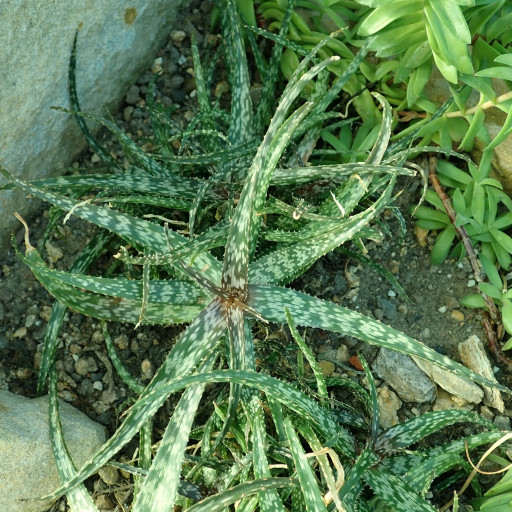
Plant Overview
Hailing from the rocky cliffs of Madagascar, Aloe bakeri—often called the Baker’s Aloe—is a pint-sized gem perfect for those who love the classic aloe look but lack the space for its giant cousins. This clumping succulent is prized for its "pincushion" growth habit, quickly filling small pots with a dense thicket of mottled, slender leaves. In the wild, it is a rare survivor, making it a special addition to any indoor desert garden.
🔍 How to Identify
- 🌿 Slender Foliage: The leaves are much narrower than the common Aloe Vera, tapering to a fine point and growing only about 4 to 6 inches long.
- 🎨 Mottled Patterns: Look for deep green or reddish-bronze leaves heavily decorated with pale white spots and streaks, giving it a marbled appearance.
- 🌸 Bi-Colored Blooms: It produces striking, bell-shaped flowers that are typically a fiery orange-red at the base, fading into a soft yellow at the tips.
🏡 In Your Garden
- 🏜️ Drainage is Vital: Because it originated in rocky, well-drained crevices, this plant is highly sensitive to "wet feet." Use a gritty cactus mix and terracotta pots to help the roots breathe and prevent rot.
- ☀️ Light Stressing: While it thrives in bright, indirect light, a bit of direct morning sun will "stress" the plant in a healthy way, causing the green leaves to take on beautiful shades of reddish-brown and copper.
⚠️ Safety & Toxicity
- 🐾 Pet Warning: Like most members of the Aloe family, Aloe bakeri contains saponins. It is considered toxic to cats and dogs if ingested, potentially causing vomiting or lethargy.
- 👶 Prickly Edges: While the "teeth" along the leaf margins are relatively soft compared to larger species, they can still cause minor skin irritation or scratches on sensitive skin.
✨ Fun Fact
In its native habitat near Fort Dauphin, Madagascar, Aloe bakeri is considered an endangered species due to habitat loss. By growing one at home, you are helping to keep the lineage of this rare Madagascan treasure alive!

Detailed Care Instructions
| Humidity | Dry |
| Lighting | Full Sun |
| Difficulty | Medium |
| Temperature | 21°C - 35°C |
| Hardiness Zones | 10A - 11B |
To grow an Aloe Bakeri plant, you can follow these steps:
- Select a healthy Aloe Bakeri plant from a reliable nursery or garden center, or obtain a cutting from an existing plant.
- Choose a well-draining pot or container that is at least 4-6 inches deep with drainage holes at the bottom. A shallow but wide container works best for this plant.
- Fill the pot with a well-draining cactus or succulent soil mix. You can also create your own mix by combining regular potting soil with sand or perlite for better drainage.
- If you have a cutting, allow it to callous for a day or two. This can be done by leaving the cut end exposed to air, which helps prevent rotting.
- Plant the Aloe Bakeri cutting or plant so that the base of the plant is level with or slightly above the soil surface. Gently firm the soil around the plant, but avoid compacting it too much.
- Place the potted plant in a location that receives bright, indirect sunlight. A south or west-facing window is ideal. Avoid placing it in direct sunlight, as it can scorch the leaves.
- Water the plant sparingly, allowing the soil to dry out between waterings. Overwatering can lead to root rot, which is a common issue with Aloe plants. Water deeply and then let the excess water drain out completely.
- Aloe Bakeri thrives in a warm environment with temperatures between 60-80°F (15-27°C). Protect the plant from temperatures below 50°F (10°C) as it is sensitive to cold.
- Fertilize the plant sparingly, using a balanced, water-soluble fertilizer specifically formulated for cacti or succulents. Follow the instructions on the fertilizer package for proper application.
- Trim off any dead or damaged leaves using clean scissors or pruning shears. This helps maintain the plant's appearance and health.
With proper care and attention, your Aloe Bakeri plant should grow well and provide you with its beautiful spiky leaves and occasional flowers.

Place in a window with dappled sun or a spot in the middle of a room. Or directly in a window facing west or east.

1. Determine the watering needs of your plant: Aloe bakeri requires moderate watering in well-draining soil.
2. Check the moisture level of the soil: Before watering your plant, stick your finger into the soil up to your second knuckle. If the soil feels dry, it's time to water. If it's still moist, wait a few more days before checking again.
3. Water thoroughly: When you do water your plant, water it thoroughly until water comes out of the drainage holes in the bottom of the pot. This ensures that the entire root system is hydrated.
4. Let the soil dry out: Allow the soil to dry out completely before watering again. Aloe bakeri does not like to sit in wet soil, so be sure to let the soil dry out for a few days before watering again.
5. Avoid overwatering: Overwatering can lead to root rot and other problems. Always err on the side of underwatering rather than overwatering.
6. Water less in the winter: Aloe bakeri is dormant in the winter, so you should water less frequently during this time. Only water when the soil is completely dry.
7. Use room temperature water: Aloe bakeri prefers room temperature water, so avoid using cold water straight from the tap. Instead, fill up a watering can and let it sit at room temperature for a few hours before watering your plant.
To fertilize this plant, use a balanced fertilizer with an N-P-K ratio of 10-10-10. Apply the fertilizer once a month during the growing season, from spring to fall. Be careful not to over-fertilize as it can damage the roots. Water the plant before fertilizing to avoid burning the leaves.
The ideal soil for Aloe Bakeri plant would be a well-draining soil mix that is slightly acidic and has moderate nutrient content. The soil should primarily consist of sand and a small amount of organic matter for moisture retention and nutrient availability. It should not hold excess amounts of water or become waterlogged as this can cause root rot and other issues. The soil pH should be between 5.5 and 7.5. It is also recommended to add perlite or coarse sand to the soil to improve the drainage. Avoid using heavy soils like clayey soils or soils with high salt levels, as they can affect the plant's growth and cause damage to the roots.
Aloe Bakeri plant can be propagated through two methods - by dividing the offsets or by planting the stem cuttings.
- Propagation by dividing offsets:
- Determine if the plant has produced any offsets. These are small plantlets that grow at the base of the mother plant.
- Wait until the offset is large enough and has a few leaves of its own.
- Carefully dig around the offset, taking care not to damage the roots of the mother plant.
- Gently pull the offset away from the mother plant.
- Plant the offset in a well-draining potting mix.
- Water thoroughly and place in a bright location with indirect sunlight.
- Propagation by stem cuttings:
- Choose a healthy stem that is at least 4 inches long.
- Cut just below a leaf node with a sterile, sharp knife.
- Place the cutting in a cool, dry location for a few days to allow it to callus over.
- Once calloused, plant the cutting in a well-draining potting mix.
- Water thoroughly and place in a bright location with indirect sunlight.
Both methods of propagation can take several weeks to several months for the new plant to develop strong roots and establish itself. Ensure the soil is moist but not waterlogged while waiting for the new plant to take root.








