Plant Overview
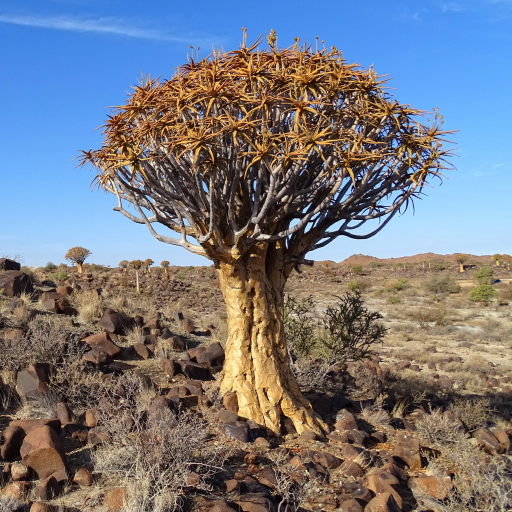
Known as the "Quiver Tree" or Kokerboom, this iconic succulent is a living monument of the Namib Desert. More of a tree than a simple garden plant, it stands as a sentinel in some of the harshest environments on Earth, living for over 200 years. Its striking, architectural silhouette has made it a symbol of resilience and a favorite for high-end xeriscaping.
🔍 How to Identify
- 🌵 Branching Pattern: The species name dichotoma refers to its "forked" growth; the branches consistently split into two, creating a perfectly rounded, umbrella-like canopy over time.
- ✨ Golden Bark: The trunk is covered in beautiful, yellowish-white scales that look like peeling parchment. These scales help reflect intense sunlight to keep the plant cool.
- 🍃 Fleshy Rosettes: At the tip of every branch sits a rosette of blue-green, sword-shaped leaves. These leaves are thick and succulent, designed to store water for months of drought.
🏡 In Your Garden
- ☀️ The Sun Seeker: This plant is an obligate sun-lover. It requires the brightest possible light to maintain its structural integrity. If grown indoors or in shade, the branches will become weak and may eventually collapse under their own weight.
- 🪨 Mineral Soil: In the wild, it grows on rocky "koppies" (hills). It hates "wet feet" and will rot quickly in standard potting soil. It needs a very gritty, fast-draining mineral mix—think more crushed rock and sand than organic peat.
- 💧 Strategic Neglect: Because it stores water in its massive trunk, it is incredibly drought-tolerant. Only water when the soil is bone-dry throughout; in winter, it enters a dormant phase and requires almost no water at all.
⚠️ Safety & Toxicity
- 🐾 Pet Safety: Like many Aloe species, the sap contains aloin, which is mildly toxic to cats and dogs. If ingested, it can cause vomiting or lethargy.
- 👶 Human Caution: While the sap isn't typically dangerous to touch, it should not be consumed. The serrated edges of the leaves and the sharp, peeling bark can also cause minor scratches to sensitive skin.
✨ Fun Fact
The common name "Quiver Tree" isn't just a nickname—the indigenous San people of Southern Africa would hollow out the soft, fibrous centers of the branches to create lightweight, durable quivers for their hunting arrows.

Detailed Care Instructions
To successfully grow an Aloe Dichotoma plant, also known as the Quiver Tree or Kokerboom, follow these steps:
- Choose the right location: Aloe Dichotoma plants thrive in hot, arid climates, preferably with full sun exposure. Ensure that the plant will receive at least six hours of direct sunlight per day.
- Select a well-draining soil: The plant prefers sandy or rocky soil with excellent drainage. Avoid heavy clay or waterlogged soils as they may cause root rot.
- Planting: Dig a hole slightly larger than the root ball of the Aloe Dichotoma plant. Place the root ball in the hole and backfill with soil, ensuring that the plant is positioned upright and the top of the root ball is level with the surrounding soil.
- Watering: Aloe Dichotoma plants are drought-tolerant but require some water during the growing season. Water deeply but infrequently, allowing the soil to dry out between waterings. In winter, reduce watering to prevent root rot.
- Fertilization: Aloe Dichotoma plants generally do not require regular fertilization. However, if desired, you can provide a diluted, balanced fertilizer once or twice during the growing season.
- Pruning: Minimal pruning is needed for Aloe Dichotoma plants. Remove any dead or damaged leaves or branches as necessary, but avoid excessive pruning, which may disrupt the plant's natural growth habit.
- Protection from frost: Aloe Dichotoma plants are not frost-resistant. If you live in a region with frosty winters, it's important to protect the plant by providing a frost cover or moving it indoors during freezing temperatures.
- Propagation: Aloe Dichotoma plants can be propagated from seeds or cuttings. Seeds require a warm, well-draining seed-starting mix to germinate, while cuttings should be taken from the base of the plant and allowed to callus before being planted in a suitable growing medium.
Remember, Aloe Dichotoma plants are slow-growing and may take several years to reach their full size. Patience and proper care are key to successfully growing this unique and beautiful plant.

Place in a bright room that is sun drenched almost all day. Or directly in a south-facing window.

To water this plant, it is best to wait until the soil has completely dried out before watering again. It is important not to let the plant sit in standing water or the roots may rot. When watering, pour water slowly onto the soil until it begins to drain out of the bottom of the pot. Allow the excess water to drain away, and then empty any remaining water from the saucer underneath the pot. It is recommended to water this plant sparingly, about once a month, as it is native to arid environments and can withstand drought. Overwatering can cause damage to the plant and should be avoided.
To fertilize this plant, mix a well-balanced, water-soluble fertilizer in water to a dilution of half the recommended strength. Water the plant with the fertilizer solution once every 3-4 weeks during the growing season. Avoid over-fertilizing as it can cause damage to the plant. Additionally, make sure the soil is moist and never let it dry out completely.
Aloe plants need well-draining soil to avoid waterlogging and root rot. Garden soil should be avoided as it can become too compact. A mixture of sand, perlite, and peat moss or coconut coir is a good option, as it allows for proper drainage while also retaining some moisture for the plant. It is also essential to use a container with drainage holes to ensure excess water can escape.
A plant propagation technique for a succulent plant can be done by dividing a mature plant. To propagate the plant, choose a mature Aloe Dichotoma which has grown for at least three years. Select a healthy stem and cut it with a sharp knife, making sure there is enough stem and roots. Place the cutting in a well-draining potting mix and press down firmly so it can stand upright. Allow the cutting to dry out in a warm, bright area and avoid water for a day or two. Once the cutting has developed roots, water sparingly and wait for it to grow and develop before transferring to a permanent location.
Common pests of the quiver tree include Mealybugs, thrips. Make a habit of checking your quiver tree frequently for pests so that any infestations can be caught and managed early.








