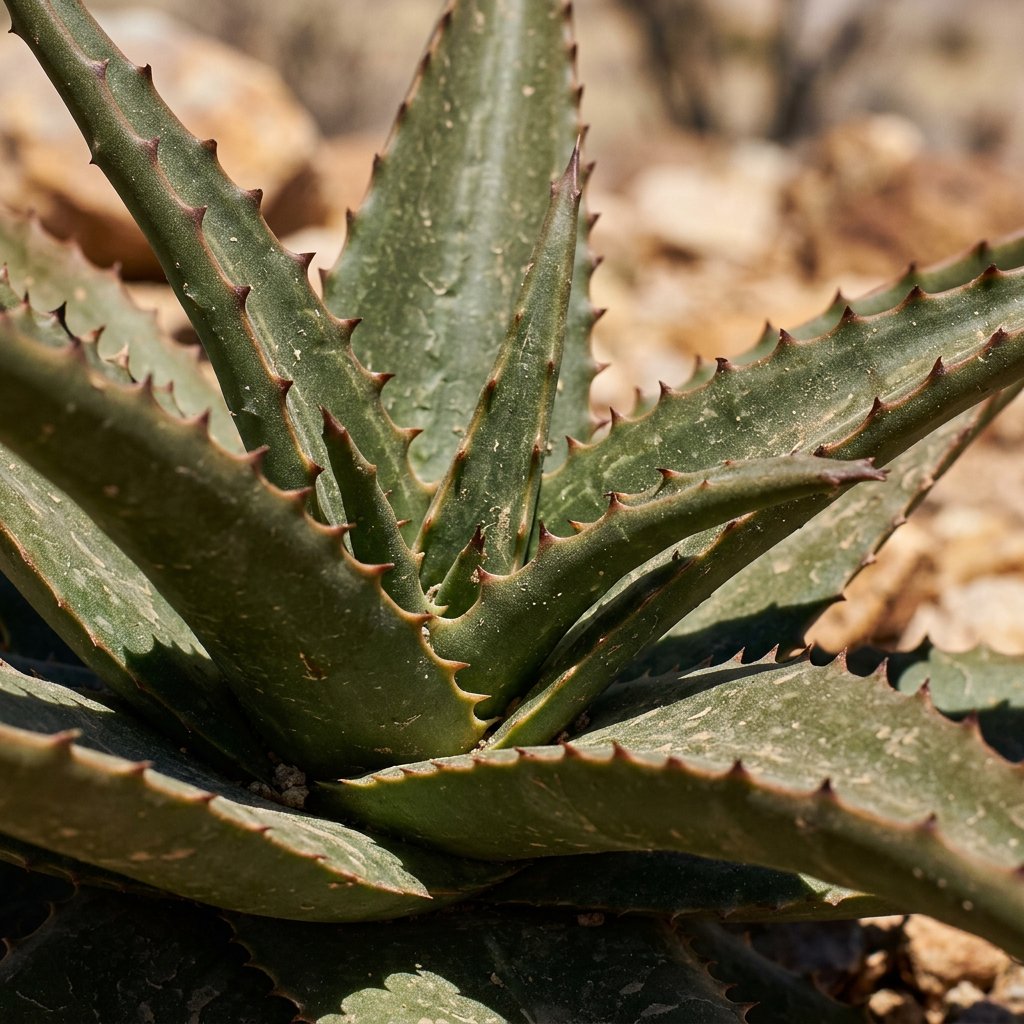
Plant Overview
Often called the Massawa Aloe, this rare beauty hails from the sandy shores of Eritrea and the Horn of Africa. Unlike its more famous desert cousins, it has adapted to breathe the salty air of the Red Sea, making it a "living treasure" of the African coastline. It is a striking, clumping succulent that brings a touch of rugged, coastal elegance to any plant collection.
🔍 How to Identify
- 🌿 The Foliage: Fleshy, sword-shaped leaves that are usually a pale grey-green. In their youth, these leaves are often decorated with striking white spots that usually fade as the plant reaches maturity.
- 🦷 The Margins: The edges of the leaves are lined with small, firm, pale teeth. They are prickly to the touch but generally less aggressive than the jagged spikes found on larger Aloe species.
- 🌺 The Flowers: It produces impressive, branched flower stalks carrying clusters of tubular, orange-to-red blossoms. These flowers are specifically shaped to welcome the beaks of nectar-seeking birds.
🏡 In Your Garden
- 🏖️ Coastal Resilience: Because it originates from coastal dunes, it is surprisingly tolerant of salt spray. This makes it a perfect choice for seaside gardens where other succulents might struggle with the briny air.
- 🪴 The Clumping Habit: This Aloe loves to "sucker," meaning it will produce small "pups" at its base. Over time, it forms a beautiful, dense colony that can serve as a structural groundcover or a full, lush potted display.
- 🏜️ Soil Nuance: While it enjoys a bit more humidity than mountain-dwelling Aloes, its roots are highly sensitive to "wet feet." It requires a very gritty, sandy potting mix to mimic its native shoreline habitat and prevent root rot.
⚠️ Safety & Toxicity
- 🐾 Mildly Toxic: Like many members of the Aloe family, Aloe massawana contains saponins and anthraquinones.
- 👶 Details: If ingested by curious pets or children, it can cause digestive upset, including vomiting or diarrhea. The yellow sap (latex) found just under the skin can also be a mild skin irritant for those with sensitive skin.
✨ Fun Fact
- 🌍 An Endangered Legacy: In its native habitat, Aloe massawana is increasingly rare and is currently listed as an endangered species. By cultivating this plant at home, you are helping to maintain the genetic legacy of a species that is slowly disappearing from the wild African dunes!

Detailed Care Instructions
To grow Aloe Massawana plant, follow these steps:
- Choose the right location: Aloe Massawana plants thrive in bright, indirect sunlight. Find a spot indoors or outdoors that receives bright light but is protected from direct sunlight.
- Prepare the soil: Use well-draining soil mix like cactus or succulent potting mix. Aloe Massawana plants prefer slightly acidic soil with a pH of 6.0 to 7.0.
- Select a container: Choose a shallow and wide container with drainage holes at the bottom. This will help prevent water from accumulating and causing root rot.
- Planting: Gently remove the Aloe Massawana plant from its nursery pot and place it into the new container. Make sure to position it at the same depth it was originally growing.
- Watering: Aloe Massawana plants are drought-tolerant and prefer dry conditions. Water the plant thoroughly when the top inch of soil feels dry. Allow the excess water to drain away.
- Fertilizing: Feed your Aloe Massawana plant once a month during the growing season (spring to fall) with a balanced, diluted liquid fertilizer. Avoid fertilizing in winter when the plant is dormant.
- Temperature and humidity: Aloe Massawana plants prefer temperatures between 70-80°F (21-27°C) during the day and cooler temperatures around 55-60°F (13-16°C) at night. They can tolerate low humidity levels.
- Repotting: Repot your Aloe Massawana plant every 2-3 years to provide fresh soil and space for growth. Choose a slightly larger pot each time.
- Propagation: Aloe Massawana plants can be propagated through offsets or "pups" that grow from the base of the plant. Remove the offset and allow it to dry for a few days before planting it in a new container with well-draining soil.
- Pruning: Trim off any dead leaves or offsets to maintain the plant's appearance and prevent disease.
Remember to monitor your plant for any signs of pests or disease, and take appropriate measures to address them. With proper care, your Aloe Massawana plant should grow and thrive.

Place in a bright room that is sun drenched almost all day. Or directly in a south-facing window.

To water this plant, you should wait until the soil in the pot or container is completely dried out before giving it water. When it's time to water, gently pour water onto the soil, making sure not to get any water on the leaves. Allow the excess water to drain through the bottom of the pot, and then discard any water sitting in the drainage tray. Over-watering can cause roots to rot, so be sure to let the soil dry out between watering sessions.
To fertilize this plant, use a balanced fertilizer with equal parts nitrogen, phosphorus, and potassium. Dilute the fertilizer to half strength before applying it to the soil. Apply the fertilizer once during the growing season (spring or summer) and once in the fall. Water the plant thoroughly before and after fertilizing to avoid burn or damage to the roots. Keep the fertilizer away from the base of the plant to avoid burning the stem.
The suitable type of soil for Aloe Massawana is a well-draining soil that has good aeration. This plant cannot tolerate heavy, compacted, or waterlogged soils. The ideal soil should be slightly acidic to neutral with a pH range of 6.0 to 7.0. It should also be rich in organic matter. A mixture of perlite, sand, and peat moss can be used to achieve the right soil texture and consistency. The soil should be moist but not soaking wet. It is important to avoid using soil that has high levels of salts, as this can cause damage to the plant. It is recommended to use a cactus or succulent mix soil for best results.
To propagate this plant, follow these steps:
- Choose a healthy parent plant with several offsets growing from its base.
- Prepare a clean and sharp cutting tool, such as a gardening knife or pruning shears.
- Cut the offsets as close to the main stem as possible, ensuring that each one has some root tissue attached.
- Allow the cuttings to dry for a day or two to form a callus. This helps prevent rotting when planted.
- Fill a well-draining pot or container with cactus or succulent soil mix.
- Plant the offsets, burying the root tissue and ensuring that the soil is firm around the base.
- Water the newly planted offsets only when the soil is completely dry.
- Keep the container in a protected area with bright, indirect sunlight, ensuring that the temperature stays between 60-80°F (15-27°C) for optimal growth.
- After a few weeks, the offsets should begin to root and develop new growth above the soil line.
- At this point, they can be transplanted into their own containers or grouped together in a larger pot.
With proper care, these Aloe Massawana plant cuttings should establish themselves and grow into mature plants.
Common pests of the aloe massawana include Mealybugs, thrips. Make a habit of checking your aloe massawana frequently for pests so that any infestations can be caught and managed early.








