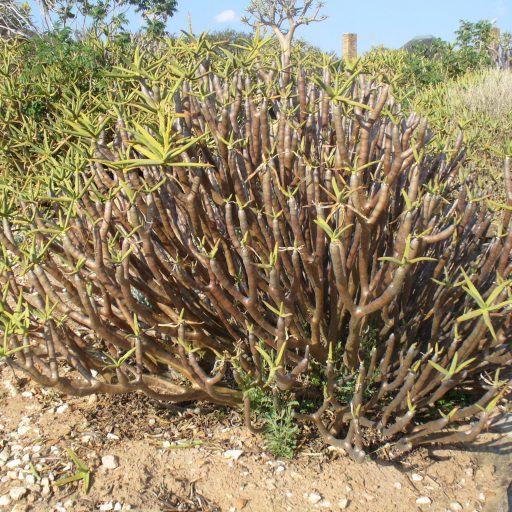
Plant Overview
The Maiden’s Quiver Tree looks like a living bonsai straight out of a prehistoric landscape. Native to the arid, rocky mountains of South Africa and Namibia, it is celebrated for its incredibly intricate, candelabra-like structure. While it is a close relative of the giant Quiver Tree, this species is much shorter and more densely branched, making it a prized "architectural" specimen for succulent collectors.
🔍 How to Identify
- 🌿 Dichotomous Branching: Its most famous trait; the stems divide repeatedly into perfect pairs, creating a dense, rounded, cauliflower-like canopy.
- 🍃 Succulent Foliage: Narrow, fleshy leaves that are blue-green to grayish-green, usually arranged in small rosettes at the very tips of the branches.
- 🥈 Waxy Bark: The trunk and branches are covered in a smooth, shimmering bark that ranges from pale yellow to silver, which helps reflect intense desert sunlight.
🏡 In Your Garden
- ☀️ Sun Worshiper: Having evolved in some of the harshest deserts on Earth, this plant requires intense, direct light. If grown indoors, it must sit in your brightest south-facing window to prevent the branches from stretching and weakening.
- 🏜️ Drainage is Non-Negotiable: It stores a massive amount of moisture in its woody trunk. To prevent root rot, it needs a gritty, mineral-heavy soil (like a cactus mix with extra pumice) and a pot with large drainage holes.
- 🐢 Slow and Steady: This is a slow-growing species that rewards the patient gardener. It focuses its energy on building a sturdy, woody "skeleton" rather than rapid height, making it an excellent long-term container plant.
⚠️ Safety & Toxicity
- 🐾 Pet Warning: Like many members of the Aloe family, it contains anthraquinones. If ingested by cats or dogs, it can cause tremors, vomiting, and digestive distress.
- 🚫 Not for First Aid: Unlike its famous cousin Aloe vera, the sap of the Quiver Tree is not meant for skin healing and can actually cause mild skin irritation or dermatitis in sensitive individuals.
✨ Fun Fact
🏹 Ancient Archery: The name "Quiver Tree" (Kokerboom) comes from the indigenous San people of Southern Africa. They would hollow out the soft, fibrous centers of the branches to create lightweight, durable quivers to hold their hunting arrows.

Detailed Care Instructions

Place in a bright room that is sun drenched almost all day. Or directly in a south-facing window.

To properly water this plant, you should allow the soil to dry out completely between waterings. When soil is dry down to about 2 inches, give your plant a good soak, allowing water to drain out the bottom of the pot. It is important not to let your plant sit in standing water. Water less frequently during the winter months when the plant is in a dormant state. Avoid over-watering as this can lead to root rot and ultimately kill the plant.
These plants can thrive without taking help from any fertilizer. However, if the medium of growth is something other than soil for instance sand then you may need to add little fertilizer. The best way to know if your plants need fertilizer or not is to check for yellowing of leaves. If the leaves start to turn yellow it’s fertilizing time.
You may use Cactus Fertilizer for your Maiden Quiver Tree
The most suitable soil for Aloe Ramosissima is one that is well-draining and can hold moisture but does not become waterlogged. It is recommended to use a mix of sand, perlite, and a small amount of peat moss. The pH level of the soil should be slightly acidic to neutral, around 6.0 - 7.0. Avoid using heavy clay soils or those with high fertility levels. The soil should be compacted just enough to hold the plant securely in place but should still be fluffy enough to allow air to circulate around the roots. It is important to choose soil that is free from pests and diseases to prevent the spread to the plant.
Common pests of the maiden quiver tree include Mealybugs, thrips. Make a habit of checking your maiden quiver tree frequently for pests so that any infestations can be caught and managed early.








