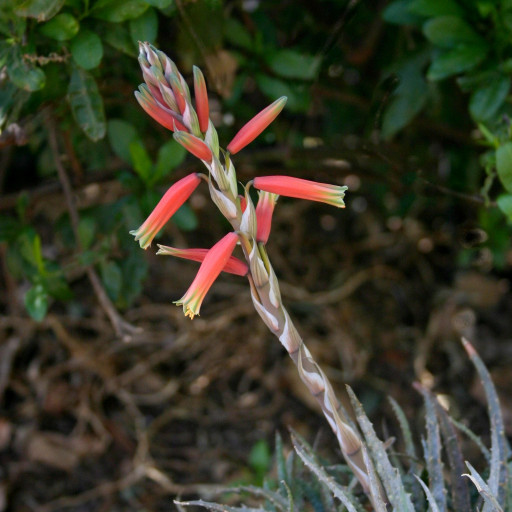
Plant Overview
Often called the Hedgehog Aloe due to its prickly-looking but soft-to-the-touch leaves, this South African native is a darling of the succulent world. It is small, spunky, and forms dense clusters that look like a gathering of tiny, blue-green sea creatures. Despite its "fierce" appearance, it is one of the most approachable and hardy Aloes for indoor growers and rock gardens.
🔍 How to Identify
- 🌵 Leaf Texture: The thick, triangular leaves are covered in distinct white bumps or "teeth" called tubercles, giving the plant a bumpy, tactile surface that looks sharp but is actually quite soft.
- 🎨 Color Palette: The foliage typically has a gorgeous glaucous (waxy) blue-green hue. When exposed to bright sun or cooler temperatures, the tips can take on a subtle reddish or purple "blush."
- 🌸 The Bloom: It produces surprisingly tall, slender flower stalks that tower over the foliage. These are topped with tubular, bright coral-orange blossoms that act as a magnet for pollinators.
🏡 In Your Garden
- 🏜️ Drainage is King: This Aloe has a shallow root system that is highly susceptible to rot. It thrives in gritty, sandy soil and actually prefers a terracotta pot, which helps the soil "breathe" and dry out between drinks.
- ☀️ Light Seekers: To keep its compact, tight rosette shape, it needs plenty of bright light. If the leaves start to flatten out or the center becomes pale and stretched, it is signaling a need for a sunnier windowsill.
- 👯 Clumping Habit: Unlike some plants that grow tall, the Hedgehog Aloe focuses on "pupping." It will naturally produce offsets around the base, eventually filling its container with a crowded family of mini-aloes.
⚠️ Safety & Toxicity
- 🐾 Pet Status: Toxic to cats and dogs. While the inner gel is famous for human skin use, the rind of the leaf contains compounds that are not safe for pets.
- 🤢 The Risk: If ingested by curious pets, it can cause vomiting, diarrhea, and lethargy. It is best placed on a high shelf or in a hanging planter if you have furry friends at home.
✨ Fun Fact
The species name humilis literally translates to "low" or "humble" in Latin. It was given this name because the plant stays close to the earth, rarely growing more than 5 inches tall, proving that you don't need to be a giant to stand out in the desert!

Detailed Care Instructions
To grow Aloe x Humilis plant, follow these steps:
- Choose a suitable pot or container: Select a well-draining pot or container with drainage holes at the bottom. Aloe x Humilis plants prefer slightly cramped conditions, so choose a pot that is just slightly larger than the plant's rootball.
- Soil: Use a well-draining soil mix specifically formulated for succulents or cacti. Alternatively, you can make your own by mixing equal parts of potting soil, sand, and perlite.
- Sunlight: Aloe x Humilis plants thrive in bright, indirect sunlight. Place the pot in a location where it receives bright light for at least 6 hours a day. Avoid exposing the plant to direct sun, especially during the hottest parts of the day, as it can cause sunburn.
- Watering: This plant is drought-tolerant, so it is important not to overwater it. Allow the soil to dry out almost completely between waterings, and then thoroughly soak the soil until water comes out of the drainage holes. During the winter months, reduce watering frequency.
- Temperature and humidity: Aloe x Humilis plants prefer temperatures between 60-80°F (15-27°C). They can tolerate lower temperatures but should be protected from frost. These plants enjoy low humidity levels, so ensure good air circulation to prevent rot.
- Fertilizer: Apply a balanced, water-soluble fertilizer specially formulated for succulents or cacti during the growing season (spring and summer). Follow the package instructions for dosage and frequency.
- Propagation: Aloe x Humilis plants can be propagated through offsets or "pups" that grow from the base of the plant. Carefully remove these offsets and plant them in separate pots using succulent soil mix. Allow the cut ends to dry for a day before planting to prevent rot.
- Maintenance: Remove any dead or withered leaves from the plant to maintain its appearance. It is also a good practice to repot the plant every 2-3 years to refresh the soil and provide more space for growth.
Remember to do some research specific to your location and climate to ensure optimal care for your Aloe x Humilis plant.

Place in a bright room that is sun drenched almost all day. Or directly in a south-facing window.

When watering this plant, one should take care not to provide too much moisture at once. The soil should be allowed to dry out slightly before watering again, typically every 1-2 weeks. When watering, pour water slowly and evenly over the soil surface and avoid getting water on the leaves of the plant. It is best to use a well-draining soil mixture and a pot with drainage holes to prevent waterlogging. During the winter months, the plant will require less frequent watering as it enters a dormant period.
- Choose a high-quality, balanced fertilizer with ratios of nitrogen, phosphorus, and potassium (N-P-K) of approximately 10-10-10 or 20-20-20.
- Mix the fertilizer with water according to the instructions on the package, and dilute it to half-strength.
- Apply the fertilizer to the soil around the base of the plant, avoiding the leaves and stem.
- Water the plant thoroughly immediately after fertilizing to help the fertilizer reach the roots.
- Repeat the fertilization process every 3-4 months during the growing season (typically spring and summer), but avoid fertilizing during the dormant season.
- Monitor the plant closely for any signs of over-fertilization, such as yellowing or wilting leaves, and adjust the fertilizer application rate accordingly.
The ideal soil for the Aloe X Humilis plant should be a well-draining mixture with good porosity. It should contain a blend of organic matter such as peat moss and coarse sand or perlite to improve aeration and drainage. The pH of the soil should be slightly acidic to neutral, ranging from 6.0 to 7.0. The plant requires a soil mix that is well-draining, as overwatering can lead to root rot. Soil that is too heavy or compact can also cause water to collect, so it is best to use a loose and sandy soil. A soil mix that is low in nutrients is ideal, as the plant does not require a lot of added fertilizers. A mix that is free of pests and diseases is also necessary to ensure the plant stays healthy.
To propagate this plant, you should begin by selecting mature and healthy leaves from the parent plant. Using a clean, sharp knife, cut the leaves off at the base and let them dry for several days. Once the leaves have dried, they can be planted in a well-draining soil mix in a small container with the cut end facing down. Water the soil well and place the container in a warm, brightly lit location, such as a sunny windowsill. Over time, new roots should begin to grow from the cut end of the leaf, and a new plant will eventually emerge. Be sure to water the new plant sparingly until it has become established in its new pot.







