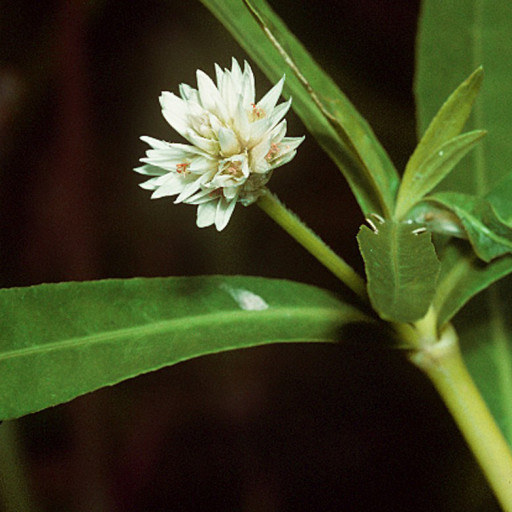
Plant Overview
Often called "Alligator Weed," this South American native is a master of adaptation, living comfortably both floating on water and rooted on land. While its white, pom-pom flowers look innocent, it is widely considered one of the world’s most resilient aquatic invaders. It is a "biological hitchhiker" that can transform a clear pond into a dense, impenetrable green mat in just a single growing season.
🔍 How to Identify
- 🌿 The Stems: They are reddish-green and uniquely hollow, acting like built-in life jackets that allow the plant to float effortlessly on the water's surface.
- 🍃 Leaf Pattern: The leaves are smooth, spear-shaped, and grow in symmetrical, opposite pairs along the stem, often with a distinct mid-vein.
- ⚪ The Bloom: Look for small, white, papery flower heads that resemble clover. These "balls" of flowers sit on short stalks that grow from the area where the leaf meets the stem.
🏡 In Your Garden
- 💧 The Uninvited Guest: If you find this in your backyard pond or damp soil, it likely arrived via water runoff or contaminated mulch. It thrives in high-nutrient environments and is incredibly difficult to discourage once it establishes its root system.
- ✂️ Resilience through Fragmentation: Be extremely careful if you attempt to remove it. Because the plant grows from "nodes," a single tiny fragment accidentally dropped or left in the mud can regenerate into an entirely new colony within weeks.
⚠️ Safety & Toxicity
- 🟢 General Safety: Alligator Weed is not known to be toxic to humans or pets upon contact. It does not have thorns or stinging hairs.
- 🚫 Environmental Risk: Its primary danger is "ecological." It chokes out native plants, depletes oxygen levels in water (which can kill fish), and creates stagnant pools that become perfect breeding grounds for mosquitoes.
- 🌾 Livestock Note: While not inherently poisonous, it is generally avoided by grazing animals and provides very little nutritional value compared to native grasses.
✨ Fun Fact
Alligator Weed is a master of cloning! In many parts of the world where it is invasive, the plant almost never produces viable seeds. Instead, it has conquered entire continents simply by breaking into pieces and drifting to new homes.

Detailed Care Instructions
| Lighting | Full Sun |
| Hardiness Zones | 7A - 10B |
To grow Alternanthera philoxeroides, commonly known as alligator weed, you can follow these steps:
- Choose a suitable location: Alligator weed requires full sun to grow well. Ensure that the planting area receives at least 6-8 hours of direct sunlight each day.
- Prepare the soil: Before planting, prepare the soil by making it loose and well-drained. Remove any weeds, rocks, or debris from the area.
- Planting options: You have two options for planting alligator weed:
- Option 1: Purchase well-established plants from a nursery or garden center. Dig a hole slightly larger than the root ball of the plant, place the plant in the hole, and backfill it with soil. Tamp down gently around the plant to ensure good soil-to-root contact.
- Option 2: Propagate the plant from cuttings. Take a 4-6 inch stem cutting from a healthy alligator weed plant. Strip the lower leaves and place the cutting in a glass of water. After some weeks, roots will start to grow. Plant the rooted cutting in the prepared soil.
- Option 1: Purchase well-established plants from a nursery or garden center. Dig a hole slightly larger than the root ball of the plant, place the plant in the hole, and backfill it with soil. Tamp down gently around the plant to ensure good soil-to-root contact.
- Watering: Alligator weed requires consistently moist soil, particularly during the growing season. Water the plant deeply but infrequently, allowing the topsoil to dry out slightly between waterings. Avoid overwatering to prevent root rot.
- Fertilization: Prior to planting, amend the soil with organic matter like compost or aged manure to enhance its fertility. You can also apply a balanced slow-release fertilizer during the growing season, following the package instructions for application rates.
- Pruning: To promote healthy growth, you can occasionally prune the plant by trimming back any leggy or overgrown branches. This will help maintain a more compact and bushy shape.
- Mulching: Apply a layer of organic mulch around the base of the plant to help conserve soil moisture, reduce weed growth, and maintain a more stable temperature for the roots.
- Care and maintenance: Regularly monitor the plant for pests or diseases, and treat them promptly if detected. Remove any weeds that may compete for nutrients and space. Provide support or staking if the alligator weed becomes top-heavy.
Remember to follow your local regulations and guidelines regarding the cultivation of alligator weed, as it can be considered invasive in some regions.

Place in a bright room that is sun drenched almost all day. Or directly in a south-facing window.

To water this plant, first, you'll want to check the soil for moisture. Stick your finger about an inch into the soil to see if it feels dry or still has some moisture. If it's dry, give the plant a good watering, making sure to soak the soil evenly. If it still has some moisture, wait a few more days and check again. When watering, be sure to avoid getting water on the leaves as this can cause damage or disease. Additionally, it's important to never let the plant sit in standing water as this can lead to root rot. Always allow the soil to drain completely before replacing the plant's saucer or placing it back in its holder.
To properly fertilize this plant, it is recommended to use a balanced fertilizer with equal parts nitrogen, phosphorus, and potassium. Apply the fertilizer once a month during the growing season, which generally occurs during the spring and summer months. Dilute the fertilizer according to the instructions on the label and apply it to the soil around the plant's base. Do not apply the fertilizer directly to the leaves or stems as it may cause damage. It is also important to ensure the plant is receiving adequate water and sunlight to promote healthy growth.
The ideal soil for the plant should be rich in essential nutrients and have good drainage properties. It should have a pH level between 6.0 to 7.5. The soil should be well-aerated to allow oxygen to reach the roots. A mix of equal parts of sand, loam, and peat moss can be an appropriate soil type for the plant. It can also be grown in a hydroponic system using a nutrient-rich solution. The soil should not be too moist as it can lead to root rot. Mulching with organic materials can help retain moisture in the soil and prevent weed growth. Adding fertilizers, such as nitrogen, phosphorus, and potassium, can promote healthy growth of the plant. It is recommended to test the soil before planting to ensure that it meets the plant's requirements.
To propagate the plant, locate a healthy and mature specimen and take a stem cutting that is approximately 4-6 inches in length. Remove the lower leaves from the cutting and dip the cut end into rooting hormone. Plant the cutting into a well-draining soil mix and water it thoroughly. Place the pot in a bright location, but out of direct sunlight. Over the next few weeks, keep the soil moist and watch for new growth. Once new growth appears, you can transplant the cutting into a larger pot or into the ground.








