Plant Overview
Often mistaken for hemp at a distance due to its distinct leaf shape, Althaea cannabina—commonly known as the Hemp-leaved Hollyhock—is actually a tall, graceful perennial from the mallow family. Native to the sun-soaked regions of Southern Europe and the Mediterranean, it is a favorite for "prairie-style" gardens because of its airy, see-through structure. It brings a touch of wild, architectural elegance to any landscape, standing tall like a flowery veil.
🔍 How to Identify
- 🍃 The Leaves: As the name suggests, the leaves are deeply divided into five narrow, toothy lobes, bearing a striking resemblance to the foliage of Cannabis.
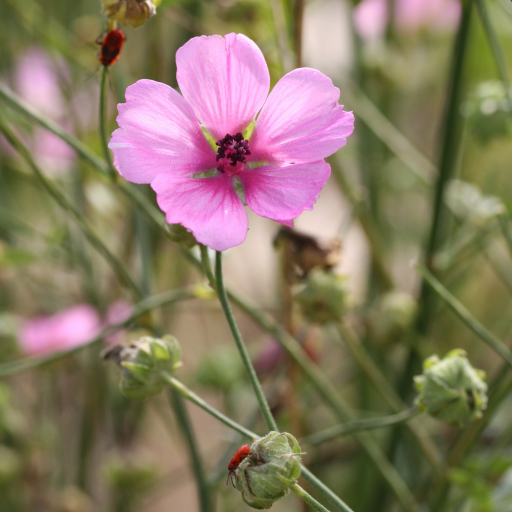
- 🌸 The Flowers: Unlike the massive blooms of common hollyhocks, these are dainty, cup-shaped, and about 1-2 inches wide. They are typically a soft lavender-pink with a dark magenta "eye" at the center.
- 📏 The Stature: It is a giant of the garden, often reaching 6 to 7 feet in height. Despite its height, the stems are slender, tough, and greyish-green, giving it a light, wiry appearance rather than a bulky one.
🏡 In Your Garden
- ☀️ Sun & Soil Nuance: This plant thrives on neglect in well-drained, "lean" soil. If the soil is too rich or over-fertilized, the stems may become floppy and lose their self-supporting strength.
- 🐝 Pollinator Magnet: Because the flowers bloom along the entire length of the upper stems from mid-summer into autumn, it provides a long-lasting buffet for bees and butterflies who can easily access the open nectar cups.
- ✂️ Low Maintenance: Unlike many tall perennials, it rarely needs staking because the stems are incredibly fibrous and flexible, swaying beautifully in the wind without snapping.
⚠️ Safety & Toxicity
- ✅ Status: Generally considered non-toxic and safe.
- 🐶 Details: There are no known toxic effects for dogs, cats, or horses. However, like many plants in the Malvaceae family, the leaves can sometimes have tiny, stiff hairs that might cause mild skin irritation for people with very sensitive skin if handled roughly.
✨ Fun Fact
Historically, the stems of this plant were used to produce high-quality fibers for making paper and rope, much like true hemp. This dual-purpose history as both a decorative flower and a textile resource is why it earned its botanical name, cannabina.

Detailed Care Instructions
To grow Althaea cannabina (also known as hollyhock mallow or lavatera), you can follow these steps:
- Choose the Right Location: Althaea cannabina prefers full sun to partial shade. Select a spot in your garden that receives at least 6 hours of direct sunlight per day.
- Prepare the Soil: Ensure that the soil is well-draining, loose, and fertile. If your garden soil is heavy clay, consider amending it with organic matter like compost or well-rotted manure to improve drainage.
- Sow Seeds: Althaea cannabina can be grown from seeds. Sow the seeds directly in the ground in spring or early summer after the danger of frost has passed. Alternatively, you can start the seeds indoors 6-8 weeks before the last frost date and then transplant them outdoors after all frost has passed.
- Watering: Keep the soil consistently moist, especially during dry periods. Water the plants deeply, ensuring that the water reaches the root zone. However, do not overwater, as this can lead to root rot.
- Fertilization: Apply a balanced, slow-release fertilizer to the soil before planting. You can also provide additional fertilization throughout the growing season with a water-soluble fertilizer, following the manufacturer's instructions.
- Mulching: Mulch around the base of the plants to help conserve moisture, suppress weed growth, and maintain an even temperature in the soil.
- Support: Althaea cannabina can reach heights of 4-6 feet, so providing support such as stakes or a trellis can help keep the plants upright and prevent them from bending or breaking.
- Pruning: Regularly pinch or prune the tips of the stems to encourage bushier growth and more flower production. Deadhead spent flowers to prolong the blooming period.
- Pest and Disease Control: Inspect your plants regularly for pests, like aphids or slugs, and take appropriate measures to control them. Monitor for common diseases like powdery mildew, and if detected, treat following the appropriate measures for control.
- Harvesting: Althaea cannabina produces attractive flowers in a variety of colors. You can harvest the flowers when they are fully open for floral arrangements or to dry them for crafts.
By following these steps, you should be able to successfully grow Althaea cannabina in your garden.

Place in a bright room that is sun drenched almost all day. Or directly in a south-facing window.

To water the plant in question, first ensure that the soil is partially dry before watering. Then, slowly water the plant at the base, avoiding wetting the leaves as this can lead to disease. Allow the water to fully drain out of the soil before placing the plant back in its desired location. Be cautious not to overwater the plant, as this can lead to root rot and cause damage to the plant's overall health.
To fertilize this plant, use a balanced fertilizer with equal amounts of nitrogen, phosphorus, and potassium. Apply the fertilizer in early spring or summer, when the plant is actively growing. Spread the fertilizer evenly around the base of the plant and water thoroughly. Do not over-fertilize, as this can damage the roots of the plant.
Althaea Cannabina plant prefers soil that is rich in nutrients and well-draining. A mix of loamy soil, sand and organic matter such as compost or peat moss is usually recommended. The soil pH level should range between 6.0-7.5 for optimal growth and health. It is important to ensure that the soil is moist but not waterlogged, as excessive moisture can lead to root rot. Additionally, a layer of mulch can be added to retain soil moisture and keep the plant cool during hot and dry conditions. The plant is generally adaptable to different soil types and can thrive in a variety of growing conditions.
Althaea cannabina can be propagated through a process called stem cuttings. Start by selecting a healthy mature stem with at least two nodes and cut it at a 45-degree angle just below the node. Remove any leaves from the bottom one-third of the stem. Dip the cut end into rooting hormone and plant it in a pot with well-draining soil. Keep the soil moist and place the pot in an area with indirect sunlight. After a few weeks, the cutting should start to develop roots. Once the roots have established, transfer the plant to a bigger pot or into the ground.








