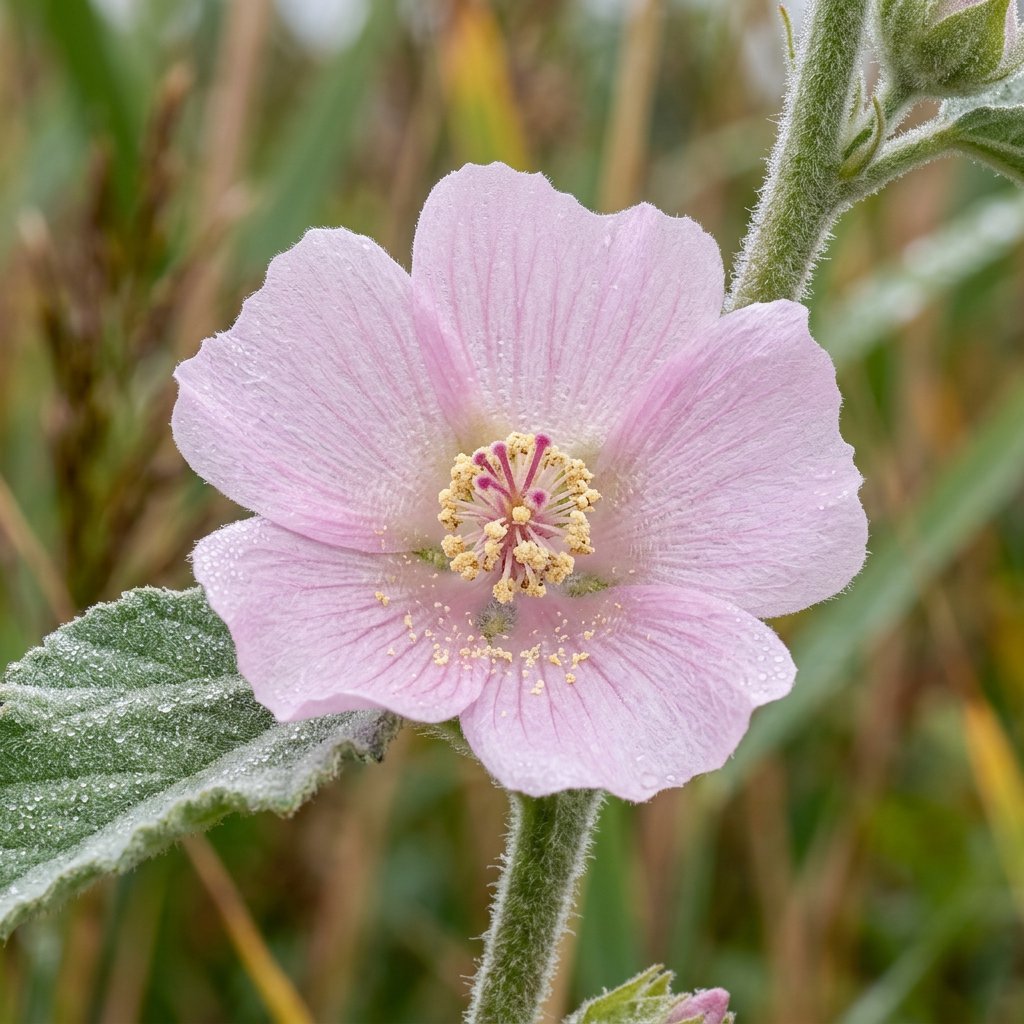
Plant Overview
Known widely as the Marsh-Mallow, this soft-textured perennial is the true ancestor of the puffy white treats we roast over campfires today. Native to the damp regions of Europe and North Africa, it has been revered for centuries as both a vital healing herb and a "famine food" used to sustain people when crops failed. It brings a touch of ancient herbalism and elegant, wild beauty to any landscape.
🔍 How to Identify
- 🌸 The Bloom: Look for delicate, five-petaled flowers that are pale pink or white. They feature a distinct central column of violet-colored stamens, making them look like a miniature, more refined version of a Hibiscus.
- 🍃 The Velvet Touch: The heart-shaped or lobed leaves are covered in a dense layer of fine, tiny hairs. This gives the foliage a unique silvery-green hue and a texture that feels exactly like soft felt or velvet.
- 📏 Upright Growth: It grows in stately, unbranched clumps, typically reaching heights of 3 to 4 feet. The stems are sturdy and covered in the same velvety fuzz as the leaves.
🏡 In Your Garden
- 💧 Moisture Lover: True to its name, this plant thrives in "marshy" conditions. It is an ideal choice for rain gardens, the edges of ponds, or any low-lying spot in your yard where the soil stays consistently damp.
- 🌱 The Taproot Secret: The plant develops a very long, thick, and fleshy taproot. Because of this deep-reaching anchor, it is notoriously difficult to transplant once it becomes established. It is best to pick a "forever home" for it right from the start.
- 🐝 Pollinator Buffet: While humans love its history, bees and butterflies love its nectar. It is a fantastic addition to a "wildlife garden" designed to support local insect populations.
⚠️ Safety & Toxicity
- ✅ Generally Safe: Althaea officinalis is considered non-toxic to humans, cats, and dogs. In fact, many parts of the plant are traditionally used in herbal teas and salves.
- 💊 Medication Note: Because the root is high in "mucilage" (a sticky, gel-like substance), it can potentially slow down the absorption of oral medications. If you are using it as a supplement, it is best to consult a professional and consume it at a different time than your prescriptions.
✨ Fun Fact
The original "marshmallow" wasn't a sugary foam! Ancient Egyptians squeezed the sap from the Marsh-mallow root, mixed it with honey and nuts, and cooked it down to create a sticky, medicinal candy reserved exclusively for royalty and the gods.

Detailed Care Instructions
The plant is sometimes confused with two other plants, the common mallow (Malva sylvestris) and tree mallow (Lavatera). Unlike common mallow, marsh mallow has multiple stems, fuzzy down on its stems and foliage, and blush-colored flowers. Marsh mallow flowers are smaller, paler, and more numerous than the common mallow. Lavatera's flowers are a bright shade of cotton candy pink and the leaves are spiky.
How do I harvest marsh mallow roots?
They can be harvested in the late fall after the plant has gone dormant. Remove the roots you'll need for your purposes, then replant the crown because the plant can continue to grow. Be sure not to harvest roots from plants that are younger than two years old.
Is marsh mallow plant invasive?
Marsh mallow plants reseed themselves, yet are not considered invasive. You might see them growing along a marshy roadside or in a meadow, and sometimes a volunteer will pop up in a home garden.
To grow Althaea officinalis, also known as marshmallow plant, you can follow these steps:
- Seeds or seedlings: Obtain marshmallow plant seeds or seedlings from a reputable nursery or online supplier. Seeds are usually sown in early spring, while seedlings can be planted in early to mid-spring.
- Site selection: Choose a location that receives full sun to partial shade. The soil should be well-draining and slightly acidic with a pH of around 6.0-7.5.
- Soil preparation: Prepare the soil by removing weeds, rocks, and debris. Loosen the soil with a garden fork or tiller and amend it with organic matter such as compost or well-rotted manure to improve drainage and fertility.
- Sowing seeds or planting seedlings:
- For seeds: Sow the seeds directly into the prepared soil, about ¼ inch (6 mm) deep. Space the seeds 8-12 inches (20-30 cm) apart and rows should be around 18-24 inches (45-60 cm) apart.
- For seedlings: Dig a hole large enough to accommodate the root ball of the seedling. Place the seedling into the hole, back-fill with soil, and gently firm it around the base of the plant.
- For seeds: Sow the seeds directly into the prepared soil, about ¼ inch (6 mm) deep. Space the seeds 8-12 inches (20-30 cm) apart and rows should be around 18-24 inches (45-60 cm) apart.
- Watering and moisture: Keep the soil consistently moist but not waterlogged during the growing season. Marshmallow plants prefer moist conditions like found in marshes or along stream banks. However, avoid overwatering, as it can lead to root rot.
- Mulching: Apply a layer of organic mulch, such as straw or wood chips, around the base of the plant. This helps to retain moisture, suppress weeds, and regulate soil temperature.
- Fertilization: Althaea officinalis does not typically require heavy fertilization. However, you can apply a balanced organic fertilizer in early spring and again in mid-summer to promote healthy growth.
- Pruning and maintenance: Trim off any dead, damaged, or diseased foliage as needed throughout the growing season. You may also cut back the plant after flowering to promote a second round of blooms.
- Harvesting: Wait until the plant reaches maturity, usually in its second or third year, before harvesting the roots. Harvest the roots in autumn by carefully digging them out with a garden fork.
Remember that the marshmallow plant is a perennial, meaning it will come back year after year. By providing proper care and maintenance, you can enjoy its medicinal benefits and attractive flowers for many years.

Place in a window with dappled sun or a spot in the middle of a room. Or directly in a window facing west or east.

This plant should be watered regularly but not excessively. One way to determine when to water is to check the soil moisture level by inserting a finger about an inch deep into the soil. If it feels dry, it's time to water. When watering, aim for the soil around the base of the plant, avoiding getting water directly on the leaves or flowers. It's best to use room temperature water rather than cold water straight from the tap. Be careful not to overwater, as this plant prefers well-draining soil and can be susceptible to root rot if conditions are too damp.
To fertilize this plant, use a balanced, slow-release fertilizer with equal parts nitrogen, phosphorous, and potassium. Apply the fertilizer in early spring before new growth appears, and again in mid-summer. Spread the fertilizer evenly around the base of the plant, and water thoroughly. Avoid over-fertilization, which can cause excessive foliage growth at the expense of flowers.
The optimal soil for the Althaea Officinalis plant should have good drainage and be rich in nutrients. It should be slightly acidic, with a pH range of 6.0 to 7.5. Sandy loam soil is the best soil type for this plant, as it allows water to flow freely and also holds nutrients in the soil. Additionally, the soil should not be too compact, as this can hinder the growth of the plant's roots. It is recommended to incorporate organic matter into the soil to improve its structure and fertility. Examples of organic matter that can be added include compost, leaf litter, and well-rotted manure. Finally, the soil should be kept moist but not waterlogged to prevent root rot.
- Cut a stem of the plant from the main shoot that is at least 10 cm long.
- Remove any leaves from the bottom of the stem.
- Make a diagonal cut at the bottom of the stem.
- Dip the cut end of the stem in rooting hormone.
- Plant the stem in a pot of damp, well-draining soil.
- Cover the pot with a plastic bag to create a greenhouse-like environment.
- Place the pot in a warm, brightly-lit area but avoid direct sunlight.
- Monitor the soil moisture and mist the plant with water if necessary.
- After a few weeks, roots should begin to form.
- Once the new plant has established a healthy root system, transplant it to a permanent location.
Common pests of the marshmallow include Spider mites, aphids, thrips. Make a habit of checking your marshmallow frequently for pests so that any infestations can be caught and managed early.








