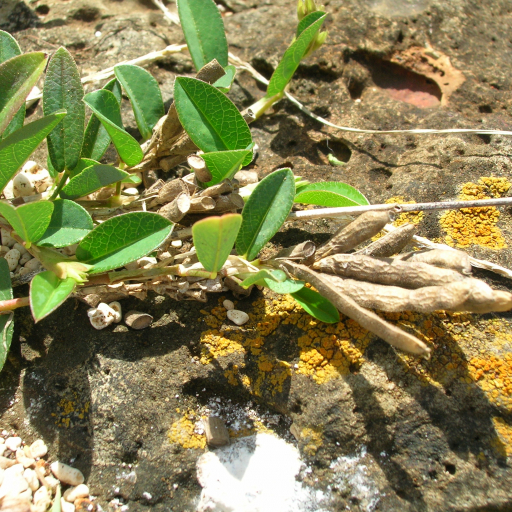
Plant Overview
Often called Alyce Clover or Buffalo Clover, this low-growing traveler isn't a true clover at all, but a member of the pea family. Originally from the tropical regions of Africa and Asia, it has hitched a ride across the globe, becoming a favorite for those looking to improve their soil naturally. Its scientific name, vaginalis, refers to the sheath-like structure that wraps around the base of its leaf stems.
🔍 How to Identify
- 🍃 The "Single" Leaf: Unlike true clovers that have three leaflets, Alyce Clover typically sports a single, oval-to-oblong leaf on each stem. The leaves are smooth and have a slightly waxy texture.
- 🌸 Pea-Like Blooms: It produces small, delicate flowers that range from reddish-orange to a soft purple. They grow in small clusters (racemes) at the ends of the branches.
- 🫘 Segmented Pods: Its seed pods are "loments"—cylindrical pods that look like tiny beaded strings. When mature, these segments break apart individually rather than splitting down the middle.
🏡 In Your Garden
- 🌱 The Soil Builder: As a legume, this plant is a powerhouse of nitrogen fixation. It works with soil bacteria to pull nitrogen from the air and "pump" it into the ground, making it an excellent green manure for exhausted garden beds.
- ☀️ Sun & Sand Lover: It thrives in well-drained, sandy soils and full sun. It is particularly drought-tolerant once established, but it lacks the cold hardiness of northern clovers, making it a "summer annual" in many temperate climates.
- 🪱 Nematode Nuance: While it is a hardy groundcover, it is notoriously susceptible to root-knot nematodes. If your garden has a history of these microscopic pests, Alyce Clover might struggle to thrive.
⚠️ Safety & Toxicity
- ✅ Safe Status: Alyce Clover is considered non-toxic to humans, dogs, and cats.
- 🐄 Forage Favorite: It is widely grown as a high-quality hay and forage crop for livestock. It is highly palatable and nutritious for cattle and horses, though it should always be introduced as part of a balanced diet to prevent bloating in ruminants.
✨ Fun Fact
Despite its name and appearance, Alyce Clover is more closely related to the Peanut than to the White Clover found in your lawn! Both belong to the same tribe within the Fabaceae family, sharing similar root structures and flowering habits.

Detailed Care Instructions
To grow Alysicarpus Vaginalis, also known as Alyce Clover, you can follow these steps:
- Climate and Soil Requirements: Alysicarpus Vaginalis prefers warm and tropical climates. It thrives in well-draining sandy or loamy soil with a pH range of 4.5 to 6.5.
- Seed Collection: Collect seeds from mature plants during the dry season. Ensure that the seeds are dry, clean, and free from pests or diseases.
- Seed Scarification: Alysicarpus Vaginalis seeds have a hard outer coat that needs to be scarified or softened to improve germination rates. You can do this by lightly rubbing the seeds with sandpaper or nicking them with a knife.
- Seed Germination: Soak the scarified seeds overnight in water to further help the germination process.
- Planting: Prepare a nursery bed or container with well-draining soil. Sow the scarified seeds about 1 cm deep and cover lightly with soil. Water gently to keep the soil moist.
- Germination: The seeds should start germinating within 7-21 days. Once they have grown true leaves and are about 10 cm tall, they can be transplanted to their permanent location.
- Transplanting: Choose a sunny location with well-draining soil. Dig holes at least 30 cm apart and ensure that the seedlings are planted at the same depth as they were in the nursery bed. Water thoroughly after transplanting.
- Maintenance: Water the plants regularly, especially during dry spells. Remove any weeds that may compete for nutrients and space. Alysicarpus Vaginalis is a nitrogen-fixing plant, so it doesn't require additional fertilization.
- Pruning: To encourage bushy growth and prevent the plants from becoming leggy, pinch back the growing tips when they reach about 15 cm in height.
- Harvesting: Alysicarpus Vaginalis can be used as a forage or green manure crop. It is usually harvested after about 90 days when it has reached a suitable biomass. Cut the plants about 10 cm above the ground and allow them to dry before use.
Remember to check your local regulations and guidelines before growing Alysicarpus Vaginalis, as it may be considered an invasive species in some regions.

Place in a bright room that is sun drenched almost all day. Or directly in a south-facing window.

To properly water this plant, you should first determine its watering needs based on its environment and growth stage. Check the moisture level of the soil by touching it with your fingers or using a moisture meter. Water thoroughly but avoid overwatering, as this can lead to root rot and other problems. Allow the soil to partially dry out before watering again, as this will promote healthy root growth and prevent waterlogged conditions. Use a watering can or hose to water the plant at the base, avoiding overhead watering which can promote fungal growth and other diseases. Consider using filtered or distilled water, as tap water may contain chemicals or minerals that can harm the plant. Alternatively, you can collect rainwater to use for watering.
To improve the growth and yield of this plant, it is recommended to apply a balanced fertilizer with an N:P:K ratio of 4:2:3. The fertilizer should be applied during the growing season every two weeks at a rate of 2-3 grams per plant. Care should be taken not to over-fertilize the plant, which can result in excessive vegetative growth at the expense of flowers or fruit. Additionally, it is important to water the plant adequately, maintaining soil moisture at a moderate level to ensure optimal growth.
A suitable soil for Alysicarpus Vaginalis plant is one that has good drainage and is rich in nutrients. It should be a well-draining soil that is loamy and slightly acidic, with a pH range of 5.5 to 6.5. The soil should contain adequate organic matter, such as compost or aged manure, to provide essential nutrients to the plant.
The soil should be moist but not waterlogged, so it's important to maintain proper watering practices for the plant. It is also important to avoid over-fertilization, as this can cause the plant to become leggy and lose its compact growth habit.
In summary, Alysicarpus Vaginalis plant prefers a well-draining, slightly acidic soil that is rich in organic matter. It should be kept moist but not waterlogged, and fertilization should be done with care to avoid over-fertilization.
Alysicarpus Vaginalis is a plant that can be propagated through various methods. One common method is through seed propagation, which involves collecting mature seeds and sowing them in well-draining soil. The seeds should be sown at a depth of approximately 1-2 cm, and kept moist until germination occurs.
Another method of propagation is through vegetative propagation. This involves taking cuttings from the parent plant and rooting them in soil or water. To take cuttings, select a healthy stem and cut it just below a node using a sharp, clean pair of scissors. Remove any leaves from the lower half of the stem, and dip the cut end in rooting hormone powder. Place the cutting in soil or water, and keep it moist until roots form.
Alysicarpus Vaginalis can also be propagated through division. This involves separating the parent plant into smaller, individual plants and replanting them. To do this, carefully dig up the parent plant and separate the roots and stems into smaller sections. Replant the sections in well-draining soil and keep them well-watered until new growth appears.








