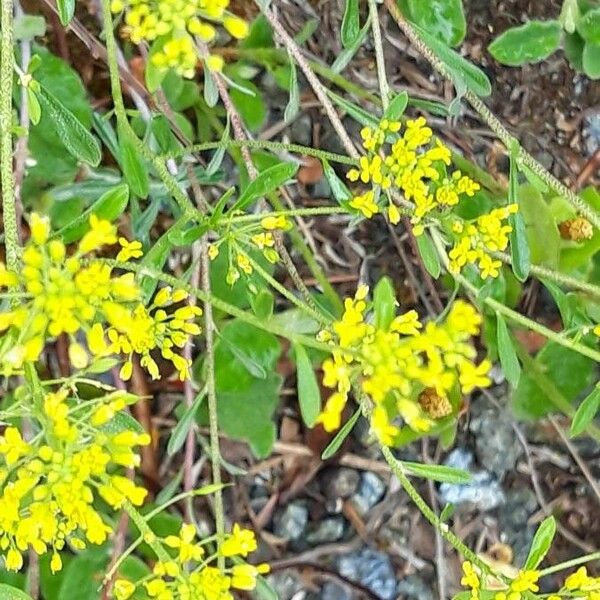
Plant Overview
Known as the "Italian Serpentine Alyssum," Alyssum bertolonii is a botanical marvel that thrives where most other plants wither. Native to the rocky terrains of Italy and the Balkans, this resilient perennial is a favorite among scientists for its "superpower" of absorbing heavy metals from the soil. In a garden setting, it offers a golden carpet of blooms that brings a rugged, Mediterranean charm to rockeries.
🔍 How to Identify
- 🌼 Golden Clusters: It produces dense, rounded clusters of tiny, four-petaled bright yellow flowers that bloom throughout late spring and early summer.
- 🍃 Silvery Foliage: The leaves are small, spatulate (spoon-shaped), and covered in fine grey-white hairs, giving the entire plant a shimmering, dusty-green appearance.
- 🪵 Woody Base: Unlike many annual alyssums, this species is a sub-shrub with a woody base that stays close to the ground, forming a low, spreading cushion.
🏡 In Your Garden
- 🪨 The Serpentine Specialist: This plant is naturally adapted to "serpentine soils," which are toxic to most life due to high concentrations of magnesium and nickel. In your garden, this means it excels in poor, rocky, or sandy soils where other plants struggle.
- ☀️ Drought Warrior: Because it has evolved to survive in harsh, sun-baked environments, it is exceptionally drought-tolerant once established. It requires excellent drainage and will likely suffer from root rot if kept in heavy, water-logged clay.
- 🧘 Minimalist Care: It hates being pampered. Avoid over-fertilizing, as rich soil can cause the plant to become "leggy" and lose its compact, tidy shape.
⚠️ Safety & Toxicity
- 🟢 General Safety: Alyssum bertolonii is generally considered non-toxic to humans and common household pets like cats and dogs.
- 🧪 Metal Accumulation: Because this plant is a "hyperaccumulator," it stores high levels of nickel in its leaves. While touching the plant is safe, it should never be consumed, as it may contain concentrated levels of heavy metals absorbed from the surrounding soil.
✨ Fun Fact
Alyssum bertolonii is a pioneer of "Phytomining." Scientists study this plant because it can absorb so much nickel that the metal can actually be harvested from the plant's ash after it is harvested and burned—essentially "mining" the earth using flowers instead of machinery!

Detailed Care Instructions








