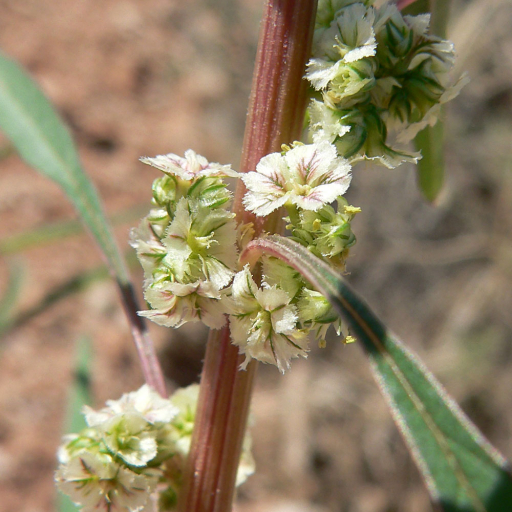
Plant Overview
Known as the Fringed Amaranth or Fringed Pigweed, this delicate desert native is a master of timing. While many of its Amaranthus cousins are bulky, aggressive garden weeds, Amaranthus fimbriatus is an elegant, airy annual that waits for the intense summer monsoon rains of the Southwest to make its grand appearance. It transforms dry, sandy washes into a haze of reddish-purple almost overnight.
🔍 How to Identify
- 🌸 Fringed Flowers: The most striking feature is the tiny flowers; the "tepals" (petal-like parts) have distinctively fringed or jagged edges that look like delicate lace under a magnifying glass.
- 🍷 Rubied Stems: The plant features slender, upright stems that often take on a deep maroon or reddish hue, especially when grown in full sun.
- 🍃 Willow-like Leaves: Unlike the broad leaves of common spinach-amaranth, this species has very narrow, linear leaves that give the plant a spindly, transparent silhouette.
🏡 In Your Garden
- 🏜️ Monsoon Specialist: This is a "thermophile," meaning it loves heat. It won't sprout in the cool spring; it sits patiently in the soil until the hottest part of the summer when the rains arrive.
- ⏳ Ephemeral Beauty: Because it is an annual adapted to the desert, its life cycle is very fast. It focuses all its energy on blooming and seeding quickly before the ground dries up again, making it a "blink-and-you-miss-it" guest in the landscape.
⚠️ Safety & Toxicity
- 🟢 Generally Safe: Fringed Amaranth is not considered poisonous to humans or common household pets like cats and dogs.
- 🐄 Nitrate Warning: Like many members of the Pigweed family, these plants can accumulate nitrates if grown in heavily fertilized soils. While not an issue for a curious gardener, it can be toxic to livestock (like cattle or horses) if they graze on large quantities in a short time.
✨ Fun Fact
The species name fimbriatus is Latin for "fringed" or "bordered with hairs," perfectly describing the unique, microscopic ruffles on its flowers that distinguish it from the hundreds of other Amaranth species worldwide!

Detailed Care Instructions
To grow Amaranthus fimbriatus, also known as Fringed Amaranth, you can follow these steps:
- Choose a suitable planting location: Amaranthus fimbriatus prefers full sun, so select a spot in your garden that receives at least 6-8 hours of direct sunlight each day. Ensure the soil is well-draining.
- Prepare the soil: Loosen the soil to a depth of 8-10 inches using a garden fork or tiller. Remove any weeds, rocks, or other debris. It is recommended to amend the soil with organic matter like compost or well-rotted manure.
- Sow the seeds: Amaranthus fimbriatus is typically grown from seeds. You can either start them indoors 6-8 weeks before the last frost, or directly sow the seeds outdoors after the danger of frost has passed. If sowing outdoors, make sure the soil temperature is consistently around 65-75°F (18-24°C).
- Plant the seeds: Sow the seeds about 1/4 inch deep into the soil. Space them 12-18 inches apart to allow sufficient room for growth. Lightly cover the seeds with soil and gently tamp them down.
- Watering and maintenance: When establishing the seedlings, water them regularly to keep the soil consistently moist but not waterlogged. Once the plants are established, they are somewhat drought-tolerant. Avoid excessive watering. Weed the area regularly to prevent competition for nutrients and space.
- Fertilization: Amaranthus fimbriatus generally grows well with minimal fertilizer. However, you can apply a balanced, slow-release fertilizer once or twice during the growing season if desired. Follow the instructions on the fertilizer packaging for application rates.
- Harvesting: You can start harvesting the leaves of Amaranthus fimbriatus when they reach an appropriate size for culinary purposes. The leaves are edible and can be used in salads, stir-fries, or as a cooked green. Harvest the entire plant by cutting it at the base when you want to collect the seeds.
By following these steps, you should be able to successfully grow Amaranthus fimbriatus in your garden.

Place in a bright room that is sun drenched almost all day. Or directly in a south-facing window.

When giving water to this plant, it is important to ensure that the soil is moist but not waterlogged. The frequency of watering will depend on the level of humidity in the air and the temperature of the environment, but generally, it should be watered every two to three days.
Before watering, gently touch the soil with your finger to check the moisture level. If it feels dry to the touch, it needs watering. Use room temperature water and avoid getting water on the leaves as this can lead to fungal diseases.
In terms of the amount of water needed, it is best to water it enough until it begins to drain from the drainage holes at the bottom of the pot. This ensures that the roots receive enough moisture without sitting in water for too long.
During the winter season, the plant will require less water, so fewer watering sessions are necessary. In contrast, during the summer season, it may need to be watered more frequently due to the increased heat and evaporation.
Over-watering can lead to root rot and a weakened plant, so it is important to monitor the soil moisture level and adjust the watering schedule as necessary.
To fertilize this plant, you should use a balanced fertilizer with an equal ratio of nitrogen, phosphorus, and potassium. Apply the fertilizer once a month during the growing season, starting in early spring. Make sure to water the plant before and after applying the fertilizer to prevent burning the roots. Avoid over-fertilizing as it can lead to excessive growth and impact the plant's overall health.
To grow Amaranthus Fimbriatus, it is best to use a well-draining soil mixture that is rich in organic matter. The soil should have a pH level ranging from 6.5 to 7.5. A mix of sand, loam, and peat moss is recommended for this plant. The soil should be kept moist, but not waterlogged as excessive moisture can result in root rot. Adding compost or slow-release fertilizer to the soil will help provide the necessary nutrients for the plant to thrive. Additionally, it is recommended to mulch around the base of the plant to help retain moisture in the soil and suppress weeds.
To propagate this particular plant, you can take stem cuttings from healthy and established plants. You should use clean and sharp pruning shears to cut a few inches of stem from the plant. Remove any leaves from the lower half of the stem. Dip the cut end of the stem into rooting hormone powder to accelerate the growth process. You can then plant the stem in moist potting soil or a mixture of peat moss and perlite. Make sure to keep the soil consistently moist and place it in a bright, warm location that receives indirect sunlight. The plant should root in a couple of weeks, and you can gradually acclimate it to direct sunlight.








