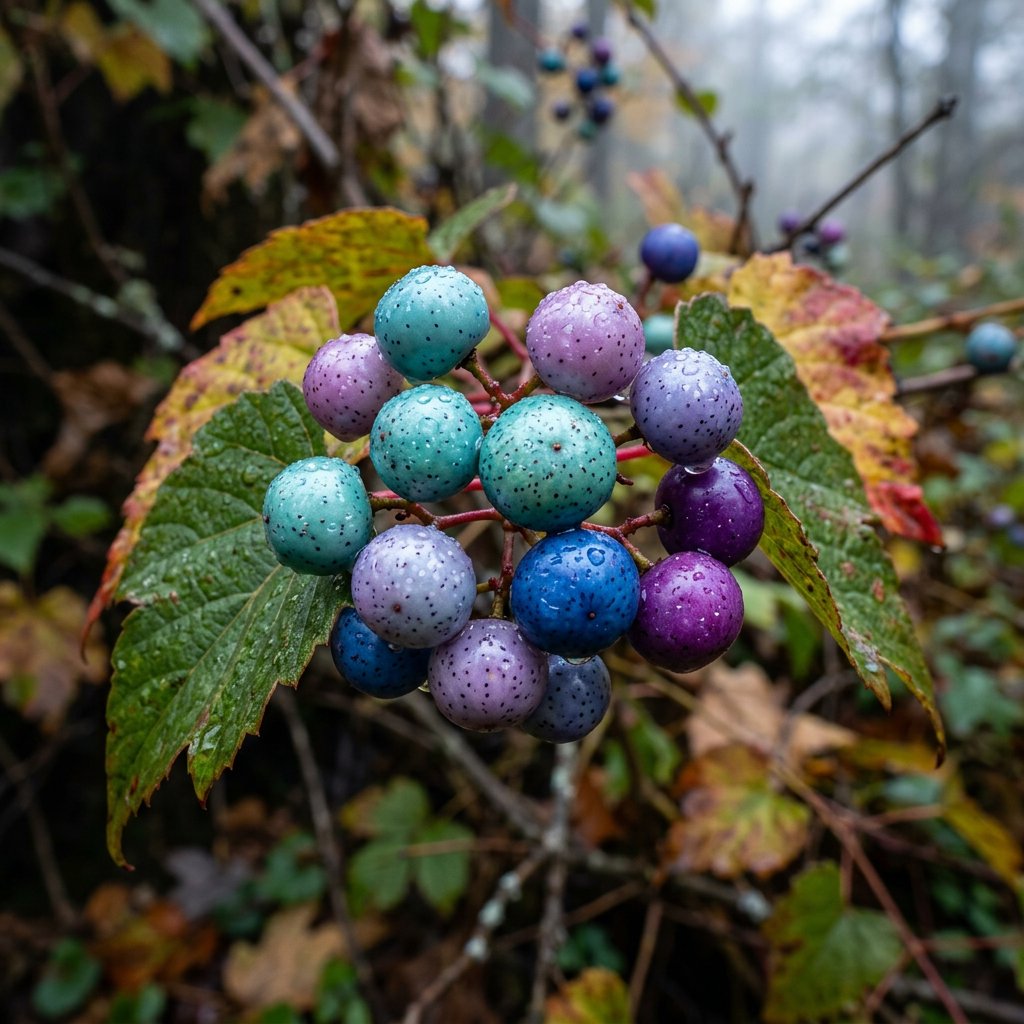
Plant Overview
Often called the Porcelain Berry or Amur Peppervine, this deciduous woody vine is famous for its jewel-toned fruit that looks like it was hand-painted by an artist. While its shimmering berries make it a favorite for ornamental fences, it is a fast-moving traveler that can quickly transform from a garden accent into a leafy conqueror. In many regions, it is admired for its beauty but managed carefully due to its vigorous growth.
🔍 How to Identify
- 🍇 The Berries: Small, circular fruits that transition through an incredible palette of colors—starting pale green, then turning cream, lilac, turquoise, and finally a deep, speckled "Robin's egg" blue.
- 🍃 The Foliage: Heart-shaped leaves with coarsely toothed edges; some leaves are deeply lobed (looking like a maple leaf), while others on the same vine may be solid and unlobed.
- 🧶 The Tendrils: It climbs using non-adhesive, forked tendrils that wrap tightly around anything in its path, allowing it to scale heights of up to 20 feet in a single season.
🏡 In Your Garden
- 🌱 Aggressive Growth: This plant grows with incredible speed. While it provides excellent coverage for a pergola or trellis, it is often labeled as "invasive" because it can easily escape cultivation and smother native trees and shrubs.
- 🪵 The "Pith" Test: You can tell it apart from a wild grapevine by cutting a stem; Ampelopsis has a white, spongy center (pith), whereas true grapevines have a brown pith.
- 🦋 Pollinator Magnet: Its flowers are tiny and greenish-white, easily overlooked by humans but highly attractive to bees and small beneficial wasps.
⚠️ Safety & Toxicity
- 🐾 Mildly Toxic: The berries are generally considered non-toxic to humans in small amounts but are very mealy and bland. However, they can cause digestive upset if consumed in quantity, so it is best to keep them away from curious children and pets.
- 🚫 Ecological Hazard: The primary "danger" of this plant is its ability to blanket entire landscapes. It can become heavy enough to pull down fences or collapse the canopy of the trees it climbs.
✨ Fun Fact
The stunning multicolored effect of the berries isn't just a trick of the light; the different colors (blue, purple, and green) actually appear at different stages of ripeness, often all occurring on the same cluster at once, earning it the nickname "The Marble Vine."

Detailed Care Instructions
To grow Ampelopsis glandulosa, also known as the porcelain vine or wild grape, you can follow these steps:
- Obtain a healthy cutting or mature plant: You can either purchase a cutting or mature plant from a local nursery or garden center, or you can ask someone who already has this plant if you can take a cutting.
- Choose a suitable location: Porcelain vines prefer full sun to partial shade, so select a spot in your garden that receives at least 4-6 hours of direct sunlight daily. Make sure the location has well-draining soil.
- Prepare the planting site: Clear away any weeds or grass, and loosen the soil to a depth of at least 12 inches. This will allow the plant's roots to grow freely and access nutrients and moisture.
- Plant the vine: Dig a hole that is wide and deep enough to accommodate the roots of the plant without crowding. Place the plant in the hole, ensuring that the soil line from its container matches the soil level in your garden. Backfill with soil, gently firming it around the roots.
- Water thoroughly: After planting, water the vine deeply to ensure the roots are well-moistened and to help settle the soil. Continue to water regularly throughout the growing season, ensuring the soil remains moist, but not overly saturated.
- Provide support: Ampelopsis glandulosa is a climbing vine, so it will need support to grow vertically. Install a trellis, arbor, or other structure near the planting site to provide a framework for the vine to grow on.
- Mulch and fertilize: Apply a layer of organic mulch, such as wood chips or straw, around the base of the plant to help retain soil moisture and suppress weeds. Additionally, you can use a balanced, slow-release fertilizer designed for flowering vines to provide essential nutrients to the plant.
- Prune regularly: Pruning helps control the size and shape of the vine. You can prune in early spring or late winter before new growth begins or trim as needed throughout the growing season. Remove dead or damaged branches, and thin out excessive growth to improve air circulation.
- Monitor for pests and diseases: While generally not prone to severe pest or disease problems, watch for common issues like aphids, leaf spot, or powdery mildew. If necessary, use appropriate measures like insecticidal soap or horticultural oils to control pests, and prune affected foliage if diseases occur.
- Provide winter protection: In colder climates, porcelain vines may need protection from harsh winter conditions to ensure survival. You can cover the base of the vine with mulch or wrap it lightly with burlap to insulate it from extreme cold temperatures.
With proper care, Ampelopsis glandulosa can grow into a beautiful and vigorous vine, providing attractive foliage and berries throughout the growing season.

Place in a window with dappled sun or a spot in the middle of a room. Or directly in a window facing west or east.

Ampelopsis Glandulosa plant prefers well-draining soil that is moist but not waterlogged. When watering, it is important to ensure that the water reaches the roots without causing any waterlogging. To achieve this, one should water slowly, directly around the base of the plant, and ensure that the water is absorbed completely before adding more. It is important not to allow the soil to dry out completely between watering sessions. Additionally, it is advisable to water the plant in the morning or early evening when temperatures are cooler and there is less risk of evaporation. Too much water can lead to root rot, while too little water can cause leaves to wilt and fall off.
To fertilize the plant, mix a balanced fertilizer such as 10-10-10 or 20-20-20 with water according to the package instructions. Apply the fertilizer solution to the soil around the roots of the plant once every two weeks during the growing season (spring and summer). Water the plant immediately after fertilizing to help spread the nutrients throughout the soil. Avoid over-fertilizing the plant, as this can cause damage or burn the roots.
When planting the Ampelopsis Glandulosa plant, it is important to choose the right soil to ensure optimal growth and health. The ideal soil should have moderate fertility, with good drainage and water retention capabilities. A mix of porous, well-draining soil and organic matter can provide the best growing conditions for this plant.
The pH of the soil should be slightly acidic to neutral, with a range between 6.0 and 7.0. The soil should also contain adequate nutrients, including nitrogen, phosphorus, and potassium, to promote healthy growth and development of the plant.
Ampelopsis Glandulosa prefers soil that is rich in organic matter, such as compost or well-rotted manure. This will provide the plant with the necessary nutrients for optimal growth and health.
When planting, ensure that the soil is moist but not waterlogged, as excess water can cause damage to the roots of the plant. It is also important to ensure that the soil is well-drained, to prevent waterlogging and fungal infections.
Overall, choosing the right soil for Ampelopsis Glandulosa is crucial to its growth and health. A soil mix that is well-draining, slightly acidic to neutral, and rich in organic matter is recommended for the best results.
The propagation of this plant can be done through stem cuttings. Select a healthy stem measuring six to eight inches long, and cut it at a 45-degree angle using a clean, sharp knife. Remove the leaves from the lower half of the stem, leaving two to three leaves at the top for photosynthesis. Dip the cut end of the stem in rooting hormone, then plant it in a pot filled with well-draining soil. Water the soil and keep it moist until the plant takes root. Place the pot in a bright, indirect light source and keep it at a warm temperature. The plant should develop roots in around 4-6 weeks.
Common pests of the porcelain berry include Scale insect, mealybugs, spider mites, thrips. Make a habit of checking your porcelain berry frequently for pests so that any infestations can be caught and managed early.








