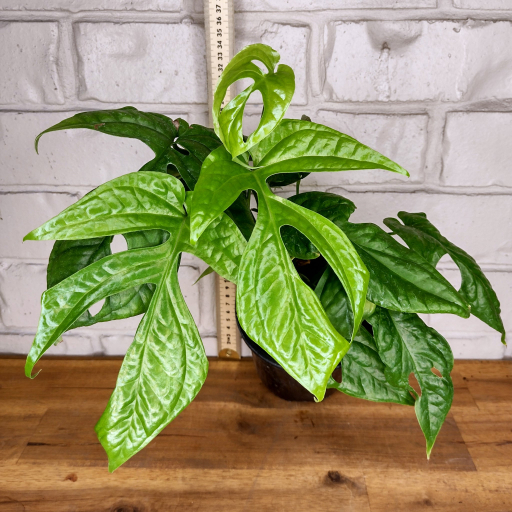
Plant Overview
Known as the "Spider-man Monstera," the Amydrium medium is a show-stopping climber that looks like it crawled straight out of a prehistoric jungle. Despite its nickname, it isn't a Monstera at all, but a unique member of the Aroid family native to the humid rainforests of Southeast Asia. It is prized by collectors for its "shredded" leaves that look like intricate skeletons or delicate spiderwebs.
🔍 How to Identify
- 🍃 Dramatic Fenestrations: As the plant matures, the leaves develop deep slits and holes that reach almost to the center vein, giving them a jagged, rib-like appearance.
- 🦎 Crocodile Texture: The leaf surface is notably rugose (bumpy or leathery), often featuring a metallic blue-green or silvery sheen that catches the light.
- 🧶 Vining Runners: It frequently produces long, leafless stems called "stolons" or runners that reach out across the ground or air, searching for a tree to climb.
🏡 In Your Garden
- 🪵 The Need to Climb: In its natural habitat, this plant is an epiphyte. To see those iconic giant, "holey" leaves, you must provide a moss pole or wooden plank; if left to trail, the leaves will remain small and heart-shaped.
- ☁️ Humidity over Water: This species is more sensitive to dry air than your average Pothos. It thrives in high-humidity environments (above 60%) and prefers "chunky" soil that allows the roots to breathe rather than sitting in heavy, wet dirt.
- 🌥️ Shadow Play: It evolved under the thick canopy of tropical forests, meaning it prefers bright, dappled light. Direct afternoon sun will quickly scorch and bleach its beautiful, textured foliage.
⚠️ Safety & Toxicity
- 🚫 Toxic Status: Toxic to humans and pets.
- 🐾 The Details: Like most Aroids, it contains insoluble calcium oxalate crystals. If leaves are chewed or swallowed, they cause immediate stinging and swelling of the mouth, throat, and tongue. Keep this one on a high shelf away from curious cats or toddlers.
✨ Fun Fact
🕷️ The Web-Slinger: It earned its "Spider-man" nickname because of its unique growth strategy. When the plant "senses" it isn't climbing, it sends out long, thin runners that look like webs being cast out to find a new structure to latch onto!

Detailed Care Instructions
| Lighting | Part Sun |
| Hardiness Zones | Max 13 |
To grow an Amydrium Medium plant, or commonly known as the Aroid Palm or Giant Aroid, you can follow these steps:
- Choose a suitable location: Amydrium Medium plants thrive in bright, indirect light. Pick a spot in your home where the plant can receive moderate to bright light, but avoid placing it in direct sunlight as it can scorch the leaves.
- Provide the right temperature and humidity: These plants prefer a warm and humid environment. Maintain temperatures between 65-85°F (18-29°C) and humidity levels above 50%. You can increase humidity by using a humidifier, placing the pot on a tray filled with water and pebbles, or misting the plant regularly.
- Select a well-draining pot and soil: Use a pot with drainage holes to prevent waterlogging. Amydrium Medium plants prefer moist but not soggy soil. A well-draining soil mix consisting of peat moss, perlite, and orchid bark is ideal.
- Watering routine: Water the plant thoroughly when the top inch of soil feels slightly dry to the touch. Ensure the excess water can drain away to prevent root rot. During cooler months, reduce watering frequency to avoid overwatering.
- Fertilize regularly: Use a balanced liquid houseplant fertilizer diluted to half the recommended strength and apply it every 2-4 weeks during the growing season (spring and summer). Reduce or stop fertilizing during winter when the plant is in a dormant phase.
- Provide support: As the plant grows, it will produce large leaves that may require support. You can use bamboo stakes or a moss pole to help the plant climb and provide stability.
- Pruning and repotting: Trim away any diseased or yellowing leaves regularly. Repotting should be done when the plant outgrows its current pot or every 1-2 years. Choose a pot that is 1-2 inches larger in diameter than the current one and use fresh potting soil.
- Keep an eye on pests: Watch out for common houseplant pests such as spider mites, mealybugs, and scale insects. Regularly inspect the leaves for any signs of infestation and treat accordingly using organic pest control methods or insecticidal soap.
- Be patient: Amydrium Medium plants are relatively slow growers. It may take time for them to reach their full potential and develop the characteristic large, fenestrated leaves.
Remember to research and understand the specific needs of your Amydrium Medium plant, as different plant variations within the species may have slightly different care requirements.

Place in a window with dappled sun or a spot in the middle of a room. Or directly in a window facing west or east.

As with any plant, it is important to water Amydrium Medium regularly to keep it healthy. To water this plant, first, check the soil moisture level by inserting your finger about an inch deep into the soil. If it feels dry, it is time to water the plant.
Using a watering can with a spout, gently pour water into the soil around the base of the plant until it starts to drain out of the bottom of the pot. Make sure you do not get water on the leaves or stem of the plant as this can cause damage or promote the growth of mold.
During the warmer months, you may need to water your Amydrium Medium more frequently as the soil can dry out faster. However, during the colder months, it is important to reduce watering as the plant may not be growing as actively and will not require as much water.
It is helpful to note that this plant prefers consistently moist soil, but be careful not to overwater it as this can lead to root rot. Always make sure the soil is sufficiently drained and not sitting in standing water.
To fertilize Amydrium Medium plant, use a balanced fertilizer with an N-P-K ratio of 10-10-10 or 20-20-20. Dilute the fertilizer to half or quarter strength and apply it once a month during the growing season. Avoid fertilizing during the dormant period. Water the plant before fertilizing and avoid getting the fertilizer on the leaves as it may cause burning.
A suitable soil mix for Amydrium Medium plant needs to be well-draining and rich in nutrients. It should have excellent water-retention capacity while being airy enough to allow good root development. A mixture of peat moss, coco coir, perlite, and vermiculite in equal parts is ideal. The pH level of the soil should be neutral to slightly acidic, around 6.0-7.0. It is also essential to ensure the soil is free of any pests or diseases before planting your Amydrium Medium plant.
To propagate the plant, you will need to take a stem cutting from the parent plant. Choose a stem that is healthy and has several leaves on it. Using a clean, sharp pair of scissors or pruning shears, cut the stem about 6 inches long, making sure to cut it just below a node (the point where a leaf attaches to the stem).
Remove the leaves from the lower half of the stem, leaving just a few at the top. Dip the cut end of the stem in rooting hormone powder. Then insert it into a pot filled with well-draining soil. Keep the soil moist and place the pot in a bright, but indirect, area.
In about four to six weeks, the stem should start to grow roots and new leaves. You can then gradually increase the amount of light the plant receives and start fertilizing it.
Once the new plant has grown enough roots and leaves, you can transplant it into a larger pot or into the ground if you live in a suitable climate.
Common pests of the spiderman monstera include Scale insect, mealybugs, spider mites, fungus gnats, thrips. Make a habit of checking your spiderman monstera frequently for pests so that any infestations can be caught and managed early.








