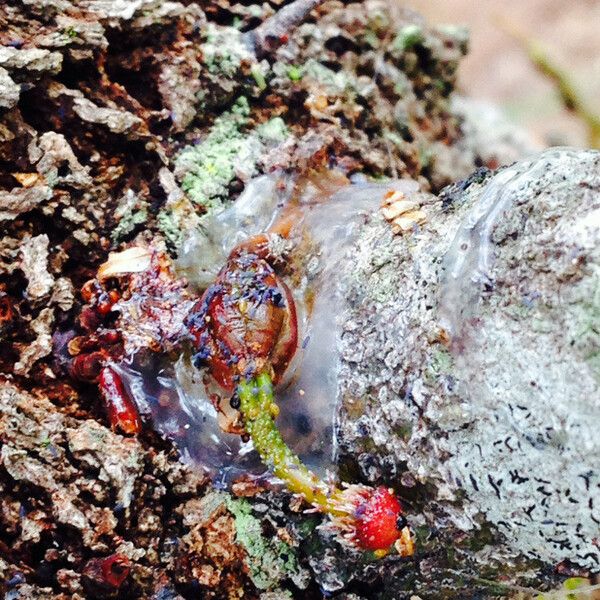
Plant Overview
Often called the Shiny-leaved Mistletoe, Amylotheca dictyophleba is a fascinating aerial acrobat native to the rainforests of Australia and New Guinea. Unlike most garden plants, it prefers a life in the canopy, gracefully dangling from the branches of host trees. In many cultures, mistletoes are symbols of mystery and life’s persistence, and this species lives up to that reputation by providing a vital "high-rise" habitat for local wildlife.
🔍 How to Identify
- 🌿 Leathery Foliage: The leaves are thick, glossy, and remarkably smooth, often growing in pairs along the stem to help the plant conserve water in the windy canopy.
- 🏮 Tubular Blooms: It produces stunning, elongated flowers that are usually bright red or orange with yellow-green tips, perfectly shaped for a bird’s beak.
- 🍒 Sticky Berries: The fruit is a small, fleshy globule that turns a deep red or purple-black when ripe, containing a single, incredibly sticky seed.
🏡 In Your Garden
- 🌳 The Guest Lifestyle: You won’t find this plant in a traditional potting mix. As a hemiparasite, it "plugs" into the vascular system of a host tree (like a Wattle or Brush Box) to steal water and minerals, while still photosynthesizing its own energy through its green leaves.
- 🦋 A Biodiversity Hub: If this mistletoe appears on your trees, it’s often a sign of a healthy ecosystem. it serves as an essential nursery for the Imperial Jezebel butterfly and a primary pantry for nectar-seeking honeyeaters.
⚠️ Safety & Toxicity
- 🚫 Toxic to Mammals: While birds feast on the berries with no ill effects, the fruit and leaves are considered toxic to humans, dogs, and cats.
- 🤢 Ingestion Risks: If eaten, the plant can cause significant stomach upset, including nausea, vomiting, and diarrhea. It is best enjoyed from a distance or with binoculars.
✨ Fun Fact
The seeds of this plant have a "sticky" survival strategy; they are coated in a glue-like substance called viscin. When a Mistletoebird eats the fruit, the seed passes through its system so quickly and stickily that the bird must rub its bottom against a branch to dislodge it, effectively "planting" the next generation of mistletoe in a perfect spot!

Detailed Care Instructions
To grow Amylotheca Dictyophleba (also known as maidenhair fern), you can follow these steps:
- Research the plant: Understand the specific growing conditions required for Amylotheca Dictyophleba. This plant prefers indirect sunlight and high humidity.
- Choose the right spot: Select a location indoors with bright, indirect light. Avoid direct sunlight as it can scorch the leaves. The ideal temperature range is between 65-75°F (18-24°C).
- Provide humidity: Amylotheca Dictyophleba thrives in high humidity. You can increase humidity by placing a tray filled with water near the plant. Evaporation will create moisture in the air.
- Watering: Keep the soil consistently moist but not waterlogged. Use room temperature water and water the plant when the top inch of soil feels slightly dry. Avoid letting the soil completely dry out or become waterlogged, as these conditions can harm the plant.
- Fertilization: Provide a balanced indoor plant fertilizer every 2-3 months during the growing season (spring and summer). Use a diluted, organic fertilizer and apply it according to package instructions.
- Repotting: If the plant outgrows its container, repot it into a slightly larger pot with well-draining soil. Maidenhair ferns prefer shallow pots with good drainage.
- Pruning: Regularly remove any dead or yellowing fronds to maintain the plant's health and appearance. Trim back any brown or damaged leaves to promote new growth.
- Pest control: Watch out for pests like aphids and spider mites. In case of an infestation, gently wipe the leaves with a damp cloth or use an organic insecticidal soap to control the pests.
- Propagation: If you want to propagate your Amylotheca Dictyophleba, you can do so by division. Carefully separate clumps of the plant, ensuring each division has healthy roots and foliage. Repot the divisions in separate containers and follow the same care instructions.
Remember that growing plants can be an ongoing learning process, and it's important to observe and respond to the specific needs of your Amylotheca Dictyophleba to ensure its healthy growth.

Place in a window with dappled sun or a spot in the middle of a room. Or directly in a window facing west or east.
To water this plant, you should first check the soil moisture level by inserting your finger into the soil to a depth of about 2 inches. If the soil feels dry, it is time to water it. Use a watering can or hose to water the plant slowly and evenly until the soil is thoroughly moistened. Avoid getting water on the leaves as this can promote disease. It is important not to let the plant sit in standing water, so make sure the container has drainage holes and empty excess water from the saucer or tray beneath the pot. Water the plant when the soil becomes slightly dry to the touch, typically about once a week.
To fertilize this plant, use a balanced fertilizer with equal amounts of nitrogen, phosphorus, and potassium. Apply the fertilizer every two weeks during the growing season, starting in the spring and continuing through the summer. Mix the fertilizer according to the package instructions and water the plant before applying the fertilizer to prevent root burn. Avoid fertilizing during the winter months when the plant is dormant.
Amylotheca Dictyophleba, a plant requiring well-drained soil with plenty of organic matter, should be grown in acidic soil with a pH ranging from 5 to 6.5. It also needs soil that is moist but not waterlogged, as the plant can be susceptible to root rot. A mixture of peat moss, pine bark, and perlite or vermiculite can be used to enhance soil aeration and drainage, as well as to maintain soil moisture. Organic mulch, such as shredded bark or leaves, can also be added to the soil surface to help retain moisture and prevent weed growth. Additionally, it is recommended to avoid using heavy clay or compacted soils, as these can limit root growth and cause plant stress.
To propagate this plant, you will need to take stem cuttings from the parent plant. Choose a healthy stem with several leaves and make a clean cut just below a node using a sharp, sterile knife or scissors. Remove any lower leaves from the cutting and dip the cut end in rooting hormone powder. Plant the cutting in a well-draining potting soil mixture and water thoroughly. Cover the cutting with a plastic bag or clear plastic dome to create a humid environment and place it in a brightly lit area with indirect sunlight. Keep the soil moist and mist the cutting regularly. After several weeks, the cutting should start to form roots and new growth. Once the cutting has established a strong root system, it can be transplanted into a larger pot or planted outdoors in a suitable location.








