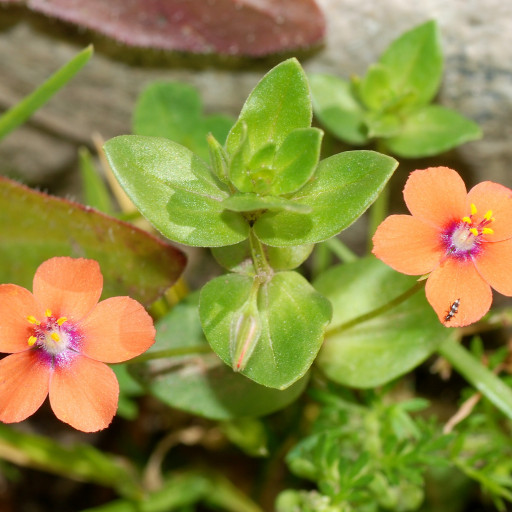
Plant Overview
Known as the "Poor Man’s Weather-glass," the Scarlet Pimpernel is a tiny, charming wildflower that has inspired everything from folklore to classic literature. While it looks like a delicate garden treasure, it is actually a hardy annual that has traveled from its native Europe to almost every corner of the globe. It is most famous for its "biological clock," opening and closing its petals with precision based on the sun and moisture.
🔍 How to Identify
- 🌸 The Bloom: Tiny, five-petaled flowers that are usually a distinct salmon-red or "scarlet," though a rare blue variety exists. The center of the flower often features a small, darker reddish-purple eye.
- 🍃 The Leaves: Small, oval-shaped, and bright green. They grow in opposite pairs along the stem and lack stalks; if you flip them over, you’ll see tiny black or purple glands.
- 📐 Square Stems: The plant has noticeably square, reclining stems that tend to sprawl across the ground in a "prostrate" habit rather than growing tall.
🏡 In Your Garden
- ☀️ The Sun-Seeker: This plant is famous for its sensitivity to light. Its flowers only open in bright sunshine and will "sleep" during cloudy weather. This isn't just a quirk—it's a mechanism to protect its pollen from rain.
- 🌱 Opportunistic Growth: It thrives in disturbed soil and full sun. If it pops up in your garden beds, it is likely because the soil was recently turned over. Its seeds are incredibly patient and can lie dormant in the earth for nearly a decade waiting for the right conditions.
⚠️ Safety & Toxicity
- 🚫 Toxic Status: The Scarlet Pimpernel is considered toxic to humans, livestock, and domestic pets (especially dogs and cats).
- 🐕 The Risk: It contains saponins and acrid properties that can cause digestive distress, lethargy, or even kidney damage if ingested in large quantities. Some gardeners may also experience mild skin irritation (dermatitis) just from handling the foliage.
✨ Fun Fact
☁️ It earned the nickname "Shepherd's Clock" because the flowers are so predictable—they typically open around 8:00 AM and close by 3:00 PM, often closing even earlier if a storm is approaching, making it a living barometer!

Detailed Care Instructions
To grow Anagallis arvensis, also known as scarlet pimpernel, you can follow these steps:
- Choose a suitable planting location: Anagallis arvensis prefers full sun to partial shade. It can tolerate a range of soil types but prefers well-drained soil.
- Prepare the soil: Loosen the soil by removing any weeds or grass. Add organic matter such as compost to improve the soil's fertility and drainage.
- Sow the seeds: Scatter the seeds on the prepared soil surface. Avoid covering them with soil, as they require light to germinate. You can sow the seeds in either spring or fall, but they may germinate more quickly in warm temperatures.
- Watering: Keep the soil moist but not waterlogged during the germination period. Once the plants are established, they are quite tolerant of dry conditions.
- Thin the seedlings: When the seedlings reach a height of a few inches, thin them out, leaving enough space (6-12 inches) between the plants to allow for proper growth.
- Mulching: Apply a layer of organic mulch around the plants to help conserve moisture, suppress weeds, and regulate soil temperature.
- Maintenance: Remove any weeds that may compete with the Anagallis arvensis plants for resources. Water the plants during dry spells if necessary.
- Pruning: Regularly deadhead the plants by removing faded flowers to stimulate continuous blooming.
- Harvesting: Once the plants bloom, you can enjoy their vibrant flowers. However, note that they are not typically grown for edible or medicinal purposes.
By following these steps, you should be able to successfully grow Anagallis arvensis in your garden or outdoor space.

Place in a bright room that is sun drenched almost all day. Or directly in a south-facing window.

To water this plant, you should ensure that the soil is slightly moist, but not waterlogged. This can be achieved by watering the plant deeply once a week, allowing the water to soak into the soil. It is important to avoid overwatering, as this can lead to root rot.
Before watering the plant, check the soil to ensure it is dry to the touch. If the soil feels moist, it is not necessary to water it yet. When watering, pour water directly onto the soil, avoiding getting water on the leaves or flowers of the plant.
Additionally, you should monitor the plant for signs of underwatering, such as wilting or yellowing leaves, and adjust your watering frequency as needed. In hot weather or dry conditions, you may need to water the plant more frequently to prevent it from drying out.
To fertilize this plant, you should use a balanced fertilizer with equal amounts of nitrogen, phosphorus, and potassium. Apply the fertilizer to the soil around the plant, taking care not to get any on the leaves. Water the plant immediately after fertilizing to help the nutrients reach the roots. Fertilize every four to six weeks during the growing season to support healthy growth.
The ideal soil for the plant should be well-draining and fertile, with a pH level of 6.0 to 7.5. It should be rich in organic matter, such as compost or well-rotted manure, which will help retain moisture and nutrients. The soil should also have good aeration, meaning it should have enough space between particles to allow for air and water movement. Avoid using heavy clay soil, as this can lead to waterlogging and cause root rot. Additionally, it's important to avoid over-watering the plant, as this can also lead to root rot and other issues. Overall, a loose and nutrient-rich soil that allows for good drainage and aeration is ideal for the plant.
To propagate this plant, one can collect seeds from the mature plant. The seeds can be sown directly into well-draining soil in the desired location or started indoors and transplanted later. Another way to propagate the plant is through stem cuttings. Cuttings should be taken from the parent plant and placed in a moist rooting medium until new roots develop. Once the roots have developed, the cutting can be transplanted into a pot or directly into the ground. Lastly, the plant can be propagated through layering, which involves burying a portion of a stem or branch in soil until it develops roots, at which point it can be separated from the parent plant and transplanted.
Common pests of the scarlet pimpernel include Spider mites, aphids. Make a habit of checking your scarlet pimpernel frequently for pests so that any infestations can be caught and managed early.








