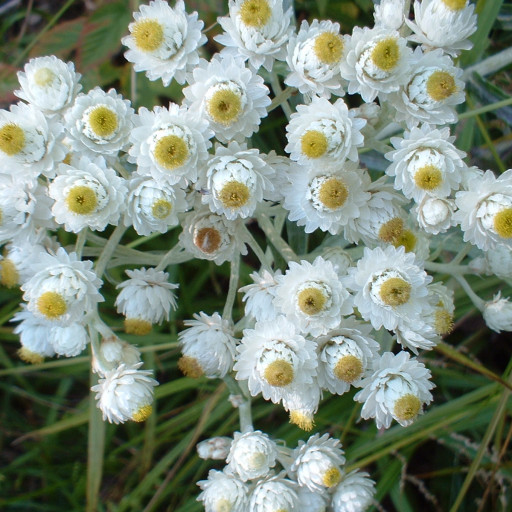
Plant Overview
Known affectionately as the Western Pearly Everlasting, this plant is a resilient beauty that looks like a cluster of tiny pearls or miniature fried eggs. Often found dancing in the wind across North American meadows, it earned its "everlasting" name because the flowers retain their shape and color long after they have been cut and dried. It is a favorite among crafters and a vital sanctuary for specific pollinators.
🔍 How to Identify
- ☁️ The Foliage: The leaves are narrow, sage-green on top, and covered in a thick, silvery-white "fuzz" or woolly coating underneath to help conserve moisture.
- 🍳 The Bloom: What look like white petals are actually dry, papery bracts (modified leaves). These surround a bright yellow center of tiny disc florets.
- 📏 Growth Habit: It typically grows in tidy, upright clumps, reaching about 1 to 3 feet tall, creating a soft, misty look in the landscape.
🏡 In Your Garden
- 🦋 The Butterfly Nursery: This plant is a primary host for the American Lady butterfly. If you see tiny silk nests among the leaves, don't reach for the pesticide—those are caterpillars preparing to transform!
- 🏜️ Tough Love: Pearly Everlasting thrives on neglect. It prefers poor, sandy, or gravelly soil and is remarkably drought-tolerant once established. In fact, soil that is too rich or "happy" can cause the plant to fall over or lose its silvery luster.
⚠️ Safety & Toxicity
- ✅ Status: Generally non-toxic and safe.
- 🐾 Details: This plant is considered safe for humans, cats, and dogs. It lacks the intense alkaloids found in many other wild plants, making it a "worry-free" choice for family-friendly gardens.
✨ Fun Fact
In the Victorian "Language of Flowers," gifting a sprig of Pearly Everlasting symbolized "Always Remembered." Because the papery white bracts don't wilt, it was historically used in funeral wreaths and winter bouquets to represent eternal life.

Detailed Care Instructions
To grow Anaphalis Margaritacea, commonly known as pearly everlasting, follow these steps:
- Choose a suitable location: Anaphalis Margaritacea thrives in full sun to light shade. The soil should be well-draining, fertile, and slightly acidic (pH 6.0-6.5).
- Collect seeds or obtain seedlings: Anaphalis Margaritacea can be grown from seeds or purchased as seedlings from a nursery. If starting from seeds, collect them from dried flower heads in late summer or early autumn.
- Prepare the soil: Clear the planting area of weeds and debris. Loosen the soil using a garden fork or tiller and add organic matter, such as compost, to improve its fertility and drainage.
- Sow the seeds or plant the seedlings: If sowing seeds, scatter them evenly over the prepared soil and lightly press them into the surface. If planting seedlings, dig a hole slightly larger than the root ball and place the seedling in, making sure the top of the root ball is level with or slightly above the soil surface.
- Water and mulch: Water the newly planted seeds or seedlings thoroughly and provide regular watering until they become established. Mulch around the plants to retain moisture, suppress weeds, and regulate soil temperature.
- Provide regular care: Anaphalis Margaritacea is a relatively low-maintenance plant. Water when the top inch of soil is dry and avoid overwatering. Fertilize in early spring with a balanced fertilizer according to the package instructions. Remove any dead flowers or foliage to encourage continuous blooming.
- Protect from pests and diseases: Anaphalis Margaritacea is generally resistant to pests and diseases. However, keep an eye out for common garden pests like aphids, snails, or slugs. Use organic methods to control them if necessary.
- Divide and propagate: Over time, Anaphalis Margaritacea can become crowded. Dividing the plant every 3-4 years in early spring can help maintain its health and vigor. Carefully dig up the clump and separate it into smaller sections, ensuring each section has healthy roots and shoots. Replant the divided sections in the desired areas.
By following these steps, you can successfully grow Anaphalis Margaritacea and enjoy its beautiful white flowers and silvery foliage.

Place in a bright room that is sun drenched almost all day. Or directly in a south-facing window.

To water this plant, first, you must check the soil moisture level regularly. It is essential to make sure the soil is evenly moist but not waterlogged. Watering should be done slowly and deeply, allowing the water to penetrate the soil and reach the plant's roots. The frequency of watering depends on the weather and the plant's age. During hot and dry weather, watering may need to be increased. However, during humid conditions, watering can be reduced. It is best to water the plant early in the morning or late in the evening to prevent water loss through evaporation. Lastly, the plant must not be allowed to stand in water for an extended period as it can lead to root rot.
To fertilize this plant, use a well-balanced fertilizer with equal amounts of nitrogen, phosphorus, and potassium. Apply the fertilizer in early spring, just before new growth appears. Follow the instructions on the fertilizer package for how much to use per square foot. Avoid over-fertilizing, as this can cause the plant to become leggy and weak.
It is recommended to use a well-draining soil mixture with a neutral to slightly acidic pH for the Anaphalis Margaritacea plant. The soil should consist of a blend of organic matter, such as compost or peat moss, and a coarse material, such as perlite or sand, to improve drainage. It is also important to ensure that the soil is not too compact or heavy, as this can lead to waterlogged roots and plant stress. A soil mix that is specifically formulated for alpine or rock garden plants may also be suitable for Anaphalis Margaritacea.
Anaphalis Margaritacea is a perennial herbaceous plant that can be propagated through seeds or cuttings. To propagate through seeds, collect the seeds from mature flowers in the fall, dry them out, and sow them in a well-draining soil mix in early spring. Keep the soil moist and the container in a bright, warm location until the seeds germinate.
To propagate through cuttings, take stem cuttings from mature plants in the early spring. Cuttings should be approximately 4-6 inches in length, taken from non-flowering stems, and should have at least two nodes. Remove the lower leaves from the cutting and dip the cut end in rooting hormone. Plant the cutting in a well-draining soil mix and keep the soil moist. Rooting should occur within a few weeks, and once roots have formed, the new plant can be transplanted into a larger pot or into the garden.








