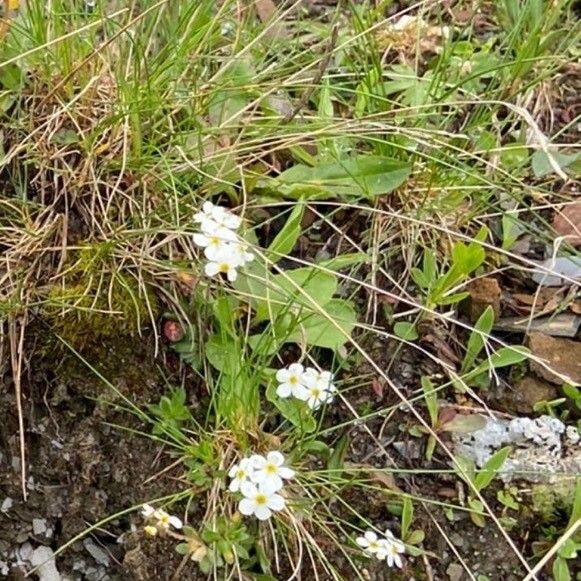
Plant Overview
Often called the Sweet Rock-jasmine, this tiny alpine jewel is a master of survival in some of the harshest environments on Earth. Native to the windswept tundras and rocky peaks of the Northern Hemisphere, it forms dense, silvery mats that look like soft cushions tucked between mountain stones. Its most charming trait is its "expressive" flowers that seem to communicate with the landscape through shifting colors.
🔍 How to Identify
- 🌸 The "Blushing" Eye: Clusters of five-petaled white flowers feature a central "eye" that starts as a bright primrose yellow and turns a deep pink or reddish-purple as the flower ages.
- 🍃 Hairy Rosettes: Small, lance-shaped leaves are arranged in tight, circular rosettes. They are covered in fine, silky white hairs which act as a tiny "fur coat" to protect the plant against frost and drying winds.
- 🧶 Mat-Forming Habit: The plant spreads via thin, reddish runners (stolons), creating a low-growing carpet that hugs the ground to stay out of the biting alpine wind.
🏡 In Your Garden
- 🏔️ Alpine Aspirations: Because it originates from high-altitude scree slopes, it demands "perfect" drainage. It is a favorite for rock gardens or "trough" containers where its roots can stay cool and dry among grit and stones.
- 💧 The Dampness Danger: While it can survive freezing temperatures that would kill most plants, it is highly sensitive to winter wetness. In a garden setting, a layer of gravel around the base of the plant is essential to keep the foliage from resting on damp soil, which causes rot.
⚠️ Safety & Toxicity
- ✅ Non-Toxic Status: Androsace chamaejasme is generally considered non-toxic to humans, dogs, and cats. It is not known to contain any harmful alkaloids.
- 🧤 Delicate Roots: The primary safety concern is for the plant itself! It grows a long taproot to anchor into rocky crevices, making it very difficult to transplant. Once you find a spot for it, it’s best to leave it undisturbed.
✨ Fun Fact
The color change in the flower’s center isn't just for show—it is a sophisticated "stoplight" for pollinators. Bees are more attracted to the yellow centers, which signal a fresh supply of nectar. Once the flower is pollinated, the center turns red, a color bees don't see well, directing them toward the unpollinated yellow flowers instead!

Detailed Care Instructions

Place in a bright room that is sun drenched almost all day. Or directly in a south-facing window.

Some plants require more regular watering than others, which should be done every few days. It's critical to maintain the soil moist all of the time. The water requirements of the same plant placed in pots with varying sizes will differ. Because the water in the smaller pot evaporates faster than the water in the larger pot, it will require more watering. Regardless of pot size, the surface should constantly be maintained moist.








