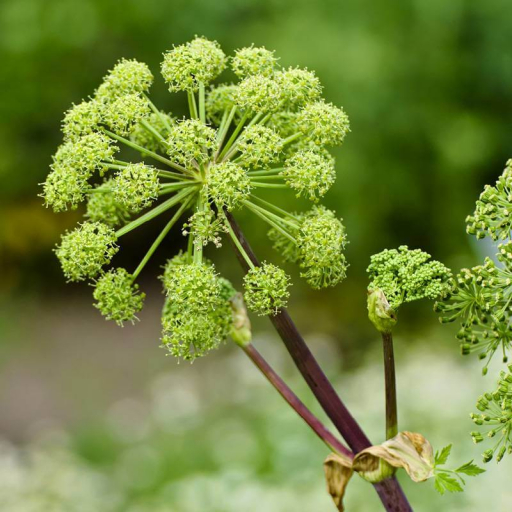
Plant Overview
Known as the "Holy Ghost" or "Wild Celery," Garden Angelica is a majestic herb with a heavenly reputation. According to European folklore, the Archangel Michael revealed this plant to a monk as a cure for the plague, earning it a permanent place in monastery gardens. Its sweet, musky scent—somewhere between juniper and celery—makes it a favorite for both herbalists and gin distillers.
🔍 How to Identify
- 🌿 Stature: A true giant of the herb garden, it can reach heights of 6 to 9 feet, standing tall on thick, hollow, often purple-tinted stems.
- ☁️ Flowers: It produces massive, globe-shaped clusters (umbels) of tiny greenish-white flowers that look like soft, exploding fireworks.
- 🍃 Foliage: The leaves are large, bright green, and divided into serrated leaflets, closely resembling oversized parsley or celery leaves.
🏡 In Your Garden
- 💧 Thirsty Nature: Unlike many Mediterranean herbs, Angelica loves "wet feet." It thrives in damp, fertile soil and is a perfect choice for the edges of ponds or low-lying areas of the yard.
- 🌱 The Taproot Rule: This plant produces a long, sensitive taproot very early in its life. Because of this, it hates being moved; choose its permanent home carefully, as transplanting usually results in the plant wilting away.
- ⏳ Short-Lived Legacy: It is a biennial, meaning it grows leaves the first year, flowers and seeds the second, and then typically dies. To keep it in your garden forever, allow it to self-seed naturally.
⚠️ Safety & Toxicity
- ☀️ Sun Sensitivity: The sap contains furocoumarins, which can cause "phytophotodermatitis"—a painful skin rash or blistering that occurs when the sap on your skin is exposed to sunlight. Always wear gloves and long sleeves when pruning.
- 🐾 Pet Caution: While humans use the stems for candy and tea, the plant is considered mildly toxic to cats and dogs if consumed in large amounts, potentially causing digestive upset.
- 🚫 Deadly Lookalikes: If you find a plant that looks like this in the wild, do not touch or eat it. Angelica looks dangerously similar to Water Hemlock and Giant Hogweed, both of which are extremely toxic or even deadly.
✨ Fun Fact
The hollow stems of this plant have been used for centuries to create "Candied Angelica." The stems are boiled in sugar syrup until they turn a vibrant, translucent emerald green, then used to decorate royal cakes and traditional French pastries.

Detailed Care Instructions
To grow Angelica Archangelica, follow these steps:
- Choose a suitable location: Angelica Archangelica prefers full or partial shade. It also prefers moist soil that is rich in organic matter. Choose a location in your garden that meets these requirements.
- Prepare the soil: Angelica Archangelica prefers deep, loamy soil that retains moisture well. Before planting, loosen the soil using a garden fork or tiller. Remove any weeds or debris, and incorporate organic matter such as compost or well-rotted manure to improve soil fertility.
- Sow the seeds: Angelica Archangelica can be grown from seeds. Sow the seeds directly into the prepared soil in spring, as soon as the soil can be worked. Scatter the seeds evenly across the soil surface, then lightly cover them with a thin layer of soil or compost. Water gently to keep the soil consistently moist.
- Maintain moisture: Angelica Archangelica requires consistently moist soil to thrive. Water the plants regularly, especially during dry spells or hot weather. Mulching around the plants with organic material, such as straw or wood chips, can help retain moisture in the soil.
- Provide support: Angelica Archangelica can grow quite tall, reaching up to 5 or 6 feet. To prevent the tall stems from bending or breaking, provide support by staking or using plant cages. This will help the plants stay upright and prevent damage.
- Fertilize: Angelica Archangelica benefits from regular fertilization. Apply a balanced organic fertilizer, such as compost or well-rotted manure, in early spring and again in midsummer. This will ensure the plants receive adequate nutrients for healthy growth.
- Harvesting: Angelica Archangelica is typically harvested in the second year. In the fall of the first year, you can cut back the leaves while leaving the crown intact. In the second year, you can harvest the leaves, stem, and seeds for culinary or medicinal purposes. Harvesting should be done before the plant flowers to ensure the best flavor and potency.
Remember to check your local gardening guidelines for specific recommendations on growing Angelica Archangelica as the optimal conditions may vary based on your location.

Place in a bright room that is sun drenched almost all day. Or directly in a south-facing window.

To water this plant, you should first make sure that the soil is slightly damp before watering. It prefers to be kept moist but not soaking wet. Watering should be done evenly, without letting water accumulate in the pot or around the base of the plant. It is recommended to water it in the morning or evening when the sun is not too strong to reduce the risks of evaporation. Use room temperature water to avoid shocking the plant with sudden temperature changes. Additionally, when watering, avoid wetting the leaves and stem as it can lead to fungal diseases.
- Begin fertilizing when the plant is in its active growing stage, typically in late spring or early summer.
- Use a well-balanced fertilizer that contains equal amounts of nitrogen, phosphorus, and potassium.
- Mix the fertilizer according to package instructions and apply it to the soil around the base of the plant.
- Avoid getting fertilizer on the foliage or stems, as this can cause burning or damage.
- Water the plant immediately after fertilizing to help distribute the nutrients throughout the soil.
- Repeat fertilizing once a month during the growing season, or as needed based on the plant's appearance and growth rate.
- Stop fertilizing in the fall when the plant begins to go dormant for the winter.
The ideal soil for a particular plant that is scientifically known as Angelica Archangelica is a well-draining, loamy soil that is rich in organic matter. The soil should have a pH level of 6 to 7.5, which is slightly acidic to neutral. When planting the Angelica Archangelica, amend the soil with aged manure or compost to increase its fertility. Additionally, the plant prefers a spot with partial shade to full sun exposure. Proper soil preparation and the right growing conditions can help ensure a healthy and vibrant Angelica Archangelica plant.
Angelica Archangelica has a unique method for propagation. You can propagate this plant through its seeds, cuttings, or root division.
Propagation through seeds involves collecting the seeds from the plant and then sowing them in a pot or garden bed. The seeds should be planted in a well-draining soil mix and kept moist but not wet. Germination can take several weeks, and the plant will take several years to mature.
Propagation through cuttings involves taking a stem cutting from the plant and rooting it in soil. Cuttings should be taken from a healthy plant in the late spring or early summer. The cutting should be about 6 inches long and have at least two sets of leaves. Dip the cutting in a rooting hormone, and plant it in a pot filled with a well-draining soil mix. Keep the soil moist and in a warm, bright location. The cutting should root in about two to four weeks.
Propagation through root division involves dividing an established plant's root system and planting the new sections in soil. This method should be done during the dormant period, typically in the fall or early spring. Dig up the root system and carefully separate it into sections, each containing a few roots and a small piece of the crown. Replant the new sections in a well-draining soil mix and keep them moist until they establish themselves.
Common pests of the angelica include Spider mites, larvae, snails. Make a habit of checking your angelica frequently for pests so that any infestations can be caught and managed early.








