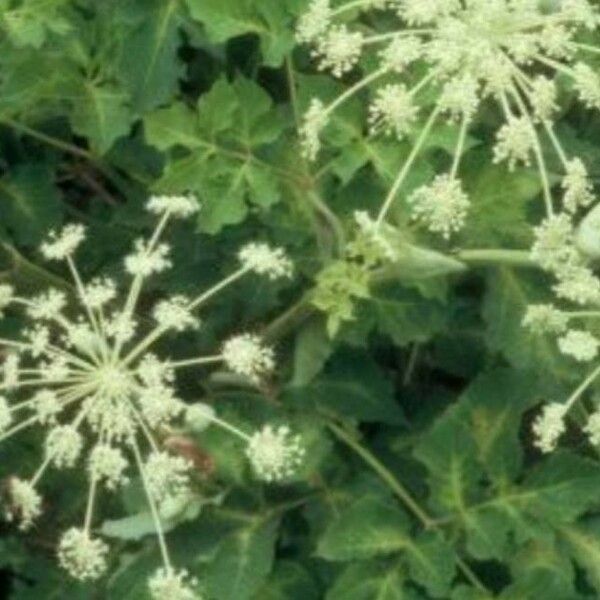
Plant Overview
Commonly known as Chinese Angelica or Bo ye dang gui, this elegant perennial is a staple of East Asian mountain meadows and traditional herbalism. Often admired for its architectural silhouette, it belongs to the same family as carrots and parsley, sporting dramatic, cloud-like white flower heads that seem to float above its sturdy stems. In various cultures, species of Angelica were often nicknamed "Root of the Holy Ghost" because they were believed to bloom on the feast day of the Archangel Michael.
🔍 How to Identify
- 🌿 The Foliage: Large, compound leaves that are deeply divided, giving the plant a lush, feathery appearance similar to a fern but much more robust and "leafy."
- ☁️ The Bloom: Tiny white flowers are clustered into "umbels"—flat-topped or slightly rounded umbrellas that can reach several inches across, creating a lace-like canopy.
- 📏 The Stature: A tall, structural plant that can reach heights of 3 to 5 feet, featuring thick, hollow stems that often display a subtle purple or reddish tint.
🏡 In Your Garden
- 🏔️ Mountain Roots: Originally hailing from the cool, moist mountainous regions of China and Korea, it thrives in dappled shade and rich, organic soil that mimics a nutrient-dense forest floor.
- 💧 The Taproot Rule: This plant develops a deep, sturdy taproot. Because of this, it hates being moved once established; transplanting often leads to "pouting" or plant death. Choose its "forever home" in your garden carefully.
- 🐝 Pollinator Platform: The broad, flat flower heads act as a perfect landing pad for beneficial insects. It is a favorite for hoverflies and tiny parasitic wasps, which act as a natural pest control squad for your other plants.
⚠️ Safety & Toxicity
- ☀️ Phototoxicity: Like many members of the Apiaceae family, the sap contains compounds that can make human skin hypersensitive to UV light. Touching the sap and then being in the sun can cause "phytophotodermatitis"—a painful, blistering rash.
- 🐾 Pet & Child Safety: While used in traditional medicine, raw ingestion can cause stomach upset in pets and children. Always wear gloves when pruning and keep curious nibblers away.
- 🚫 The Deadly Double: WARNING: Angelica polymorpha looks strikingly similar to Water Hemlock and Poison Hemlock, which are among the most toxic plants in the world. Never forage for this plant in the wild unless you are 100% certain of its identity.
✨ Fun Fact
The specific epithet polymorpha literally means "many forms." This refers to the plant’s frustrating (but fascinating) habit of changing its leaf shapes significantly as it matures, often confusing even seasoned botanists!

Detailed Care Instructions

Place in a window with dappled sun or a spot in the middle of a room. Or directly in a window facing west or east.

Some plants require more regular watering than others, which should be done every few days. It's critical to maintain the soil moist all of the time. The water requirements of the same plant placed in pots with varying sizes will differ. Because the water in the smaller pot evaporates faster than the water in the larger pot, it will require more watering. Regardless of pot size, the surface should constantly be maintained moist.








