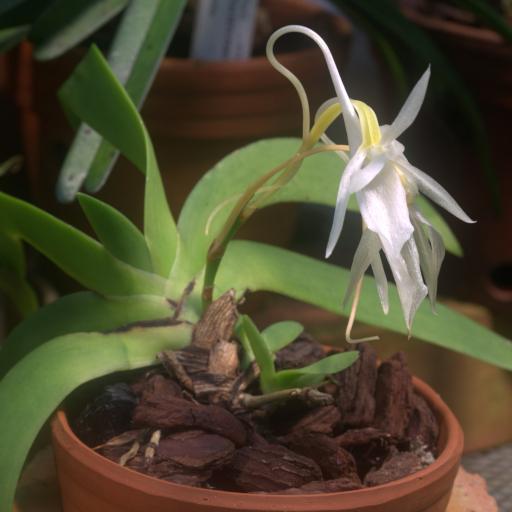
Plant Overview
Often called the "Leonis Orchid" or the "Twin-spurred Angraecum," this Madagascan treasure is a true showstopper for those who appreciate structural beauty. Unlike many orchids that look like a mess of tangled stems when not in bloom, Angraecum leonis boasts a stunning, symmetrical fan of silver-green leaves that looks like a living sculpture. When it does bloom, it fills the night air with a fragrance so sweet and heavy it rivals the finest French perfumes.
🔍 How to Identify
- 🍃 The Architect’s Fan: The leaves are thick, succulent-like, and grow in a perfectly flat, overlapping fan pattern (distichous).
- ❄️ Crystalline Flowers: It produces star-shaped, waxy white blossoms that have a shimmering, crystalline texture under bright light.
- 🧪 The Nectar Spur: Each flower features a long, elegant, curved "tail" or spur that holds nectar, a signature trait of the Angraecum genus.
🏡 In Your Garden
- 💨 Airflow is Vital: In the wild, this orchid grows on the branches of trees where its roots are exposed to the wind. It hates "wet feet," so it performs best in slatted wooden baskets or mounted on cork bark rather than in a traditional pot.
- 💧 The Crown Warning: Because of the tight, fan-shaped arrangement of the leaves, water can easily become trapped in the center. If left there, it can cause "crown rot." Always water the roots directly or ensure there is a fan nearby to dry the foliage quickly.
- ⏳ Slow and Steady: This is a slow-growing species. It rewards patience with longevity, often staying in bloom for several weeks during the winter or spring months.
⚠️ Safety & Toxicity
- 🐾 Pet Friendly: Good news for pet owners! Angraecum leonis is generally considered non-toxic to cats, dogs, and horses.
- 🖐️ Physical Fragility: While not chemically toxic, the leaves are quite rigid and brittle. They do not bend; they snap. Keep it in a low-traffic area where it won't be bumped by passing pets or children.
✨ Fun Fact
This orchid is a night-bloomer's best friend. It releases its intense jasmine-like scent only after the sun goes down to attract its primary pollinators: specialized hawkmoths with incredibly long tongues designed to reach the nectar at the bottom of the flower's spur!

Detailed Care Instructions
To grow Angraecum Leonis, also known as the Lion's Mane Orchid, you can follow these steps:
- Lighting: Provide bright, indirect light. Place the plant near a window where it can receive filtered sunlight, but avoid direct sunlight as it can burn the leaves.
- Temperature: The ideal temperature range for Angraecum Leonis is between 60°F (15°C) and 80°F (27°C). It is important to maintain a consistent temperature to promote healthy growth.
- Humidity: This orchid thrives in high humidity environments. You can increase humidity by placing the pot on a tray filled with water and pebbles, or by using a humidifier near the plant. Alternatively, you can mist the leaves regularly.
- Watering: Watering is crucial for orchids, but consistently moist soil can cause root rot. Wait until the top inch of the soil feels dry, then water thoroughly, ensuring water drains out of the pot. Avoid letting the plant sit in standing water.
- Air circulation: Good air circulation is essential for Angraecum Leonis. Use a fan to ensure proper air movement around the plant, but avoid placing it in a drafty location.
- Potting and medium: These orchids prefer a well-draining medium. Use a mix of bark chips, sphagnum moss, and perlite to create a suitable potting mix. Repotting should be done every 2-3 years or when the plant outgrows its current pot.
- Fertilizer: Feed the orchid with a balanced orchid fertilizer, following the instructions on the packaging. Apply fertilizer every 2-3 weeks during the growing season and reduce frequency during winter.
- Flowering: Angraecum Leonis produces stunning white flowers with long, thread-like petals. It usually blooms in the late spring or summer. To encourage blooming, provide cooler nighttime temperatures and avoid drastic changes in the plant's environment.
- Care during dormancy: These orchids may enter a dormant phase during winter. Reduce watering and fertilization during this time, but continue to provide adequate light and humidity.
By following these care instructions, you can successfully grow Angraecum Leonis and enjoy its beautiful flowers.

Place in a window with dappled sun or a spot in the middle of a room. Or directly in a window facing west or east.

Angraecum Leonis is an epiphytic plant that requires a specific watering technique to survive. To water this plant, it is important to ensure that the soil is moist but not waterlogged. This can be achieved by soaking the substrate in water for around 30 minutes, allowing the roots to absorb the moisture before draining the excess water.
It is important to not let the pot sit in standing water as this can cause root rot and lead to the plant's death. To avoid this, place a layer of pebbles or gravel in the bottom of the pot to elevate it above any excess water.
Angraecum Leonis prefers to be watered in the morning and needs to dry out slightly between waterings. The frequency of watering will depend on the environment, the size of the pot, and the substrate used.
It is also important to provide humidity for the plant, which can be achieved by misting daily or placing the pot on a tray of damp pebbles. Remember to avoid getting water on the leaves as this can cause fungal diseases.
Overall, it is important to monitor and adjust the watering routine based on the plant's needs to ensure optimal growth and health.
- Choose a balanced fertilizer with a nitrogen-phosphorus-potassium ratio of 20-20-20.
- Dilute the fertilizer to half strength as recommended on the label.
- Apply the fertilizer every two weeks during the plant's growing season (spring and summer).
- Water the plant thoroughly before fertilization to prevent clogging of the roots.
- Apply the fertilizer to the soil, avoiding contact with the plant's foliage.
- Do not fertilize the plant during its dormant season (fall and winter).
Angraecum Leonis plant requires a well-draining soil mix that is aerated and light. A soil mix that is composed of small bark chips, perlite, and charcoal is ideal for these plants. It is important to avoid using heavy soil mixes that can retain too much moisture as this can cause root rot and other fungal diseases. The soil mix should be slightly acidic and have a pH level of around 5.5-6.0. Angraecum Leonis plant thrives in bright indirect light and high humidity, so the soil mix should be able to absorb moisture and allow air to circulate around the roots. Regular fertilization with a balanced orchid fertilizer is also recommended to promote healthy growth and blooming.
An orchid enthusiast can propagate Angraecum Leonis by dividing its aerial roots and carefully separating the plant into multiple sections. One should ensure that each section has a good amount of healthy roots and some leaves attached. The new sections can then be potted into individual containers with fresh potting soil and watered lightly. It is important to keep the new plantings in a shaded area and maintain a consistent watering schedule until they have established themselves in their new environment. With proper care and attention, Angraecum Leonis can thrive and produce beautiful flowers.
Common pests of the angraecum leonis include Scale insect, mealybugs, spider mites, thrips. Make a habit of checking your angraecum leonis frequently for pests so that any infestations can be caught and managed early.








