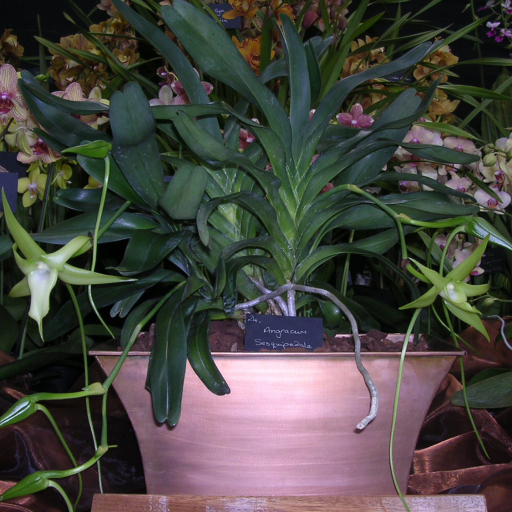
Plant Overview
Often called the "Star of Bethlehem Orchid" or "Comet Orchid," Angraecum is a genus of ethereal, star-shaped orchids primarily native to Madagascar and tropical Africa. These plants are famous for their ghost-white blossoms and their heavy, sweet fragrance that only emerges after sunset. They carry an air of Victorian mystery, having played a pivotal role in the history of evolutionary biology.
🔍 How to Identify
- ⭐ The Bloom: Large, waxy, star-shaped flowers that typically appear in shades of pristine white, ivory, or pale crystalline green.
- 🧬 The Nectary: A distinctive, remarkably long "spur" or tail hanging from the back of the flower, which holds the plant’s nectar.
- 🍃 The Foliage: Thick, leathery, strap-like leaves that grow in a two-ranked (distichous) fashion, creating a neat, fan-like appearance along a single central stem.
🏡 In Your Garden
- 🌬️ Air and Humidity: As epiphytes (plants that grow on trees), they crave high humidity and excellent air circulation. They prefer "chunky" orchid bark or mounting on slabs rather than traditional potting soil.
- 🚫 Root Sensitivity: These orchids are famously "homebodies." They have sensitive, brittle roots that resent being disturbed, so it is best to avoid repotting until the growth truly overflows its container.
- 🌓 Light Nuance: They enjoy bright, filtered light—think of the dappled sun through a tropical canopy. If the leaves turn dark forest green, they need more light; if they yellow, they are getting too much.
⚠️ Safety & Toxicity
- ✅ Status: Generally Non-Toxic.
- 🐾 Details: Angraecum orchids are not known to be poisonous to cats, dogs, or humans. However, because they are often treated with specialized fertilizers or pesticides in a greenhouse setting, it is still best to keep them out of reach of curious nibblers.
✨ Fun Fact
This plant is the star of a famous scientific "prediction." When Charles Darwin saw the 12-inch long nectar spur of Angraecum sesquipedale, he predicted a moth must exist with a tongue long enough to reach the bottom. Decades later, the Morgan’s Sphinx Moth was discovered, proving him right!

Detailed Care Instructions

Some plants require more regular watering than others, which should be done every few days. It's critical to maintain the soil moist all of the time. The water requirements of the same plant placed in pots with varying sizes will differ. Because the water in the smaller pot evaporates faster than the water in the larger pot, it will require more watering. Regardless of pot size, the surface should constantly be maintained moist.







