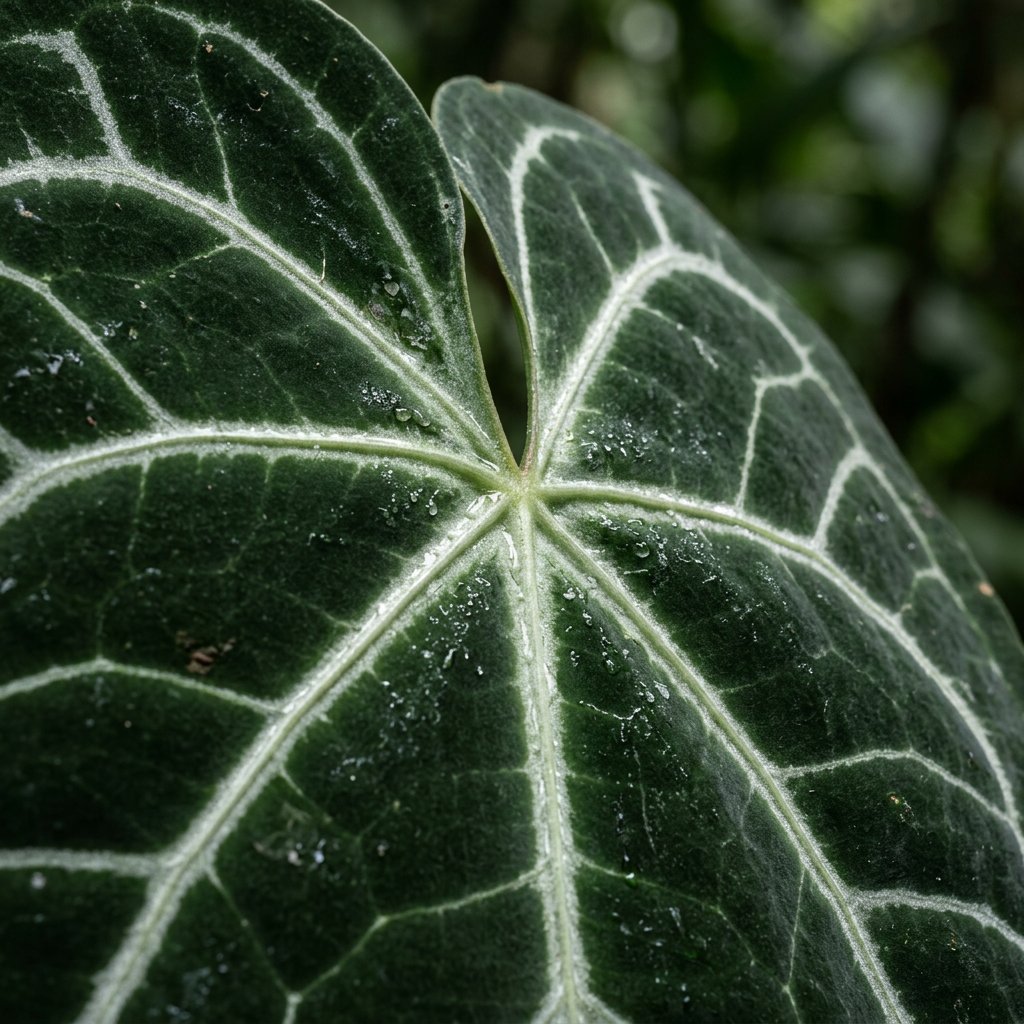
Plant Overview
Often called the "Crystal Anthurium," this emerald gem looks like it was plucked from a Victorian velvet parlor. While its cousin, the Flamingo Flower, is famous for bright waxy blooms, Anthurium crystallinum is celebrated entirely for its majestic foliage. Its deep green, heart-shaped leaves act as a living canvas for shimmering, crystalline veins that appear to glow when they catch the light.
🔍 How to Identify
- 🍃 The Velvet Touch: Large, heart-shaped (cordate) leaves that have a luxurious, suede-like texture rather than a glossy finish.
- 💎 Crystalline Veins: Prominent, silvery-white veins that trace a geometric pattern across the leaf, catching the light with a distinct "sparkle."
- 📏 Rounded Petioles: The leaves sit atop long, smooth, rounded stems (petioles) that emerge from a central base.
- 🌱 Subtle Blooms: It produces a modest, narrow green spathe and a brownish-yellow spadix—an understated flower that takes a backseat to the dramatic leaves.
🏡 In Your Garden (or Living Room)
- ☁️ Humidity is King: This plant hails from the rainforests of Central and South America; it craves high humidity (ideally above 60%). In dry household air, the leaf edges will quickly turn brown and "crispy."
- 🥣 The "Aroid" Diet: It hates heavy, suffocating soil. To keep it thriving, use a chunky, airy mix of orchid bark, perlite, and sphagnum moss. This mimics the debris-filled nooks in trees where these plants often grow in the wild.
- ☀️ Filter the Sun: Direct sunlight is the enemy of the Crystal Anthurium. It prefers bright, indirect light that mimics the dappled sunshine of a forest canopy—too much sun will bleach and burn the velvet.
⚠️ Safety & Toxicity
- 🚫 Toxic Status: Highly toxic to both humans and pets (cats and dogs).
- 👄 The Danger: The plant contains insoluble calcium oxalate crystals. If leaves are chewed or swallowed, they cause immediate intense burning of the mouth, tongue, and throat, along with potential swelling and digestive upset.
- 🧤 Skin Sensitivity: The sap can cause mild skin irritation for some gardeners, so it is best to wear gloves when pruning or repotting.
✨ Fun Fact
The "shimmer" on the veins isn't just a pretty color—it’s a survival tactic! The plant's epidermal cells are shaped like tiny lenses, which help focus even the dimmest light from the rainforest floor into the plant's photosynthetic centers, effectively "magnifying" the sun.

Detailed Care Instructions
| Soil Ph | 5.5-6.5 (Slightly Acidic) |
| Humidity | Normal |
| Lighting | Part Sun |
| Toxicity | Poisonous |
| Soil Type | Coarse, Moist Potting Mix |
| Bloom Time | Flowers Freely |
| Difficulty | Medium |
| Plant Type | Herbaceous Perennial |
| Mature Size | 12 To 18 Inches, 9- To 12-Inch Spread |
| Native Area | Central America, Northern South America, Caribbean |
| Temperature | 22°C - 32°C |
| Sun Exposure | Bright Indirect Light |
| Hardiness Zones | 11-12 |
To grow an Anthurium Crystallinum plant successfully, you can follow these steps:
- Lighting: Place the plant in a location that receives bright, indirect sunlight. Direct sunlight can scorch the leaves, so it's best to provide filtered light or keep it a few feet away from a window.
- Temperature: These plants prefer temperatures between 60-80°F (15-27°C), with a minimum temperature of 55°F (13°C). They are susceptible to cold drafts, so avoid placing them near windows or doors during winter.
- Humidity: Anthurium Crystallinum thrives in high humidity. To increase humidity, you can mist the leaves regularly or place the pot on a tray filled with water and pebbles. Grouping plants together can also create a more humid microclimate.
- Watering: Maintain consistently moist soil, but avoid overwatering. Allow the top inch of soil to dry between waterings. It's better to water with room temperature water, as cold water can shock the roots. Ensure good drainage by using well-draining potting mix.
- Fertilizer: Use a balanced, water-soluble fertilizer at half strength every 2-4 weeks during the growing season (spring and summer). Reduce or stop fertilizing during the winter months when the plant is in a dormant phase.
- Potting and Repotting: Choose a pot that has drainage holes and is slightly larger than the current container. Anthurium Crystallinum prefers being slightly root-bound. Repotting can be done every 1-2 years or when the roots become crowded.
- Pruning: Remove any dead or yellowing leaves by cutting them at the base of the stem. Pruning helps maintain the plant's overall shape and allows for new growth.
- Propagation: Anthurium Crystallinum can be propagated by dividing the plant or through stem cuttings. Divide the plant carefully, ensuring each division has roots attached. For stem cuttings, select a healthy stem with at least one node and place it in moist soil or water until roots develop.
Remember that Anthurium Crystallinum is toxic to humans and pets if ingested, so keep it out of reach. With proper care and attention, your Anthurium Crystallinum can grow and thrive, adding beauty to your indoor space.

Place in a window with dappled sun or a spot in the middle of a room. Or directly in a window facing west or east.

Anthurium Crystallinum is a tropical plant that requires specific care when it comes to watering. To provide adequate moisture to the plant, you should first ensure that the soil is consistently damp but not waterlogged. The best way to achieve this is by watering the plant deeply, allowing the water to soak in and drain away before watering it again.
To avoid overwatering, Anthurium Crystallinum requires well-draining soil, which prevents the roots from becoming waterlogged and rotting. You can use a mix of peat moss, perlite, and bark to achieve the perfect soil composition. Another way to ensure proper drainage is by placing the pot on a tray filled with pebbles and water. This method allows the plant to absorb moisture without sitting in standing water.
It is also important to note that Anthurium Crystallinum prefers slightly humid conditions, so you may need to mist the leaves of the plant occasionally or place a humidity tray nearby. Finally, pay attention to the plant's individual needs; factors such as temperature, light, and size will all affect how much water your Anthurium Crystallinum requires.
To fertilize Anthurium Crystallinum, use a balanced water-soluble fertilizer with an N-P-K ratio of 20-20-20 or 10-10-10 every two weeks during the growing season (spring and summer). Dilute the fertilizer to half strength and apply it directly to the soil. Be careful not to get any fertilizer on the leaves, as this can cause burning. During the fall and winter months, reduce fertilization to once a month or stop altogether. Always follow the instructions on the fertilizer package for proper application.
Anthurium Crystallinum requires well-draining soil that is high in organic matter. A soil mix made with peat moss, perlite, and orchid bark would be a good choice. The soil pH should be slightly acidic, around 5.5-6.5. The plant prefers moist soil, but not waterlogged conditions. It is important to avoid using soil that is heavy or has poor drainage, as it can lead to root rot. Additionally, adding a layer of organic mulch on top of the soil can help retain moisture and improve soil structure.
Propagation of this plant can be done by root division or stem cuttings. For root division, carefully remove the plant from its pot and gently separate the roots into smaller sections. Each section should have at least two stems and a healthy root system. Replant these sections into fresh soil and water thoroughly.
For stem cuttings, choose a healthy stem and cut below a leaf node. The cutting should be around 6-8 inches in length and have at least two leaves. Remove any lower leaves and dip the cut end in rooting hormone. Plant the cutting in moist soil and cover with plastic wrap to create humidity. Keep the soil moist and the cutting in a warm, bright location. After a few weeks, new growth should appear indicating successful rooting.
Common pests of the flamingo flower include Mealybugs, spider mites, thrips. Make a habit of checking your flamingo flower frequently for pests so that any infestations can be caught and managed early.








