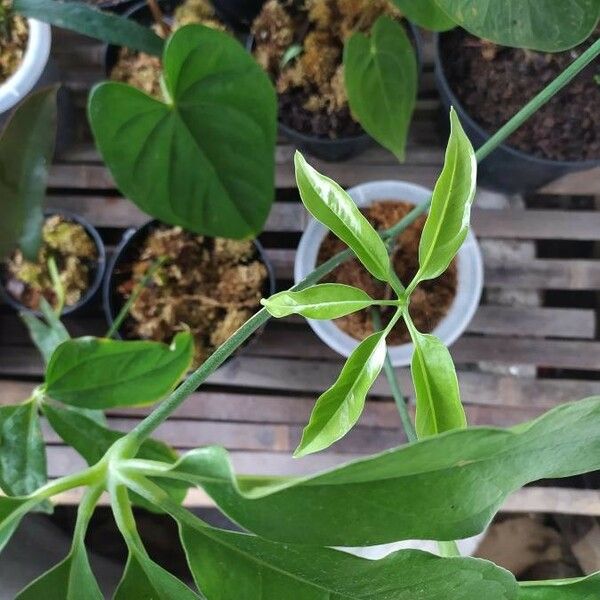
Plant Overview
Often called the "Hand of the Jungle," the Anthurium digitatum is a dramatic departure from the classic heart-shaped leaves most people associate with this genus. Native to the lush rainforests of Venezuela and Colombia, this climber is a prized "unicorn" for collectors who love architectural foliage. It brings a prehistoric, tropical vibe to any indoor space, looking more like a prehistoric palm than a typical houseplant.
🔍 How to Identify
- 🖐️ Leaf Structure: The most striking feature is its "digitately compound" foliage. Instead of one solid blade, the leaf is divided into several distinct leaflets that radiate from a single point, resembling an open hand or a fan.
- 🌿 Texture & Sheen: The leaflets are typically leathery and semi-matte. Unlike the velvety Anthuriums, these are built to be tough, with prominent veins that give the "fingers" a ribbed appearance.
- 🧗 Growth Habit: This is a vigorous hemiepiphyte. It begins its life on the forest floor but quickly seeks out a tree trunk to climb, using thick aerial roots to anchor itself as it ascends toward the canopy.
🏡 In Your Garden
- 🪜 The Vertical Requirement: Because of its climbing nature, this plant will struggle to look its best in a standard hanging basket. It requires a sturdy moss pole or wooden plank to mimic a tree trunk; providing this support actually triggers the plant to produce larger, more mature leaves.
- 💨 Root Respiration: In the wild, its roots are often exposed to humid air rather than buried deep in soil. To keep it happy at home, use an "aroid mix" consisting of orchid bark, perlite, and sphagnum moss to ensure the roots can "breathe" and never sit in stagnant water.
⚠️ Safety & Toxicity
- 🚫 Toxic to Ingest: Like all members of the Araceae family, this plant contains calcium oxalate crystals, which are sharp, microscopic needles.
- 🐾 Pets & Children: Ingestion can cause immediate mouth irritation, swelling of the throat, and digestive distress. It is best kept on high shelves or in a dedicated plant room away from curious pets and toddlers.
✨ Fun Fact
- 🧬 Numerical Mystery: The name digitatum comes from the Latin word for "finger." While a young plant might only have three to five leaflets, a fully mature Anthurium digitatum can grow up to 13 "fingers" on a single leaf stalk, creating a massive, circular green halo!

Detailed Care Instructions

Place in a window with dappled sun or a spot in the middle of a room. Or directly in a window facing west or east.

The presence of a dry surface layer of soil does not indicate that the plant requires water. Instead, stick your finger 1-2" (3-5 cm) deep in the soil to feel dampness or moisture content. If the soil seems dry, it's time to water your greens. If the soil is still moist, however, it is better not to water your plant and instead wait a day or two. Overwatering or waterlogging raises the risk of root rot. So if the soil takes longer than a week to dry, check the light conditions because it's likely that the plant isn't getting enough light. It's fine if the upper layer of soil is dry between waterings, but the deeper soil layer should always have some moisture.
These plant needs regular fertilizing during growing seasons. Fertilizing your plants in dormant state during the winter, might result in scorching or browning of the leaf tips. If mature plants display signs of nutrient insufficiency, fertilizer administration is necessary to restore the plant to its previous state.
You may use All Purpose Plant Food or Green Plant Food for your Anthurium Digitatum
Common pests of the anthurium digitatum include Mealybugs, spider mites, thrips. Make a habit of checking your anthurium digitatum frequently for pests so that any infestations can be caught and managed early.








