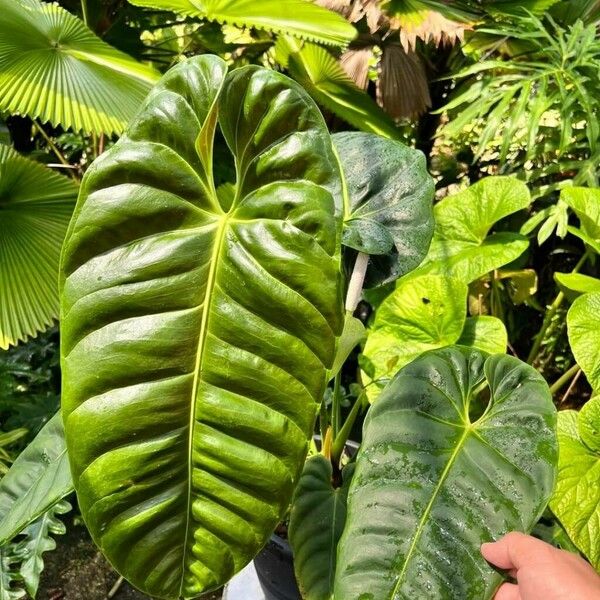
Plant Overview
The Anthurium esmeraldense is a true crown jewel of the Ecuadorian rainforest, named after the Esmeraldas province where it originates. Often referred to by collectors as the "Emerald Strap Leaf," this plant is prized for its dramatic, elongated foliage that hangs like living velvet ribbons. Unlike the common waxy-flowered Anthuriums found in grocery stores, this species is a sophisticated choice for those looking to turn their home into a lush, tropical sanctuary.
🔍 How to Identify
- 🍃 Leaf Shape: The leaves are remarkably long and narrow (lanceolate), often reaching over two feet in length while remaining quite slim.
- 🟢 Deep Pigmentation: The foliage is a rich, saturated emerald green with a matte, almost velvety sheen that absorbs light rather than reflecting it.
- 📐 Prominent Midrib: A thick, sturdy central vein runs down the leaf, providing a structural "spine" that allows the heavy leaves to drape gracefully downward.
🏡 In Your Garden
- ☁️ Humidity is Non-Negotiable: Because it hails from the cloud forests of Ecuador, this Anthurium craves high humidity (60% or higher). Without it, the tips of those beautiful long leaves may turn brown and crispy.
- 🪴 The "Aroid" Airy Mix: It hates "wet feet." Instead of standard potting soil, it thrives in a chunky mix of orchid bark, perlite, and charcoal. This mimics its natural habit of growing on trees (epiphytic) rather than in the heavy ground soil.
- 💧 Watering Nuance: It prefers to stay consistently moist but never soggy. Think of a wrung-out sponge; that is the moisture level it enjoys most.
⚠️ Safety & Toxicity
- 🚫 Status: Toxic to humans and pets.
- 🐾 Details: Like all members of the Araceae family, it contains insoluble calcium oxalate crystals. If chewed or swallowed, it causes immediate mouth irritation, swelling of the throat, and digestive upset. Keep it on a high shelf away from curious cats or toddlers.
✨ Fun Fact
In its natural habitat, Anthurium esmeraldense is a "pendant" epiphyte, meaning it spends its entire life hanging off the sides of mossy trees. This is why the leaves grow straight down—it’s an evolutionary trick to shed heavy rainwater quickly so the plant doesn't get weighed down or develop fungal rot!

Detailed Care Instructions

Place in a window with dappled sun or a spot in the middle of a room. Or directly in a window facing west or east.

The presence of a dry surface layer of soil does not indicate that the plant requires water. Instead, stick your finger 1-2" (3-5 cm) deep in the soil to feel dampness or moisture content. If the soil seems dry, it's time to water your greens. If the soil is still moist, however, it is better not to water your plant and instead wait a day or two. Overwatering or waterlogging raises the risk of root rot. So if the soil takes longer than a week to dry, check the light conditions because it's likely that the plant isn't getting enough light. It's fine if the upper layer of soil is dry between waterings, but the deeper soil layer should always have some moisture.
These plant needs regular fertilizing during growing seasons. Fertilizing your plants in dormant state during the winter, might result in scorching or browning of the leaf tips. If mature plants display signs of nutrient insufficiency, fertilizer administration is necessary to restore the plant to its previous state.
You may use All Purpose Plant Food or Green Plant Food for your Anthurium Esmeraldense
Common pests of the anthurium esmeraldense include Mealybugs, spider mites, thrips. Make a habit of checking your anthurium esmeraldense frequently for pests so that any infestations can be caught and managed early.








