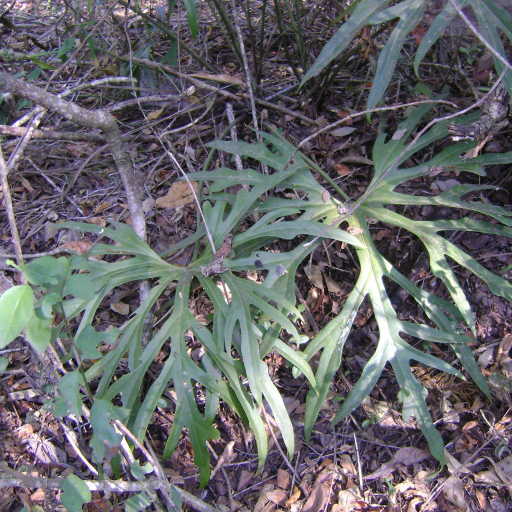
Plant Overview
Often called the "Finger-Leaf Anthurium," this Mexican native looks like something pulled straight from a Jurassic jungle. Unlike its cousins with heart-shaped leaves, Anthurium podophyllum features deeply lobed, skeletal foliage that looks like a green hand reaching out from the soil. It is a sophisticated choice for collectors who want the drama of an aroid without the typical "valentine" leaf shape.
🔍 How to Identify
- 🖐️ Finger-Like Lobes: The most striking feature is its "pedate" leaves, which split into multiple narrow segments or "fingers" as the plant matures.
- 🌿 Texture & Color: The leaves are leathery (coriaceous) to the touch and a deep, matte forest green, often with prominent veining.
- 📏 Sturdy Petioles: The leaves sit atop long, stiff stalks that grow upright, giving the plant a structural, architectural silhouette.
🏡 In Your Garden
- 🧗 A Natural Climber: While it starts as a terrestrial plant, it loves to climb. Providing a moss pole or cedar plank mimics its natural habit of scaling tropical trees to reach better light.
- 🌬️ Airy Roots: Because it is an aroid, its roots hate "wet feet." It thrives in a chunky, bark-heavy potting mix that allows oxygen to circulate around the root system.
- 💧 Humidity Lover: Coming from the humid forests of Veracruz, it will struggle in dry, air-conditioned rooms. Grouping it with other plants or using a humidifier keeps those dramatic leaf tips from browning.
⚠️ Safety & Toxicity
- 🚫 Toxic Status: Highly toxic if ingested.
- 🐾 The Risk: Like all members of the Araceae family, it contains insoluble calcium oxalate crystals. If chewed by pets or children, it causes immediate mouth pain, swelling of the throat, and digestive distress.
- 🧤 Skin Sensitivity: The sap can be a mild skin irritant for some people; it’s wise to wear gloves when pruning or propagating.
✨ Fun Fact
This plant is a master of disguise! When Anthurium podophyllum is a "baby," its leaves are simple and oval. As it grows older, it undergoes a process called heteroblasty, where the leaves completely change shape to become the complex, multi-fingered structures seen in adult plants.

Detailed Care Instructions
To grow Anthurium Podophyllum plant, follow these steps:
- Choose a suitable location: Anthurium Podophyllum prefers indirect bright light. Place the plant near a north or east-facing window where it can receive filtered sunlight.
- Temperature and humidity: Maintain a temperature of 60°F to 75°F (15°C to 24°C). Anthurium Podophyllum thrives in high humidity, so mist the leaves regularly or place the pot on a tray filled with water and pebbles to increase humidity.
- Soil and pot: Use well-draining potting soil that retains some moisture. The pot should have drainage holes to prevent waterlogging. Select a pot that is slightly larger than the root ball to allow for growth.
- Watering: Water the plant when the top inch of soil feels slightly dry. Anthurium Podophyllum prefers slightly moist soil but be cautious of overwatering, as it can lead to root rot. Ensure the pot drains well after watering.
- Fertilization: Feed the plant with a balanced liquid fertilizer every two to four weeks during the growing season (spring and summer). Dilute the fertilizer according to the package instructions.
- Pruning: Trim any yellow or brown leaves and remove dead flowers to encourage new growth. Regularly inspect the plant for pests such as aphids or mealybugs and take appropriate measures to control them.
- Propagation: Anthurium Podophyllum can be propagated through stem cuttings or division. Take a stem cutting with at least two nodes and place it in a well-draining, moist potting mix. Keep it in a warm, humid environment until it develops roots.
- Repotting: Repot the Anthurium Podophyllum every two to three years or when the roots start to outgrow the pot. Choose a pot that is slightly larger and replace the old soil with fresh potting mix.
By following these steps, you can successfully grow and care for Anthurium Podophyllum plant.

Place in a window with dappled sun or a spot in the middle of a room. Or directly in a window facing west or east.

To water the Anthurium Podophyllum plant, ensure that you follow proper care guidelines to keep it healthy. First, examine the soil moisture level by sticking your finger one inch into the soil. If it feels dry at this depth, it's time to water the plant.
Choose a suitable watering method, such as using a watering can with a narrow spout or a spray bottle. This will enable you to precisely water the soil without wetting the foliage excessively. Gently pour water at the base of the plant, aiming for the soil rather than the leaves or flowers.
Water the Anthurium Podophyllum plant until you notice water escaping through the drainage holes at the bottom of the pot. This ensures that water reaches the roots and effectively hydrates the plant. However, be cautious not to overwater, as excessive moisture can lead to root rot or other issues.
Maintain a consistent watering schedule, usually once every seven to ten days, depending on various factors such as humidity, temperature, and soil composition. It's essential to allow the top layer of soil to dry out between waterings, as Anthurium Podophyllum plants prefer slightly drier conditions.
Additionally, take into consideration the environmental conditions surrounding the plant. Increased humidity levels may reduce the frequency of watering, while drier environments may necessitate more frequent watering to prevent the soil from drying out completely.
Regularly monitor the plant's overall health to determine if any adjustments to the watering routine are necessary. Healthy Anthurium Podophyllum plants exhibit vibrant and glossy leaves, while those underwatered may show signs such as drooping or yellowing foliage.
While watering is an essential part of caring for the Anthurium Podophyllum plant, remember to consider other factors such as light, temperature, and fertilization to provide comprehensive care for this tropical plant.
- Start by choosing a suitable fertilizer for Anthurium Podophyllum, preferably a balanced water-soluble fertilizer.
- Dilute the fertilizer according to the instructions on the package. Use half the recommended strength to avoid over-fertilization, as Anthurium Podophyllum is sensitive to excessive nutrients.
- Water the plant thoroughly before applying the fertilizer. This helps prevent fertilizer burn and ensures the roots are well-hydrated.
- Pour the diluted fertilizer solution onto the soil around the base of the plant. Avoid getting it on the leaves or flowers, as it may cause damage or discoloration.
- Repeat the fertilization process once every 4-6 weeks during the growing season, which is typically spring and summer. Reduce or stop fertilizing during the dormant period in fall and winter.
- Regularly monitor the soil moisture level to prevent waterlogged conditions. Anthurium Podophyllum prefers slightly moist but well-draining soil.
- Observe the plant for any signs of nutrient deficiency or excess. Yellowing or browning leaves, stunted growth, or leaf burn may indicate a problem. Adjust the fertilizer dosage accordingly.
- Rinse the soil with plain water every few months to prevent salt build-up from the fertilizer.
- Keep in mind that while fertilizing is important, it is equally crucial to provide Anthurium Podophyllum with adequate sunlight, proper watering, and suitable temperatures for overall health and growth.
Note: If you require further information specific to a particular type of fertilizer or growing conditions, please specify for more detailed instructions.
Anthurium Podophyllum is a tropical plant that requires specific soil conditions to thrive. The ideal soil for this plant should be well-draining and rich in organic matter. It is recommended to use a mixture of equal parts of peat moss, perlite, and orchid bark.
Peat moss helps to retain moisture while also providing good aeration, ensuring that the roots of the Anthurium Podophyllum do not become waterlogged. Perlite is added to improve drainage and prevent the soil from becoming compacted. Orchid bark provides additional drainage and also enhances the overall structure of the soil.
This soil mixture replicates the natural habitat of Anthurium Podophyllum, which is typically found growing as an epiphyte in the wild. As an epiphyte, it attaches itself to trees and gains nutrients from organic matter accumulating around its roots. Therefore, the rich organic matter in the soil mixture helps to mimic this natural environment and provide necessary nutrients for the plant's growth.
It is important to note that Anthurium Podophyllum is sensitive to overwatering, so it is crucial to use a well-draining soil and to water the plant sparingly. Additionally, the soil should be slightly acidic, with a pH level ranging from 5.5 to 6.5, to ensure optimal growth conditions for the Anthurium Podophyllum plant.
To propagate Anthurium Podophyllum plant, you can follow these steps:
- Select a healthy and mature Anthurium Podophyllum plant that has several well-developed leaves.
- Prepare a well-draining propagation medium such as a mixture of peat moss, perlite, and orchid bark.
- Take a clean and sharp knife or pruning shears and make a clean cut just below a node or a leaf joint.
- Dip the cut end of the stem in a rooting hormone powder or gel to encourage root development.
- Prepare a small pot or container filled with the propagation medium and make a small hole in the center.
- Carefully place the stem cutting in the hole, making sure that the node or leaf joint is buried in the medium.
- Gently press the medium around the stem cutting to provide stability.
- Water the cutting thoroughly and allow excess water to drain out of the pot.
- Create a humid environment by covering the pot with a clear plastic bag or placing it in a propagator.
- Place the pot in a bright but indirect sunlight location to ensure proper growth.
- Mist the cutting daily to maintain humidity levels and prevent the soil from drying out.
- Monitor the cutting regularly for any signs of growth and root development.
- After a few weeks to a couple of months, new roots should start emerging from the buried node.
- Once the cutting has established a healthy root system, you can gradually acclimate it to normal growing conditions by removing the plastic covering or propagator.
- Transplant the rooted cutting into a slightly larger pot with regular potting soil or a suitable Anthurium mix.
- Continue to provide optimal care, including regular watering, indirect sunlight, and appropriate fertilization, to ensure the plant's healthy growth.
Following these steps should help you successfully propagate Anthurium Podophyllum plant.
Common pests of the anthurium podophyllum include Mealybugs, spider mites, thrips. Make a habit of checking your anthurium podophyllum frequently for pests so that any infestations can be caught and managed early.








