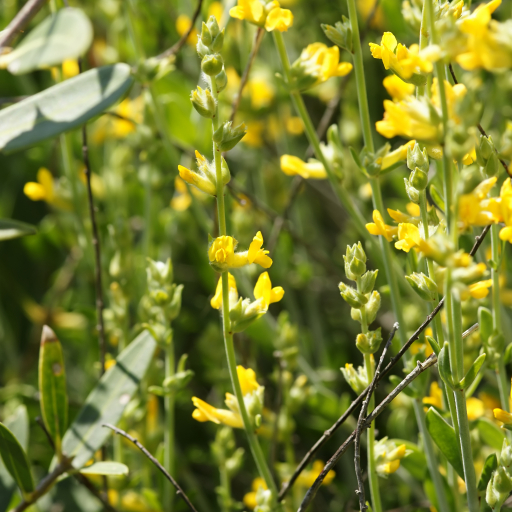
Plant Overview
Known as "Albaida" or "White Broom," this Mediterranean beauty is a master of survival in sun-scorched landscapes. Its common name comes from the Arabic word for "white," referring to the shimmering, silvery-grey sheen that covers its foliage like a protective velvet cloak. It is a staple of the coastal scrublands of Spain and North Africa, turning rocky hillsides into a sea of silver and gold during the peak of spring.
🔍 How to Identify
- 🌿 Silvery Foliage: The leaves and young stems are covered in fine, silky white hairs that reflect sunlight, giving the entire plant a distinct "ghostly" or dusty-grey appearance.
- 🌼 Pea-like Flowers: Clusters of small, vibrant yellow blooms appear in dense spikes. Being part of the legume family, the flowers have a classic "butterfly" or pea-shape.
- 🪵 Woody Habit: It grows as a dense, many-branched shrub, typically reaching about 3 to 4 feet in height, with a rugged, woody base that helps it withstand high winds.
🏡 In Your Garden
- ☀️ A Sun Specialist: This plant is a "heliophile," meaning it thrives in the harshest direct sunlight. It is an ideal choice for xeriscaping, rock gardens, or south-facing slopes where other plants might scorch.
- 🏜️ Soil Improver: Like many legumes, the Albaida has a symbiotic relationship with soil bacteria that allows it to "fix" nitrogen. It actually improves the quality of the soil it grows in, making it perfect for reclaiming "dead" or nutrient-poor patches of land.
- 🐝 Pollinator Buffet: It is a high-value nectar source. During its blooming season, it will likely become the busiest hub in your garden for honeybees and wild solitary bees.
⚠️ Safety & Toxicity
- ✅ Low Risk: Anthyllis cytisoides is generally considered non-toxic and is not known to be a threat to humans or common household pets.
- 🐶 Digestive Caution: While not poisonous, the plant is very fibrous and not meant for consumption. If a curious pet grazes heavily on the woody stems, they may experience minor digestive upset.
✨ Fun Fact
In the Mediterranean, the Albaida is famous among beekeepers. It is the primary source for "Albaida Honey," a gourmet variety prized for its exceptionally light color, delicate floral scent, and its ability to stay liquid for a long time without crystallizing.

Detailed Care Instructions
To grow Anthyllis cytisoides plant, you can follow these steps:
- Select a suitable location: Choose a spot in your garden that receives full sun to partial shade. Anthyllis cytisoides prefers well-draining soil, so ensure the area has good drainage.
- Prepare the soil: Before planting, prepare the soil by loosening it and removing any weeds or debris. If the soil is heavy, improve drainage by adding organic matter, such as compost or well-rotted manure.
- Plant the seeds: If you have seeds, sow them directly into the prepared soil in spring or autumn. Ensure the seeds are covered with a thin layer of soil. Space the seeds about 12 to 18 inches apart.
- Water regularly: Anthyllis cytisoides plants require regular watering, especially during their establishment period. Keep the soil evenly moist but not waterlogged. Once the plants are established, they can tolerate some drought.
- Mulch the soil: Apply a layer of organic mulch, such as bark chips or straw, around the plants. This helps retain soil moisture, suppresses weeds, and regulates soil temperature.
- Prune and shape: To maintain a compact and tidy appearance, prune the plants after flowering. You can trim back any overgrown or leggy branches to encourage branching and bushier growth.
- Fertilize sparingly: Anthyllis cytisoides is a nitrogen-fixing plant, meaning it can convert atmospheric nitrogen into a form usable by plants. Therefore, it generally doesn't require much additional fertilizer. However, if your soil is poor, you can apply a balanced, slow-release fertilizer during the growing season.
- Protect from extreme cold: If you live in a colder climate, provide protection to the plant during winter. Use a thick layer of mulch or cover the plant with a breathable fabric or burlap to shield it from freezing temperatures.
- Monitor for diseases and pests: Anthyllis cytisoides is generally a resilient plant, but it can occasionally be prone to fungal diseases or aphid infestations. Inspect the plant regularly for any signs of damage or diseases, and take appropriate measures to control them, such as using organic fungicides or insecticidal soaps if necessary.
With proper care and maintenance, your Anthyllis cytisoides plant should grow well and provide you with its beautiful yellow blossoms.

Place in a bright room that is sun drenched almost all day. Or directly in a south-facing window.

To water this plant, it is important to first check the soil moisture. Stick your finger about 2 inches into the soil and if it feels dry, it is time to water. Ensure that the water is poured directly onto the soil rather than the leaves. Overwatering can cause root rot, so allow the soil to dry out slightly between watering. When watering, aim for a slow, deep soak, ensuring that the water reaches the root zone. During hot and dry weather, the plant may require more frequent watering. Ensure that any excess water is allowed to drain away, and avoid letting the plant sit in standing water.
This particular plant requires a balanced fertilizer with equal amounts of nitrogen, phosphorus, and potassium. It should be fertilized once a month during the growing season, which is typically spring and summer. Use a slow-release granular fertilizer or a liquid fertilizer diluted to half strength. Apply the fertilizer around the base of the plant, making sure not to get it on the leaves or flowers. Water the plant well after fertilizing.
The recommended soil for Anthyllis Cytisoides should have a neutral to slightly alkaline pH level ideally between 6.5 to 7.5. It should be well-draining and have good aeration to prevent waterlogging. The soil should be sandy or loamy with a moderate amount of organic matter. It is also important that the soil is not too rich in nutrients as a high-nutrient soil can cause the plant to grow too vigorously resulting in weak stems and susceptibility to diseases.
Anthyllis Cytisoides is a perennial plant that belongs to the Fabaceae family. It is native to the Mediterranean region and grows well in warm, sunny areas with well-drained soil.
Propagation of this plant can be done through seeds or cuttings. To propagate through seeds, wait until late summer or early fall when the seed pods have dried and turned brown. Collect the seeds and sow them in a pot or directly into the soil. Keep the soil moist and the temperature warm (around 20-25°C) until the seeds germinate, which usually takes around 2-4 weeks.
To propagate through cuttings, take a 4-6 inch cutting from a mature Anthyllis Cytisoides plant in the spring or summer. Remove the lower leaves from the cutting and dip it into a rooting hormone powder to stimulate root growth. Plant the cutting in a pot filled with well-draining soil and keep it moist and warm (around 20-25°C). Once the cutting has rooted and starts to grow, it can be transplanted into the garden.
Regardless of the propagation method used, it is important to provide the new plants with proper care, such as regular watering and fertilization, to ensure healthy growth.








