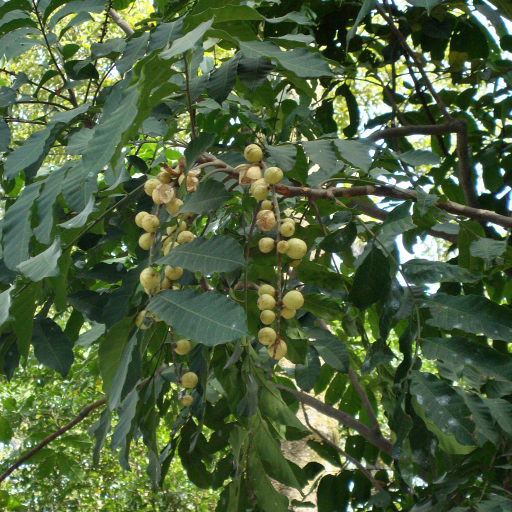
Plant Overview
Often called the Pithraj Tree or Rohituka, this evergreen giant is a regal member of the Mahogany family. Native to the tropical forests of South and Southeast Asia, it is revered in traditional Ayurvedic medicine as a "king" among healing plants. In the wild, its dense, spreading canopy provides a cooling sanctuary for forest creatures, while its striking red fruits add a splash of drama to the landscape.
🔍 How to Identify
- 🍃 Lush Foliage: The leaves are large, glossy, and "odd-pinnate," meaning they grow in pairs along a central stem with one lone leaf at the very tip.
- 🟡 Spiked Flowers: It produces tiny, globose, creamy-yellow flowers that huddle together on long, drooping stalks known as spikes.
- 🔴 Jewel-Like Seeds: The most identifiable feature is the fruit—a three-valved capsule that splits open when ripe to reveal black seeds nestled inside bright, fleshy red coatings (arils).
🏡 In Your Garden
- 💧 Thirst for Humidity: As a tropical native, the Pithraj Tree thrives in high humidity and consistently moist, well-draining soil; it won't tolerate "wet feet" or stagnant water around its roots.
- 🌳 Space to Breathe: This is not a plant for small patios. It develops a thick, woody trunk and a wide-reaching canopy, making it an excellent "anchor tree" for large estates or permaculture projects where shade is needed.
- 🌿 Deep Shade Tolerance: While it enjoys the sun, it is remarkably patient with partial shade, a trait it developed from its natural life as an understory tree in dense jungles.
⚠️ Safety & Toxicity
- 🟢 Generally Safe: This plant is not known for causing skin irritation upon contact and is widely handled for its timber and medicinal bark.
- 🐾 Seed Precaution: While the bark and oil are used medicinally by professionals, the seeds contain high concentrations of fatty acids and bitter compounds. It is best to keep fallen seeds away from curious pets and small children to avoid stomach upset.
✨ Fun Fact
The oil extracted from the seeds of Aphanamixis polystachya is so rich that it was historically used as a fuel for lighting lamps in remote villages and is currently being studied as a potential source for sustainable biodiesel!

Detailed Care Instructions
To grow Aphanamixis Polystachya, also known as the mast tree or soapberry tree, follow these steps:
- Climate requirements: Aphanamixis Polystachya thrives in tropical and subtropical climates. Ensure that the temperature ranges between 20-35°C (68-95°F). It can tolerate both humid and dry conditions.
- Sunlight: Select a location that receives full to partial sun exposure. The tree can tolerate partial shade but prefers bright sunlight for optimal growth.
- Soil requirements: The tree prefers well-draining soil with a pH level between 6 to 7.5. Prepare the soil by adding organic matter such as compost to improve its fertility and drainage.
- Planting method: The most common method of propagation is through seeds. Soak the seeds in water for 24 hours before planting to aid germination. Plant them in individual pots or directly in the ground, burying them about 1-2 cm deep. Water the soil immediately after planting.
- Watering: Keep the soil consistently moist but not waterlogged, especially during the initial stages of growth. Once established, the tree can tolerate moderate drought conditions.
- Fertilization: Apply a balanced slow-release fertilizer during the growing season to promote healthy growth. Follow the manufacturer's instructions for the recommended dosage.
- Pruning: Aphanamixis Polystachya requires minimal pruning. Remove any dead or damaged branches to maintain a clean appearance and enhance its shape. Pruning can be done during the dormant season.
- Pest and disease control: The tree is generally resistant to pests and diseases. However, monitor for any signs of insect infestation or diseases, such as leaf spots or powdery mildew. In case of any issues, use suitable organic or chemical treatments.
- Mulching: Apply a layer of organic mulch around the base of the tree to retain soil moisture, suppress weed growth, and provide additional nutrients.
- Patience: Aphanamixis Polystachya is a slow-growing tree and may take several years to reach maturity and full height. Be patient and provide consistent care throughout its growth journey.

Place in a bright room that is sun drenched almost all day. Or directly in a south-facing window.

To water this plant, ensure that the soil around the roots is moist but not waterlogged. Water the plant once a week with a watering can or a hose attachment on a low setting. Water slowly and deeply to allow the water to penetrate deep into the soil. Avoid getting water on the leaves as this can lead to fungal growth. Check the soil moisture level regularly and adjust watering frequency accordingly. During periods of drought or hot weather, the plant may require more frequent watering. It is also important to ensure proper drainage to prevent roots from becoming waterlogged.
To fertilize this plant, use a water-soluble fertilizer and mix it according to the package instructions. Apply the fertilizer to the soil around the base of the plant, being careful not to get any on the leaves or stems. Water the plant immediately after fertilizing. Repeat this process every two to four weeks during the growing season, which is typically from spring to fall. Avoid fertilizing during the winter months when the plant is dormant.
For optimal growth and health, it is recommended to use a well-draining soil mix that has a slightly acidic to neutral pH level. The soil should be enriched with organic matter and nutrients, as this plant has a high demand for them. A mixture of peat moss, perlite, and vermiculite can be used to create a balanced growing medium. It is important to ensure that the soil is not compacted, as this can impede proper water and oxygen uptake by the plant's roots. Regular fertilization is also necessary to promote healthy growth and flowering.
There are several methods of propagating this plant. One method is through seed propagation. The seeds should be collected from mature fruit pods and sowed in a well-draining soil mix. The mix should be kept moist, but not waterlogged, and placed in a warm, bright location until the seeds germinate.
Another method of propagation is through stem cuttings. Select a healthy stem and take a cutting that is around 4-6 inches in length. Remove the lower leaves and dip the cut end in rooting hormone before planting it in a soil mix. Keep the soil moist and place the cutting in a location with bright, filtered light.
The plant can also be propagated through air layering, which involves wrapping a section of the stem in moist sphagnum moss and covering it with plastic. Roots will develop within the moss, and once they are well-established, the section can be cut and planted in a new pot with soil.
Regardless of the propagation method chosen, it is important to provide the new plant with consistent moisture, warmth, and bright, filtered light until it becomes well-established.








