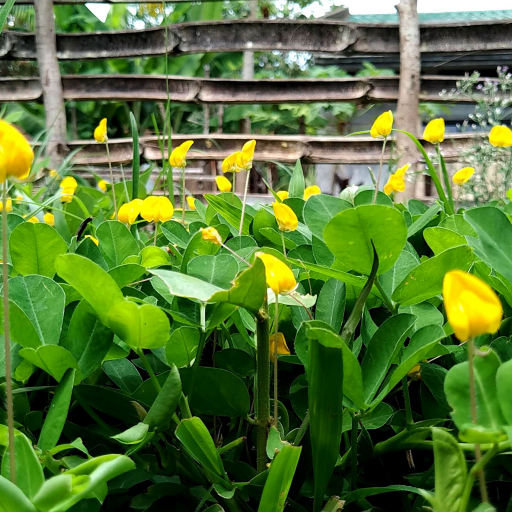
Plant Overview
Often called the "Pinto Peanut" or "Yellow Carpet," Arachis pintoi is a vibrant, low-growing cousin to the common peanut. Originally from Brazil, this tropical perennial has become a favorite for sustainable gardeners looking to replace thirsty lawns with a lush, flowering tapestry. It is celebrated not just for its beauty, but for its "magical" ability to naturally fertilize the soil around it.
🔍 How to Identify
- 🌿 Leaf Structure: It features smooth, oval-shaped leaflets that grow in groups of four. These deep green leaves form a dense, mat-like canopy that crowds out pesky weeds.
- 🌼 The Flowers: Small, pea-like blooms in a brilliant shade of sunny yellow. They emerge throughout the warmer months, looking like scattered gold coins across a green field.
- 🌱 Growth Habit: This is a "creeping" plant. It spreads via stolons (runners) that root at every node, allowing it to hug the ground tightly and prevent soil erosion.
🏡 In Your Garden
- 🧪 Soil Improver: As a legume, this plant has a symbiotic relationship with soil bacteria to "fix" nitrogen. This means it actually feeds the soil as it grows, making it an excellent companion for fruit trees or nitrogen-hungry palms.
- 👣 Lawn Alternative: While it isn’t as tough as Bermuda grass, it handles light foot traffic remarkably well. It’s the perfect solution for those "difficult" spots where grass won't grow or where you want to stop mowing forever.
- 🚿 Drought Resilience: Once its root system is established, it is incredibly hardy. It can survive dry spells by going dormant, only to "wake up" and turn green again as soon as the rains return.
⚠️ Safety & Toxicity
- ✅ Status: Generally Non-Toxic and Safe.
- 🐾 Details: Arachis pintoi is safe for pets, livestock, and children. In fact, it is often used as high-quality forage for cattle and horses because of its high protein content. It does not produce the edible peanuts we eat, but it poses no danger if accidentally nibbled.
✨ Fun Fact
The Pinto Peanut practices a unique botanical trick called "geocarpy." After the yellow flower is pollinated, the stalk (or "peg") actually grows downward, pushing the developing seed underground to ripen in the safety of the soil!

Detailed Care Instructions
| Humidity | High |
| Lighting | Shade |
| Difficulty | Easy |
| Hibernation | Cold Period |
| Temperature | 22°C - 30°C |
| Hardiness Zones | 8 - 12 |
To grow Arachis Pintoi plant, you can follow these steps:
- Choosing the right location: Arachis Pintoi prefers full sun to partial shade. Select an area in your garden that receives at least 6-8 hours of direct sunlight daily.
- Preparing the soil: Arachis Pintoi prefers well-draining soil. If your soil is heavy or clay-like, amend it with compost or organic matter to improve drainage. Ensure the pH of the soil is neutral to slightly acidic.
- Planting the seeds or plugs: Arachis Pintoi can be grown from seeds or plugs. If using seeds, sow them directly into the prepared soil, about half an inch deep. If using plugs, dig holes and place the plugs into the holes, ensuring the top of the plug is level with the soil surface.
- Watering: Keep the soil moist, but not overly saturated, during the establishment period. Water the plant regularly, especially during dry spells. Ensure the soil does not dry out completely.
- Fertilizing: Arachis Pintoi generally does not require much fertilization. However, you can apply a slow-release balanced fertilizer during the growing season to promote healthy growth.
- Weed control: Keep the area around the plant free from weeds, as they can compete with the Arachis Pintoi plant for nutrients and water.
- Mowing: Once the plant establishes itself, you can mow it regularly to maintain a desired height. Maintain a height of around 2-3 inches for an optimal appearance.
- Pest and disease control: Arachis Pintoi is relatively resistant to pests and diseases. However, occasional inspection is recommended to identify and address any issues promptly.
By following these steps, you should be able to successfully grow Arachis Pintoi in your garden.

Place in a window with dappled sun or a spot in the middle of a room. Or directly in a window facing west or east.

Arachis Pintoi plant requires consistent watering, especially during the first few months of growth. It is important to water deeply and ensure that the soil is evenly moist but not waterlogged. Watering should be reduced during the colder months to prevent waterlogging and root rot. It is also recommended to mulch around the base of the plant to help retain moisture in the soil. Meanwhile, it is essential to avoid overhead watering, which may lead to foliar diseases. The plant should be watered during the early morning or late evening to minimize evaporation.
To fertilize this plant, use a slow-release fertilizer with a balanced NPK ratio and apply it in early spring before new growth begins. Be sure to follow the instructions on the package for dosage and application. Additionally, top-dressing the soil with organic matter such as compost can also improve soil fertility and promote healthy plant growth. Avoid over-fertilizing as this can lead to excessive foliage growth and reduced flowering.
Arachis Pintoi is a perennial plant that requires nutrient-rich soil for its growth and development. The soil type that is best suited for this plant is well-draining and rich in organic matter. The ideal pH range for the soil to be used for Arachis Pintoi is between 5.5 and 6.5.
It is recommended to use a soil mixture that contains a significant amount of organic matter, such as compost or other natural fertilizers. The soil should also be able to retain moisture while allowing excess water to drain away, as Arachis Pintoi is susceptible to root rot if the soil is too waterlogged.
In addition to proper soil selection, regular watering and fertilization are important for the overall health of the plant. It is advisable to water Arachis Pintoi regularly and fertilize it with a balanced, slow-release fertilizer to ensure it receives adequate nutrients throughout the growing season.
To propagate this plant, take a healthy stem cutting of about 6-8 inches in length from a mature parent plant. Remove any leaves from the bottom of the stem to expose at least one node. Dip the cut end of the stem into rooting hormone powder. Plant the stem cutting into a pot filled with well-draining soil and water it well. Keep the soil moist and in a warm, bright area with indirect sunlight until the cutting begins to root. Once it has rooted and grown a few inches, it can be transplanted to its permanent location. Alternatively, the plant can also be propagated via seeds or division.








