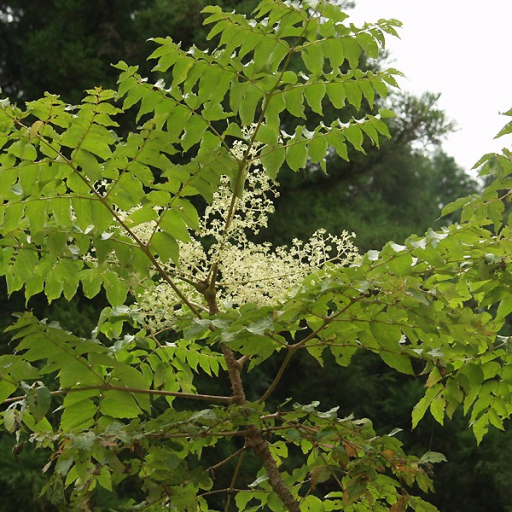
Plant Overview
Known widely as the Japanese Angelica Tree, Aralia elata is a striking, architectural deciduous tree that looks like something out of a prehistoric forest. Often called the "Devil's Walking Stick" (a name it shares with its American cousin), it is prized by gardeners for its dramatic, umbrella-like canopy and large, exotic foliage. In its native East Asia, it is as much a culinary delicacy as it is an ornamental powerhouse.
🔍 How to Identify
- 🌿 Giant Foliage: It features massive, bipinnate (double-feathered) leaves that can grow up to 3 or 4 feet long, giving the tree a lush, tropical appearance even in temperate climates.
- ⚔️ Thick Spines: The gray bark of the trunk and the leaf stalks are heavily armed with sharp, stout prickles that serve as a natural deterrent to climbing animals.
- ☁️ Cloud-like Blooms: In late summer, the tree is topped with huge, airy clusters of tiny white flowers that look like white foam, which later turn into small, dark purple-to-black berries.
🏡 In Your Garden
- 🌱 Spreading Nature: This tree is known for "suckering," meaning it sends out underground runners to create new shoots. If you want a single specimen, you’ll need to prune these babies back; otherwise, it will happily form a dense, thorny thicket.
- 🌤️ Architectural Placement: Because of its unique structure—stiff, upright branches with foliage mostly at the top—it works beautifully as a focal point or a "see-through" plant at the back of a border where its thorny trunk won't snag passersby.
⚠️ Safety & Toxicity
- 🌵 Physical Hazard: The most immediate danger is the sharp spines. Wear heavy-duty gloves when pruning or handling, as they can easily puncture standard gardening gloves.
- 🐾 Mild Toxicity: While the young shoots are a delicacy for humans when prepared correctly, the berries and bark contain saponins which can cause digestive upset in pets or curious children if ingested in quantity. The sap may also cause minor skin irritation for some.
✨ Fun Fact
In Korea and Japan, the young, tender spring shoots of the Aralia elata (known as dureup or tara-no-me) are harvested and fried into tempura or blanched. They are considered the "King of Forest Greens" for their unique, slightly bitter, and earthy flavor.

Detailed Care Instructions
| Toxicity | Poisonous |
| Mature Size | 12' To 40' Tall And 6' To 30' Wide |
| Sun Exposure | Full Sun To Partial Shade |
| Hardiness Zones | 4-8 |
To grow Aralia Elata, also known as Japanese angelica tree or Devils walking stick, follow these steps:
- Choose a suitable location: Aralia Elata grows best in a partially shaded area with well-draining soil. It prefers acidic to neutral soil but can tolerate a range of soil types.
- Propagation: Aralia Elata can be propagated through seeds, cuttings, or division.
- Seeds: Collect fresh seeds from ripened fruits and plant them in the fall. Soak the seeds in water for 24 hours before planting to enhance germination. Sow the seeds 1 inch deep in a pot or directly in the ground.
- Cuttings: Take 6-8 inch semi-hardwood cuttings from healthy plants in late summer or early fall. Remove the leaves from the lower half of the cutting and dip the cut end in rooting hormone. Plant the cutting in a pot filled with well-draining soil and keep it in a warm and humid environment until roots develop.
- Division: Divide established plants during the dormant season (late fall or early spring). Dig up the plant and carefully separate the rooted sections, ensuring each division has intact roots.
- Seeds: Collect fresh seeds from ripened fruits and plant them in the fall. Soak the seeds in water for 24 hours before planting to enhance germination. Sow the seeds 1 inch deep in a pot or directly in the ground.
- Planting: Whether starting from seeds or cuttings, plant the Aralia Elata at the same depth it was previously growing. Space multiple plants about 4-8 feet apart.
- Watering and maintenance: Keep the soil consistently moist, especially during the first year of growth. Water deeply and regularly, especially during dry periods. Adding mulch around the base of the plant helps retain moisture and suppress weed growth.
- Fertilization: Feed the Aralia Elata plant with a balanced, slow-release fertilizer in early spring. Follow the directions on the fertilizer packaging for appropriate application rates.
- Pruning: Prune the plant in early spring to remove dead or damaged branches. Also, remove any suckers that emerge from the base to maintain a single trunk form.
- Winter protection: In colder regions, provide winter protection by mulching the base of the plant with straw or leaves to insulate the roots.
- Pests and diseases: Aralia Elata is generally resistant to pests and diseases, but it may sometimes be susceptible to aphids or scale insects. Inspect regularly and take appropriate measures if infestations occur.
By following these steps, you can successfully grow Aralia Elata and enjoy its striking foliage and unique appearance.

Place in a window with dappled sun or a spot in the middle of a room. Or directly in a window facing west or east.

To properly water this plant, it is important to first check the soil moisture level. Insert a finger into the soil to a depth of about 2 inches. If the soil feels dry, then it is time to water the plant.
When watering, take care to not overwater as this can lead to root rot. The best watering technique is to water deeply and then allow the soil to partially dry out before watering again.
Ensure that the pot has drainage holes and that excess water is able to drain away from the plant. Finally, avoid getting water on the leaves as it can lead to fungal growth and damage.
To fertilize your Aralia Elata plant, apply a balanced fertilizer during the growing season (spring through summer) every 2-3 weeks. Use a slow-release fertilizer or a liquid fertilizer diluted to half-strength. Be sure to water the plant well before and after fertilizing. Avoid fertilizing in the fall and winter when the plant enters dormancy.
Aralia Elata requires well-draining soil that is fertile and rich in organic matter. The pH level of the soil should be slightly acidic to neutral, ideally between 5.5 to 7.5. It thrives in a location with medium moisture and partial shade. The soil should not be waterlogged as it can lead to root rot and other fungal diseases. A good mix for Aralia Elata may include a combination of loamy soil, perlite, compost, and sand. It is important to ensure that the soil is consistently moist but not wet. Regular feeding with a balanced fertilizer can help promote healthy growth.
The most effective way to propagate this plant is through hardwood cuttings taken in the late fall or winter. Select a healthy branch that is at least 6 inches in length and has several buds along its length. Using a sharp, sterile knife, make a clean diagonal cut just below a leaf node. Remove any leaves or buds from the lower two-thirds of the cutting, leaving only two or three leaves at the top. Dip the bottom of the cutting into rooting hormone powder, then plant it in a well-draining potting soil mixture, making sure it is planted deep enough to cover the bottom leaf nodes. Water the cutting well and place it in a warm, bright location out of direct sunlight. Keep the soil moist but not soaking wet and mist the cutting daily to raise the humidity around it. After several weeks, new growth should appear, indicating that the cutting has rooted. At this point, it can be potted on to a larger container or transplanted outdoors in a protected location.








