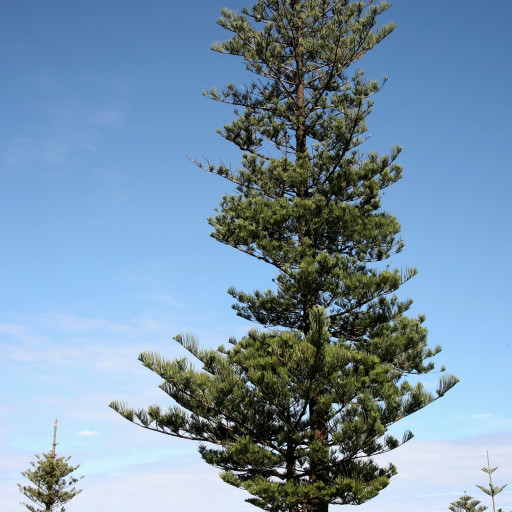
Plant Overview
Often called the "Star Pine" or "Norfolk Island Pine," this elegant evergreen isn't actually a true pine at all. Native to a tiny island in the South Pacific, it has become a global favorite for its perfect, tiered symmetry and its popular role as a "living Christmas tree." In its natural habitat, it can tower over the coastline, but in our homes, it remains a slow-growing, stately companion that brings a forest-like peace to any room.
🔍 How to Identify
- 🌿 Layered Symmetry: Branches grow in distinct, horizontal tiers that form a near-perfect star shape when viewed from above.
- 🌲 Soft Needles: Young foliage is composed of bright green, soft-to-the-touch needles that curve slightly inward toward the branch.
- 🪵 Straight Trunk: It features a remarkably straight, central trunk with grayish-brown bark that becomes rough and scaly as the tree ages.
🏡 In Your Garden
- ☀️ Light Seekers: These trees are highly phototropic, meaning they will lean dramatically toward the nearest window; be sure to rotate the pot a quarter-turn every week to keep the trunk growing straight.
- 💧 Island Humidity: Coming from a misty oceanic environment, they despise dry indoor air. If the air is too dry, the lower branches will turn brown and drop—a loss that is unfortunately permanent.
- 🚫 The "No-Topping" Rule: Never cut the top off to control its height. Removing the central leader will permanently destroy its symmetrical growth habit and cause the tree to grow in a distorted, bushy shape.
⚠️ Safety & Toxicity
- 🐾 Mildly Toxic: While not considered deadly, the needles contain resins that can cause stomach upset, vomiting, or lethargy in cats and dogs if ingested.
- 🌵 Skin Irritation: As the tree matures, the once-soft needles can become quite stiff and sharp, which may cause minor skin pricks or irritation during pruning or decorating.
✨ Fun Fact
Captain James Cook was the first European to "discover" these trees in 1774. He originally hoped the tall, straight trunks would provide a primary source of masts for the British Royal Navy, but it was later discovered the wood was too brittle to survive the stresses of the open ocean!

Detailed Care Instructions
| Soil Ph | 5.5–4.5 |
| Humidity | Dry |
| Lighting | Part Sun |
| Toxicity | Non-Toxic |
| Soil Type | Peat-Based Mixture |
| Difficulty | Medium |
| Plant Type | Evergreen |
| Mature Size | Up To 60 M Tall In The Wild; 1,5-2,5 M Tall Indoors |
| Native Area | Norfolk Island In The Pacific |
| Temperature | 16°C - 24°C |
| Sun Exposure | Full Sun; Can Tolerate Shade |
| Hardiness Zones | 10-11 |
To grow Araucaria heterophylla, also known as Norfolk Island Pine, you can follow these steps:
- Choose a suitable location: Araucaria heterophylla prefers bright, indirect sunlight. Place it near a window that receives partial sunlight throughout the day.
- Select the right soil: Use well-draining soil that is slightly acidic. A mix of peat moss, perlite, and sand works well for Araucaria heterophylla.
- Planting: Select a pot that is slightly larger than the plant's root ball. Make sure the pot has drainage holes to prevent waterlogging. Put a layer of small rocks or broken pottery at the bottom of the pot to improve drainage. Fill the pot with the soil mix and plant the Araucaria heterophylla, ensuring that the base of the plant is level with the soil surface.
- Watering: Keep the soil consistently moist but not soggy. Water the plant thoroughly and allow the top inch of soil to dry out between waterings. Avoid overwatering, as this can cause root rot.
- Humidity requirements: Araucaria heterophylla prefers high humidity. Mist the plant regularly with water to increase humidity levels. Alternatively, you can place a pebble tray filled with water beneath the pot to provide the plant with some humidity.
- Temperature: Araucaria heterophylla thrives in average indoor temperatures around 65-75°F (18-24°C). Avoid placing the plant near cold drafts or direct heat sources, as extreme temperature fluctuations can be harmful.
- Fertilizing: During the growing season (spring and summer), feed the plant with a balanced, water-soluble fertilizer once a month. Follow the instructions on the fertilizer package for proper dosage.
- Pruning: To maintain a desired shape, trim any dead or damaged branches. You can also prune for height control if needed. Do the pruning in spring or early summer.
- Repotting: As the Araucaria heterophylla grows, it might outgrow its pot. Repotting it every 2-3 years, preferably in spring, will provide it with fresh soil and room for growth.
By following these guidelines, you can successfully grow and care for your Araucaria heterophylla plant.

Place in a window with dappled sun or a spot in the middle of a room. Or directly in a window facing west or east.

Araucaria Heterophylla is an evergreen tree that requires regular watering to remain healthy. When watering, ensure that the soil is moist, but not waterlogged, as this can lead to root rot. It is best to water deeply but infrequently to encourage the roots to grow deeper into the soil. Allow the soil to dry out slightly before watering again. The frequency and amount of water required may vary depending on the plant's location, light exposure, and temperature. It is also important to avoid getting water on the foliage as this can lead to fungal diseases. Alternatively, use a drip irrigation system or water directly at the base of the plant to avoid getting the foliage wet.
To fertilize this plant, you will want to mix a balanced fertilizer, with equal parts of nitrogen, phosphorus, and potassium. Apply the fertilizer to the soil once a month during the growing season, typically spring to fall. Make sure to dilute the fertilizer at half strength before applying, as too much can burn the roots. Additionally, ensure that the soil is moist before fertilizing.
Araucaria Heterophylla plant requires well-draining soil that is rich in organic matter. Soil with a neutral to slightly acidic pH level is ideal for this plant. It is recommended to mix in peat moss, compost, or other organic materials into the soil to improve its quality. The soil should be loose and crumbly to encourage proper root growth. In addition, the soil should not be too compact or heavy, as this can impede drainage and lead to waterlogged roots. It is important to avoid using soil that is too sandy or rocky, as this can cause the plant to dry out quickly. A good quality potting mix or compost-enriched garden soil can also be used for planting Araucaria Heterophylla.
Propagation of this plant can be done through several methods including seed propagation, stem cutting, and air layering.
Seed propagation involves planting the seeds of the plant in a well-draining soil mix, keeping them moist and warm until they germinate. It can take several weeks for the seedlings to emerge and they should be kept in a bright, but indirect light.
Stem cutting propagation involves taking a cutting from the parent plant, approximately 4-6 inches in length. The cutting should be taken from a healthy and vigorous stem and the leaves on the lower third of the stem should be removed. The cutting should be dipped in rooting hormone and planted in a well-draining soil mix. Keep the soil moist and cover the cutting with a plastic bag to maintain humidity until roots develop.
Air layering is another method of propagation, which involves creating a new plant from a stem of the parent plant while it is still attached. A small area of bark is removed from the stem and a rooting hormone is applied. A small amount of soil is then added around the exposed portion of the stem and it is covered with plastic wrap to maintain humidity. The new plant will develop roots in the soil and can be separated from the parent plant once sufficiently rooted.
Common pests of the norfolk island pine include Mealybugs. Make a habit of checking your norfolk island pine frequently for pests so that any infestations can be caught and managed early.








