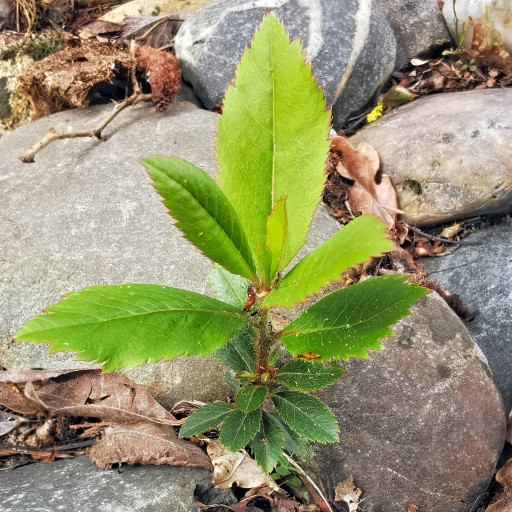
Plant Overview
Often called the Strawberry Tree, Arbutus unedo is a Mediterranean gem that famously found its way to the emerald hills of Ireland. It is beloved by gardeners for its unusual ability to display delicate, bell-like flowers alongside ripe, ruby-red fruits simultaneously. This evergreen brings year-round texture and a touch of ancient folklore to any landscape.
🔍 How to Identify
- 🍃 Foliage: Glossy, dark green leaves with a leathery texture and finely serrated (saw-toothed) edges that stay vibrant all winter.
- 🔔 Flowers: Small, drooping clusters of waxy white or pale pink blossoms that look remarkably like "Lily of the Valley."
- 🍓 The Fruit: Round, bumpy berries about 2cm wide that transition from yellow to a deep scarlet. While they look like strawberries, their skin is much more "warty."
- 🪵 The Bark: On mature specimens, the reddish-brown bark begins to flake and peel in thin strips, revealing a smooth, cinnamon-colored layer beneath.
🏡 In Your Garden
- 🧱 Placement is Permanent: This tree develops a sensitive taproot. It is best to plant it in its "forever home" while it is young, as it hates being moved once established.
- 🌤️ Coastal Champion: It is incredibly hardy against salt spray and wind. This makes it a perfect choice for seaside gardens where other evergreens might wither.
- 🦉 Wildlife Magnet: Because it flowers in late autumn and winter when most plants are dormant, it provides a vital late-season nectar source for bees and shelter for birds.
⚠️ Safety & Toxicity
- 🍴 Status: Edible but underwhelming. The species name unedo comes from the Latin "Unum Edo," meaning "I eat only one"—likely because the fruit is mealy and bland!
- 🐾 Pets & Kids: It is generally considered non-toxic to humans, dogs, and cats. However, eating large quantities of the ripe fruit can cause mild stomach upset or a "drunk" feeling if the fruit has begun to ferment on the branch.
✨ Fun Fact
The Strawberry Tree is the centerpiece of the Coat of Arms for the city of Madrid. If you visit the Spanish capital, you will find a famous bronze statue of a bear reaching up to eat the fruit from an Arbutus unedo tree!

Detailed Care Instructions
| Soil Ph | Acidic Soil |
| Lighting | Full Sun |
| Mature Size | 8 To 12 Feet Tall And Wide |
| Hardiness Zones | 7-10 |
To grow an Arbutus unedo plant (also known as the strawberry tree), you can follow these steps:
- Choose a suitable location: Arbutus unedo plants prefer full sun but can tolerate partial shade. They also require well-draining soil with good moisture retention.
- Prepare the soil: Ensure that the soil is well-draining by adding organic matter such as compost or well-rotted manure. This will improve soil structure and drainage.
- Planting: Dig a hole that is slightly larger than the root ball of the plant. Place the plant in the hole, ensuring that it is at the same depth as it was in its previous container or nursery pot. Backfill the hole with soil, firming it gently around the plant.
- Watering: Water the plant thoroughly after planting and ensure that the soil remains consistently moist but not waterlogged. Watering deeply and less frequently is better than shallow, frequent watering.
- Mulching: Apply a layer of organic mulch around the plant, leaving a few inches of space around the stem to prevent rotting. Mulch helps retain soil moisture and suppresses weed growth.
- Fertilization: Arbutus unedo plants generally do not require heavy fertilization. However, you can provide a balanced, slow-release fertilizer in the spring to encourage healthy growth.
- Pruning: Arbutus unedo plants have a naturally attractive, bushy habit, so pruning is not often necessary. However, you can remove any dead, broken, or diseased branches as needed. Avoid heavy pruning, as it can negatively impact the plant's appearance and fruit production.
- Harvesting: Arbutus unedo plants produce edible fruits that resemble small strawberries. Fruits usually ripen in the fall. You can harvest them when they turn red and slightly soft.
- Protection: Arbutus unedo plants are generally hardy, but young plants may benefit from protection during very cold winters. You can cover them with burlap or horticultural fleece to protect against frost and freezing temperatures.
Overall, Arbutus unedo plants are relatively low-maintenance. By providing appropriate growing conditions and regular care, you can enjoy the beauty of their evergreen foliage, attractive flowers, and flavorful fruits.

Place in a bright room that is sun drenched almost all day. Or directly in a south-facing window.

To water this plant, it is best to allow the topsoil to dry out slightly before watering again. Water deeply and then allow excess water to drain away from the soil to prevent root rot. Watering should be reduced during the winter months when growth slows down. Additionally, it is important to avoid getting water on the leaves and flowers as this can promote disease. It is recommended to water in the early morning or late evening to reduce evaporation.
To fertilize this plant, it is recommended to use a slow-release fertilizer that is high in nitrogen, phosphorus, and potassium. Apply the fertilizer in the spring, after the last frost, and again in late summer. Be sure to follow the manufacturer's instructions for the appropriate amount of fertilizer to apply based on the size of the plant. Avoid fertilizing the plant during its dormant period in the winter.
The ideal soil for Arbutus Unedo plants should be well-draining and rich in organic matter. It should also be slightly acidic, with a pH of around 6.0 to 6.5. A mix of peat moss, compost, and coarse sand is recommended for planting Arbutus Unedo in pots or containers. In outdoor planting, it is recommended to mix organic matter into the existing soil to improve drainage and fertility. The soil should be moist but not waterlogged, as Arbutus Unedo prefers moderate moisture levels. Avoid using heavy clay soils or soils that are too compacted, as they can lead to root rot and poor drainage.
Arbutus unedo can be propagated through seed or cuttings. For seed propagation, the berries should be harvested when fully ripe and the pulp should be removed by crushing the fruit. The seeds should be washed and then stratified by storing them in an airtight container in a refrigerator for several weeks. After stratification, the seeds should be sown in a well-draining soil mix and kept moist until germination occurs.
For propagation by cuttings, a semi-hardwood cutting should be taken from a healthy branch in the summer. The cutting should be about 10cm long and have several leaves and no flowers or buds. The bottom of the cutting should be dipped in rooting hormone and then planted in a well-draining soil mix. The cutting should be kept moist and in a warm, shaded area until roots develop.
Once the new plants have established, they can be transplanted to a larger container or directly into a garden bed. It is important to ensure that the soil is well-draining and that the plants are not overwatered. Arbutus unedo plants prefer full sun to partial shade and can tolerate a range of soil types.








