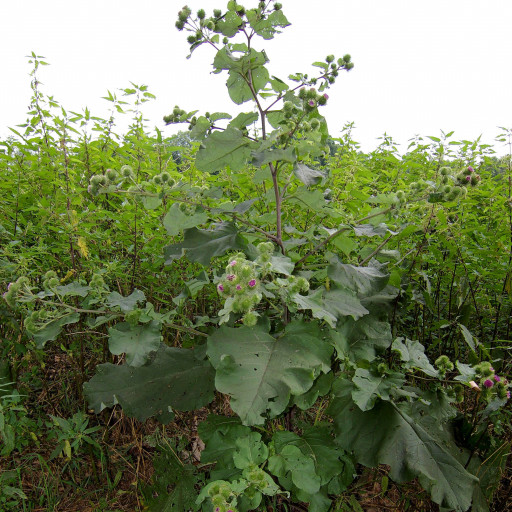
Plant Overview
Known as the "Greater Burdock" or "Wild Rhubarb," this hardy biennial is a towering figure in the world of wild herbs. While it might look like a giant weed to the untrained eye, it has been a staple of traditional medicine and gourmet Japanese cuisine for centuries. Its most famous legacy, however, isn't in a soup pot, but in the world of engineering—its sticky burs served as the biological blueprint for one of the most common fasteners in the world.
🔍 How to Identify
- 🍃 Enormous Leaves: The lower leaves are massive, heart-shaped, and can grow up to 2 feet long. They are bright green on top with a soft, woolly, whitish underside.
- 🟣 Thistle-like Blooms: In its second year, the plant sends up a tall stalk topped with clusters of purple, globular flowers that resemble thistles but lack the sharp spines on the leaves.
- 🧶 Hooked Burs: Once the flowers fade, they transform into brown, spherical seed heads covered in hundreds of tiny hooks designed to hitchhike on passing animals.
🏡 In Your Garden
- 🥕 The Deep Taproot: Burdock is famous for its massive, fleshy taproot that can dive three feet into the earth. Because of this, it is notoriously difficult to transplant; if you want it in your garden, it’s best to sow seeds directly where you want them to stay.
- 🚜 Soil Reclaimer: This plant loves disturbed, nitrogen-rich soil. It acts as a "dynamic accumulator," drawing nutrients from deep in the subsoil up to the surface, which can actually improve the quality of your garden beds over time.
⚠️ Safety & Toxicity
- ✅ Status: Generally safe and edible, but requires caution.
- 🐕 Physical Irritant: While the roots are a popular vegetable (known as Gobo in Japan), the hooked burs are a significant hazard for pets. They can become painfully matted in fur or cause injury if they get stuck in an animal's eye or mouth.
- 🧤 Skin Sensitivity: Some individuals may experience a mild contact dermatitis when handling the leaves or the fuzzy underside of the plant, so wearing gloves during a harvest is recommended.
✨ Fun Fact
In 1941, Swiss engineer George de Mestral went for a hike with his dog and returned covered in Burdock burs. After studying the tiny hooks under a microscope, he was inspired to create a synthetic version, eventually patenting the world-famous "hook-and-loop" fastener known as Velcro!

Detailed Care Instructions
To grow Arctium lappa, also known as burdock, follow these steps:
- Choose a suitable planting location: Burdock plants prefer full sun but can tolerate some shade. Make sure the soil is well-draining and rich in organic matter.
- Prepare the soil: Loosen the soil with a garden fork or tiller and remove any weeds or rocks. Add compost or well-rotted manure to improve soil fertility.
- Sow the seeds: Burdock seeds are best sown directly into the ground in early spring or autumn. Scatter the seeds evenly over the prepared soil and lightly cover them with a thin layer of soil or compost.
- Keep the soil moist: Water the planting area regularly to keep the soil evenly moist but not waterlogged. Avoid overhead watering to prevent fungal diseases. Burdock plants require consistent moisture throughout the growing season.
- Thin out the seedlings: Once the seedlings emerge, thin them out to a spacing of about 6-12 inches (15-30 cm) apart. This will allow enough space for the plants to grow and develop roots.
- Mulch around the plants: Apply a layer of organic mulch, such as straw or wood chips, around the base of the plants. Mulch helps retain moisture, suppresses weed growth, and regulates soil temperature.
- Prune and harvest: As the plants grow, remove any yellow or diseased leaves. Harvest the roots and leaves when they reach maturity. The roots are typically harvested in the fall after the first frost, while the leaves can be harvested throughout the growing season.
- Control pests and diseases: Burdock plants are relatively pest and disease-resistant. However, occasional problems such as aphids or powdery mildew may occur. Monitor the plants regularly and take appropriate action if necessary, such as using organic insecticides or fungicides.
- Save seeds: If you want to grow burdock again next year, remember to save some seeds from the mature plants. Let the seed heads dry on the plants, then collect them and store them in a cool, dry place for future use.
By following these steps, you should be able to grow Arctium lappa successfully.

Place in a window with dappled sun or a spot in the middle of a room. Or directly in a window facing west or east.

To water this plant, you should first check the moisture level of the soil by inserting your finger a couple inches into the soil. If the soil feels dry, it is time to water. Water the plant slowly and thoroughly, making sure the water reaches the roots. Avoid getting water on the leaves or stems if possible as this can lead to fungal issues. Allow excess water to drain out of the pot before returning it to its location. Water the plant consistently, but make sure to not over-water as this can lead to root rot.
To fertilize this plant, first make sure the soil is moist but not waterlogged. Then, apply a balanced granular fertilizer, such as 10-10-10 or 20-20-20, at a rate of 1 tablespoon per square foot of soil. Spread the fertilizer evenly around the base of the plant, being careful not to get any on the leaves or stems. Water the plant thoroughly after fertilizing to help distribute the nutrients throughout the soil. Repeat this process every 4-6 weeks during the growing season.
Arctium Lappa plants prefer a well-draining and fertile soil with a pH level between 6.0 and 7.0. The ideal soil for this plant consists of a mix of loam, sand, and clay. It should be evenly moist, but not waterlogged. It is also recommended to add compost or well-rotted manure to the soil to improve its nutrient content. The soil should be prepared before planting by digging a hole twice the size of the root ball and incorporating organic matter. Once planted, the soil should be kept moist but not waterlogged and fertilized with a balanced fertilizer every two to three weeks during the growing season.
Arctium Lappa is a plant that can be propagated through a few methods including seed germination or root division.
To propagate through seed, wait until the plant has finished flowering and the seeds have matured. Collect the mature seeds and plant them in well-draining soil in a sunny location. Water the seeds regularly and wait for them to germinate.
To propagate through root division, wait until the plant is dormant or has finished flowering. Carefully dig up the plant and separate the roots into smaller sections. Make sure each section has a few healthy leaves and roots. Plant the divided sections in well-draining soil in a sunny location and water regularly.
Propagation through cuttings is also possible, but it is less common and may be more difficult. Cut off a 4-6 inch stem from the plant, making sure it has a few healthy leaves. Dip the cut end in rooting hormone and plant it in moist soil. Keep the soil consistently moist and wait for roots to form.
No matter which method is used, it is important to keep the new plants well-watered and protected from harsh weather or extreme temperatures until they are well-established.
Common pests of the great burdock include Spider mites, aphids, larvae. Make a habit of checking your great burdock frequently for pests so that any infestations can be caught and managed early.








