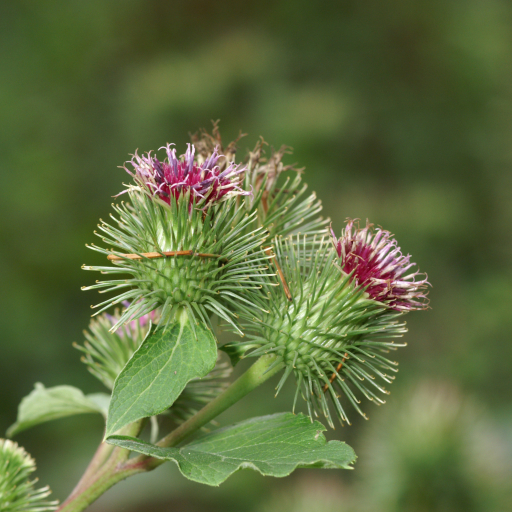
Plant Overview
Often found standing tall at the edges of ancient forests, Woodland Burdock is the wild, slightly more refined cousin of the common field burdock. Known for its massive, "elephant-ear" leaves and famously "sticky" seeds, this plant is a master of hitchhiking. While many see it as a stubborn weed, it is a fascinating example of nature’s engineering and the direct inspiration for one of the 20th century's greatest inventions: Velcro.
🔍 How to Identify
- 🍃 Grand Leaves: The leaves are enormous, heart-shaped, and dull green, often reaching up to 2 feet in length. The stalks (petioles) are usually solid, which distinguishes it from some of its hollow-stalked cousins.
- 🧶 Hooked Flower Heads: The purple, thistle-like flowers are encased in a globe of stiff, hooked bracts. These hooks are designed to grab onto fur or fabric with incredible strength.
- 🦒 Towering Stature: As a biennial plant, it spends its second year growing a robust, branching stem that can easily reach 3 to 6 feet in height, often tinged with a reddish-purple hue.
🏡 In Your Garden
- 🐝 Pollinator Magnet: If you have space for this giant, you’ll be rewarded with a parade of visitors. It is a vital nectar source for long-tongued bees, butterflies, and even hoverflies.
- 🌱 Taproot Power: It possesses a deep, sturdy taproot that mines minerals from deep within the soil. Because of this root, it is famously difficult to transplant once established; it prefers to stay exactly where it first sprouted.
- 🌲 Woodland Preference: True to its name, Arctium nemorosum thrives in dappled shade and moist, nitrogen-rich soils, making it a common sight along forest paths and hedgerows.
⚠️ Safety & Toxicity
- 🌿 Low Toxicity: The plant is generally considered non-toxic to humans and pets; in fact, burdock roots are a staple in some cuisines.
- 🧤 Skin Irritation: Some individuals may experience "burdock dermatitis," a mild skin rash caused by the tiny hairs on the leaves or contact with the hooked bracts.
- 🐕 Pet Hazard: The "burrs" (seed pods) are a significant physical nuisance for long-haired dogs. They can become painfully matted in fur or, more dangerously, get stuck in a pet's ears, nose, or between paw pads.
✨ Fun Fact
In 1941, Swiss engineer George de Mestral went for a hike in the woods and noticed how Burdock burrs stubbornly stuck to his wool trousers and his dog’s fur. After examining the hooks under a microscope, he was inspired to replicate the mechanism, eventually leading to the invention of Velcro!

Detailed Care Instructions
To grow Arctium nemorosum, also known as woodland burdock, you can follow these steps:
- Choose the right location: Arctium nemorosum prefers full sun to partial shade. Find a spot in your garden that receives at least 6 hours of sunlight each day.
- Prepare the soil: The plant prefers well-draining soil with a pH between 6.5 and 7.5. If your soil is heavy clay, add some organic matter like compost to improve drainage.
- Sow the seeds: Arctium nemorosum can be grown from seeds. Sow the seeds directly into the prepared soil in early spring or autumn. Plant them about 1/4 to 1/2 inch deep and space them 12-18 inches apart.
- Watering and maintenance: Keep the soil evenly moist during germination. Once the plants are established, they are relatively drought-tolerant and require less frequent watering. However, it is a good practice to water them deeply during dry spells.
- Mulch: Apply a layer of organic mulch around the plants to conserve moisture, suppress weeds, and regulate soil temperature.
- Support the plants: As Arctium nemorosum grows, it can become top-heavy and may require support. You can use stakes or a trellis to provide support and prevent the plants from bending or breaking.
- Pruning: Deadhead the spent flowers regularly to prevent self-seeding and to encourage continued blooming.
- Pests and diseases: Arctium nemorosum is relatively resistant to pests and diseases. However, some common garden pests like slugs or snails may occasionally feed on it. Monitor the plants and take appropriate measures if required.
- Harvesting: You can harvest the roots of Arctium nemorosum in the fall. Dig them up carefully, clean them, and dry them for use in medicinal preparations or as a vegetable.
Remember, Arctium nemorosum can spread vigorously, so it's essential to monitor and control its growth, especially if you don't want it to take over your garden.

To water this plant, you should first observe the soil to determine if it is dry or moist. If the soil is dry to the touch, water the plant thoroughly until the excess water drains out of the bottom of the pot or planting area. Avoid overwatering the plant as it can lead to root rot and other problems. It is important to ensure that the soil is well-draining and does not retain water for too long. Additionally, try to water the plant in the morning or early evening to avoid evaporation and heat stress on the plant. Finally, monitor the plant's growth and condition and adjust watering as necessary to maintain a healthy and thriving plant.
- Begin fertilizing during the early stages of growth in the spring.
- Use a balanced, slow-release fertilizer with equal amounts of nitrogen, phosphorus, and potassium.
- Apply the fertilizer to the soil around the base of the plant, being careful not to get it on the leaves or stem.
- Water the plant thoroughly after fertilizing to help distribute the nutrients.
- Repeat fertilizing every four to six weeks throughout the growing season.
- Stop fertilizing in late summer to allow the plant to prepare for dormancy in the fall.
- To avoid overfertilizing, always follow the manufacturer's instructions for application rates.
When planting Arctium Nemorosum plants, it is important to use a soil that is well-draining and high in organic matter. A pH level of 5.5 to 7.5 is ideal, as this will provide the necessary nutrients for healthy growth. The soil should be a mix of loam and sand, with a moderate amount of clay to provide structure and stability. The addition of compost or other organic matter will improve soil fertility, as well as provide the necessary micronutrients needed for strong root growth. It is important to avoid compacted soils, as this can hinder root growth and lead to stunted growth or even plant death. Overall, using a well-draining, nutrient-rich soil is essential for successful Arctium Nemorosum growth.
To propagate this plant, you can take stem cuttings from healthy mature plants. Choose a stem that is about 4 inches long and has a few nodes. Cut the stem just below a node using sharp and sterilized scissors. Remove the leaves from the lower half of the stem and dip the cut end in rooting hormone powder. Plant the stem cutting in a pot filled with well-draining soil mix and water it well. Keep the pot in a warm and humid place and mist the cutting regularly. Within a few weeks, you should see new roots and the cutting will start growing new leaves. Once the plant is rooted and established, you can transplant it to a bigger pot or in the garden.








